What the maker puts in writing
- “This ash vacuum features a 1200W motor to quickly collect dry ash from fireplaces, pellet stoves, wood stoves, fire pits, grills, and outdoor ovens”
- “Dual-Layer Filtration: The outer washable polyester bag captures larger ash particles, while the inner HEPA filter traps finer dust and helps avoid the ash vacuum cleaner from clogging”
- “The SPCC steel tank and lined hose help protect the ash vacuum from residual heat. Use only for dry ash after the fire is fully extinguished”
- “A 8 ft power cord and 4 ft hose provide a wider working radius”
- “Use the side port to collect ash or connect the hose to the top air outlet to blow away leaves and light snow”
- Catalog: 3198 g (112.8 oz) · 290 × 290 × 340 mm (11.4 × 11.4 × 13.4 in) · 4 gallon tank
The strictest temperature rule here, and that is the recommendation
“Use only for dry ash after the fire is fully extinguished.”
No number, no margin, no exception. And on this shelf that bluntness is worth more than a figure.
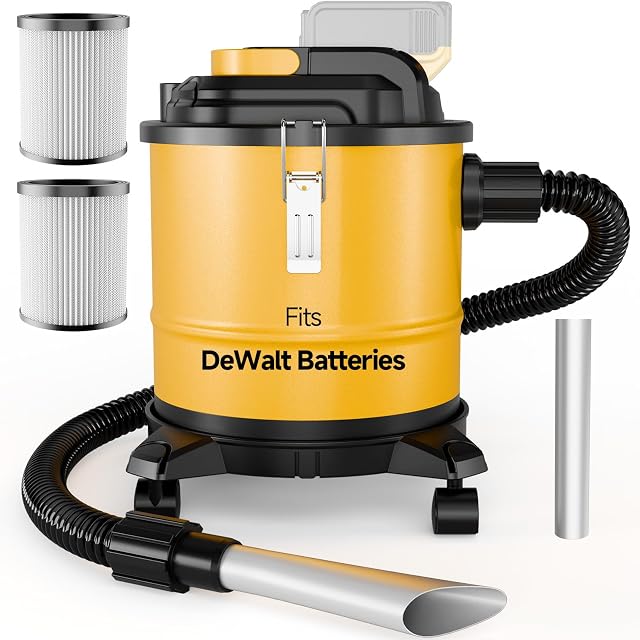
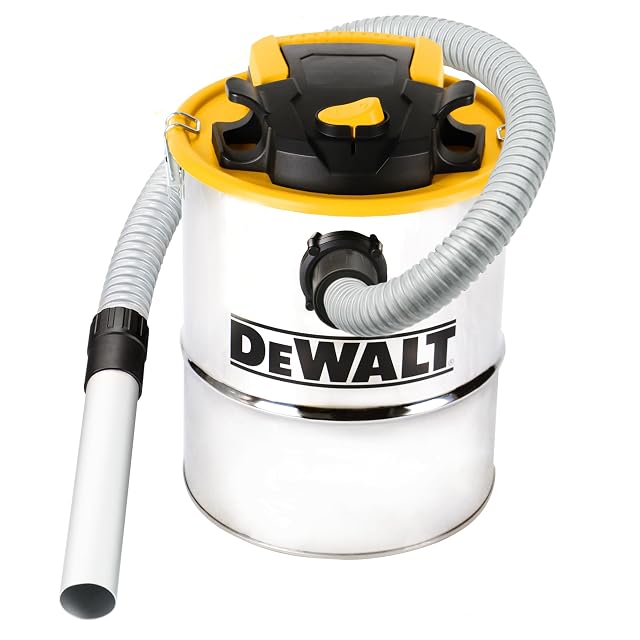
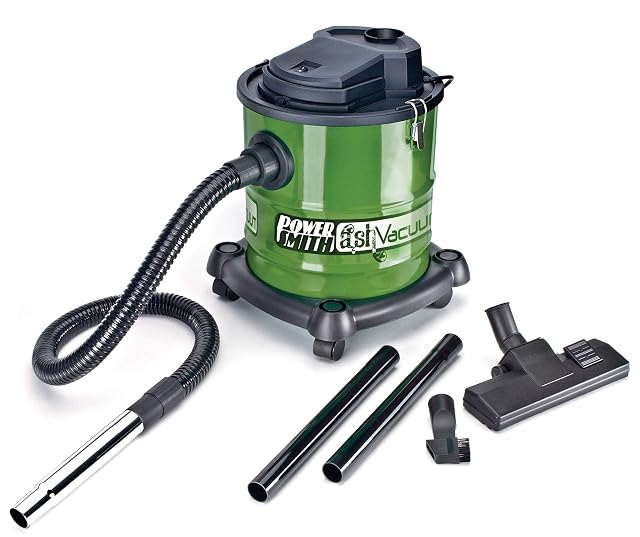
Look at what the others say. Both SIPPON listings and the DEWALT publish “below 104°F (40°C)”. The Snow Joe says “cold ash”. Both PowerSmith listings claim “warm and cool ash” and publish no temperature limit at all — the only two that do.
And two listings contradict themselves inside one bullet. The ApexPower offers “both cold and warm ash” then warns “the ash temperature must be below 104℉/40℃”. The BACOENG writes “compatible with both warm (ash below 104F (40°C (104 °F))) and cool ash”.
Forty degrees is barely above body temperature. Ash at 40 °C is cold ash. “Warm-ash capable, below 40 °C” is a promise that cancels itself.
So the honest summary of the whole shelf: wait until the ash is cold. This listing is the one that simply says so.
1200 W is the input power, and on 120 V American mains it is exactly the same thing as the “10 Amp” that both PowerSmith listings publish. Same number, two conventions.
What it does not tell you is suction. Input watts describe the electricity bill; pascals describe the ash leaving the hearth. Only the ApexPower publishes a pressure figure on this shelf — 10,000 Pa — and only the Snow Joe distinguishes the two at all: “5 Amp motor generates up to 500 W of suction power”.
The oddity is the DEWALT’s “4 HP”. Four horsepower is 2983 W, and a 120 V socket on a 15 A breaker caps near 1800 W. It is a peak-horsepower catalog figure, not a measurement.
So at this price, 1200 W is the right side of the shelf without being a claim about performance.
The bag in front of the HEPA, which is the real design
“The outer washable polyester bag captures larger ash particles, while the inner HEPA filter traps finer dust and helps avoid the ash vacuum cleaner from clogging.”
This is why an ash vacuum is not a shop vac with a different sticker.
Wood ash is fine, light and abrasive. It packs into the pleats of a filter in minutes, and then the motor roars and the nozzle picks up nothing. A coarse bag in front takes the bulk so the HEPA only sees fine dust.
The VANPORE listing says it most plainly: “the bag filter prevents the pleated filter from clogging.”
Two stages here, washable, and that is the standard the shelf converges on — PowerSmith calls it a “2-stage filter system with sonic welded seams”, BACOENG a “fire-retardant cloth filter & HEPA”, Snow Joe a “pre-filter pleated filter” with a reusable cartridge.
What this listing does not publish is a flame rating for the filter. SIPPON names a “flame-retardant” filter and BACOENG a “fire-retardant” one, and the filter is precisely the part that would ignite if something live got through. Worth knowing that this one leaves it unsaid.
A steel tank, a lined hose, and why both matter
SPCC steel tank, hose lined against residual heat.
Even with cold ash, the point of a metal body is that a single missed ember cannot melt its way out. Plastic canisters exist in this category and they are the reason the metal ones advertise being metal.
Eight of the twelve listings here are explicit about a metal canister and a heat-resistant or metal hose. It is the baseline, not a luxury.
Twelve feet of reach
8 ft cord + 4 ft hose.
That is the short end of the shelf. For comparison: BACOENG publishes 15 ft of cord and 5 ft of hose — twenty feet, the longest here. The larger VEVOR 5.3 gallon gets 13 ft and 5 ft. The DEWALT does the arithmetic for you and publishes a “12-ft flexible cleaning range”, the same as this.
Both SIPPON listings claim a “31.5-inch extension cord” — eighty centimeters — described as “making it easy to operate and saving you a lot of time and energy”. Eighty centimeters saves nobody anything; the figure is either wrong or means 31.5 feet.
Twelve feet is enough for a stove in the room you are standing in. It is not enough to leave the vacuum in a doorway.
Also a blower
Hose to the top outlet, and it blows — for leaves, a patio, light snow.
Eight of twelve here do this: both VEVOR, both SIPPON, both PowerSmith, both VANPORE. The DEWALT, ApexPower, Snow Joe and BACOENG do not mention it.
It is a genuine second use for a machine that otherwise works a few weeks a year.
What is not published
No suction figure in pascals or inches of water, which is the number that describes the job.
No noise figure. Only two listings publish one, and the gap between them is large: PowerSmith 79 dB, called “quiet”, against ApexPower 60 dB, called “whisper-quiet”. Nineteen decibels is roughly eight times the sound pressure.
No distinction between tank size and ash capacity, and that matters more than it sounds. The PowerSmith PAVC101 is the only listing on this shelf that separates them: “Canister Size: 5.2 Gallons, Canister Ash Capacity: 3 Gallons” — because the filter assembly fills the top. Which casts doubt on every unqualified gallon figure here, including this one.
No fill-level indicator, which only the BACOENG has — and which tells you honestly what happens if you ignore it: “You can still continue to vacuum, but the suction power will decrease.”
No safety certification named. The ApexPower publishes CE, CB and GS; the Snow Joe publishes ETL. The other ten, including this one, name none.
Availability
Read on the day this page was built: $47 at the American Amazon shop.
Read from Keepa on the day this page was last revised; stock and price both move without notice.
Prices quoted in this text were read on 2026-10-04. The live price is at the top of the page.