Skip to content

VEVOR Ash Vacuum 5.3 Gallon review

5.3 gallons on casters with eighteen feet of reach, for $11.51 over the 4-gallon VEVOR.

Where this ends up Eleven dollars and fifty-one cents more than its own four-gallon sibling buys a third more capacity, casters, and five extra feet of reach. The same 1200 watts and the same strict rule about waiting for the fire to go out.

What the maker puts in writing

  • “This ash vacuum features a 1200W motor to quickly collect dry ash from fireplaces, pellet stoves, wood stoves, fire pits, grills, and outdoor ovens”
  • “Dual-Layer Filtration: The outer washable polyester bag captures larger ash particles, while the inner HEPA filter traps finer dust and helps avoid the ash vacuum cleaner from clogging”
  • “The SPCC steel tank and lined hose help protect the ash vac from residual heat. Use only for dry ash after the fire is fully extinguished”
  • “A 13 ft power cord and 5 ft hose provide a wider working radius. The large-capacity tank with casters allows the fireplace vacuum to move easily while cleaning”
  • “Use the side port to collect ash or connect the hose to the top air outlet to blow away leaves and light snow”
  • Catalog: 4100 g (144.6 oz) · 370 × 370 × 420 mm (14.6 × 14.6 × 16.5 in) · 5.3 gallon tank

Eleven dollars for a third more tank and six more feet of cord

The same maker sells a 4 gallon version on this shelf at $43.39. This is $54.90, and the three differences are all published:

Tank: 4 → 5.3 gallons. A third more, which halves how often you stop. Reach: 8 ft cord + 4 ft hose → 13 ft cord + 5 ft hose. About 12 feet becomes 18. Casters, where the smaller one has none.

Everything else is identical: 1200 W, SPCC steel, the same two-stage bag-and-HEPA filtration, the same blower outlet, the same temperature rule, the same wording throughout.

And the casters are not decoration. 4100 g (144.6 oz) against 3198 g (112.8 oz) is nine hundred grams more to lift, and you lift it when it is full. A machine you have to carry is a machine you use less.

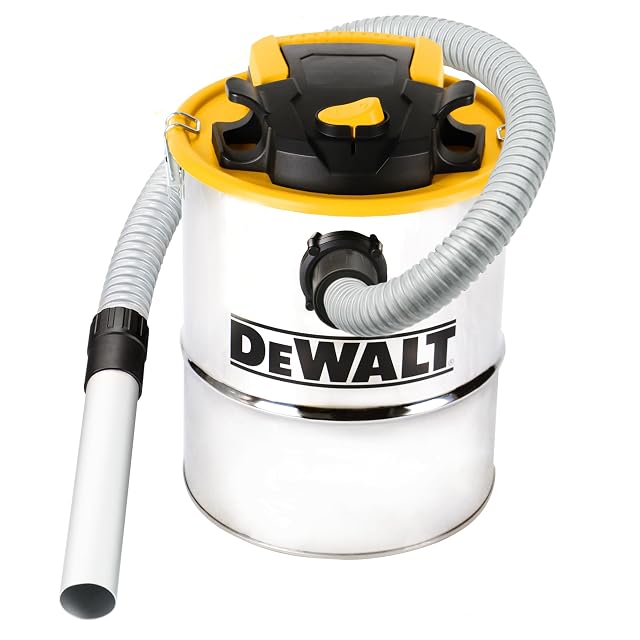
Eighteen feet of reach places this second on the shelf behind only the BACOENG at twenty, and well ahead of the DEWALT’s published 12-foot range or the VANPORE’s 3.5 m (11 ft) radius.

The strictest temperature rule here, which is the right one

“Use only for dry ash after the fire is fully extinguished.”

No number, no margin. And across twelve listings that is the version to follow.

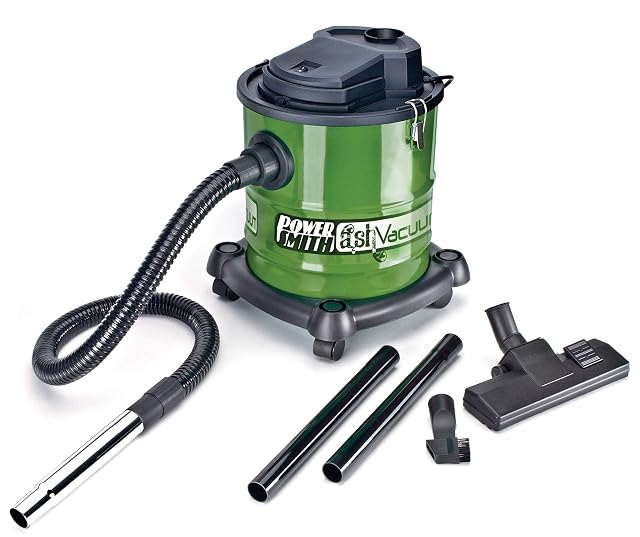
What the others say. Both SIPPON listings and the DEWALT publish “below 104°F (40°C)”. The Snow Joe says “cold ash”. Both PowerSmith listings claim “warm and cool ash” and publish no limit at all — the only two that do.

Two listings contradict themselves inside one bullet. The ApexPower offers “both cold and warm ash” then requires “below 104℉/40℃”. The BACOENG writes “both warm (ash below 104F (40°C (104 °F))) and cool ash”.

Forty degrees is barely above body temperature. Ash at 40 °C is cold ash. So the warm-ash capability most of this shelf advertises is either unquantified or self-canceling, and what VEVOR writes in plain words is what every machine here actually requires.

Twelve hundred watts, and the five units this shelf uses

1200 W is input power. On 120 V American mains it is exactly the “10 Amp” that both PowerSmith listings publish — the same number, two conventions.

The full spread:

1200 W — both VEVORs, both VANPOREs, BACOENG 10 Amp — both PowerSmiths, which is the same 1200 W 800 W — both SIPPONs 5 Amp, giving “up to 500 W of suction power” — Snow Joe, the only listing separating input from output 4 HP — DEWALT, which is 2983 W; a 120 V socket on a 15 A breaker caps near 1800 W, so it is a peak-horsepower catalog figure 10,000 Pa — ApexPower, the only suction pressure on the shelf

Input watts describe the electricity. Pascals describe the ash leaving the grate. Only one listing here publishes the second, and it is not this one.

The bag in front of the HEPA

“The outer washable polyester bag captures larger ash particles, while the inner HEPA filter traps finer dust and helps avoid the ash vacuum cleaner from clogging.”

This is the reason an ash vacuum is not a shop vacuum with a sticker.

Wood ash packs into the folds of a pleated element within minutes. Then the motor is loud and the nozzle picks up nothing. A coarse stage in front takes the bulk so the fine element only sees fine dust.

The VANPORE listing says it most plainly: “the bag filter prevents the pleated filter from clogging.”

Both stages here are washable, so a season costs nothing in consumables. The alternative approach is on the Snow Joe, which is bagless with a reusable cartridge — no bag to replace, messier to empty.

What is missing is a flame rating. The SIPPON pair name a “flame-retardant” filter and the BACOENG a “fire-retardant” one. The element is the only part of the path that is not metal, and that is where a missed ember would land.

Steel tank, lined hose

SPCC steel tank, hose lined against residual heat.

Even with cold ash, the argument for a metal body is that one missed ember cannot melt through it. Plastic canisters exist in this category, and they are why the metal ones say so.

Eight of twelve listings here are explicit about a metal canister and a heat-resistant hose. It is the baseline of the category.

Also a blower

Hose to the top outlet, for leaves, a patio, light snow.

Eight of twelve do this: both VEVOR, both SIPPON, both PowerSmith, both VANPORE. The DEWALT, ApexPower, Snow Joe and BACOENG do not mention it.

A genuine second use for a machine that otherwise works a few weeks a year.

What is not published

No suction figure in pascals or inches of water.

No noise figure. Two listings publish one: PowerSmith 79 dB called “quiet”, ApexPower 60 dB called “whisper-quiet”. Nineteen decibels is roughly eight times the sound pressure, and 79 dB is not quiet.

No distinction between tank size and ash capacity. The PowerSmith PAVC101 is the only listing here that separates them — “Canister Size: 5.2 Gallons, Canister Ash Capacity: 3 Gallons” — which casts doubt on every bare gallon figure on this shelf, including this one.

No fill indicator, which only the BACOENG offers, with the honest addition that “you can still continue to vacuum, but the suction power will decrease”.

No certification named. The ApexPower publishes CE, CB and GS; the Snow Joe publishes ETL. The other ten name none.

Availability

Read on the day this page was built: $55 at the American Amazon shop.

Read from Keepa on the day this page was last revised; stock and price both move without notice.

Prices quoted in this text were read on 2026-10-04. The live price is at the top of the page.
What it does well, and badly

Strengths

  • A third more capacity and casters for $11.51 over the four-gallon VEVOR
  • Eighteen feet of reach, second only to one listing on this shelf
  • The same unambiguous temperature rule — dry ash, fire fully out

Compromises

  • Nine hundred grams heavier, which is why the casters are not optional
  • No suction figure, no noise figure, no flame rating for the filter
  • Does not say whether 5.3 gallons is tank volume or ash volume

Specifications

Tank5.3 gallons, SPCC steel — a third more than the 4-gallon VEVOR at $11.51 less
MobilityCasters — the 4-gallon VEVOR has none
Reach13 ft cord + 5 ft hose = about 18 ft, against 12 ft on its sibling
Motor1200 W — identical to its sibling, and the same as the "10 Amp" two rivals publish
FiltrationTwo stages: washable outer polyester bag, inner HEPA
Temperature ruleDRY ASH ONLY, after the fire is FULLY EXTINGUISHED
BlowerYes — hose to the top air outlet
Weight4100 g (144.6 oz), against 3198 g (112.8 oz) for the 4-gallon
Dimensions370 × 370 × 420 mm (14.6 × 14.6 × 16.5 in)
Suction figureNot published
NoiseNot published
Ash capacity vs tank sizeNot distinguished
Fill indicatorNot published
Amazon referenceB0HF6N9CJK
EAN0199912981528

The questions we hear

Is it worth $11.51 over the four-gallon VEVOR?

Yes, and three published figures say why. Capacity goes from 4 to 5.3 gallons — a third more, which halves how often you stop to empty. Reach goes from "8 ft power cord and 4 ft hose" to "13 ft power cord and 5 ft hose", so about 12 feet becomes 18, which is the difference between the vacuum standing beside you and standing in the doorway. And it gains casters, which on a 4100 g (144.6 oz) machine against the sibling’s 3198 g (112.8 oz) is not a luxury: nine hundred grams more, carried full of ash, is the moment you decide you cannot be bothered. Everything else is the same — the same 1200 W motor, the same SPCC steel tank, the same two-stage bag-plus-HEPA filtration, the same blower outlet, the same strict rule about waiting for the fire to go out. Eleven dollars for a third more tank and six more feet of cord is the clearest value decision on this shelf.

Does 5.3 gallons mean 5.3 gallons of ash?

The listing does not say, and on this shelf that distinction is the one worth chasing. The PowerSmith PAVC101 is the only listing here that separates them: "Canister Size: 5.2 Gallons, Canister Ash Capacity: 3 Gallons" — the filter assembly occupies the top of the drum, so the volume you can fill is much smaller than the volume quoted. Three listings do qualify their figure: the PAVC102 ("4 gallon Ash capacity"), the Snow Joe ("stores up to 4.8 gallons of ashes") and the VANPORE ("20 liters", which matches its 5.2-gallon title). This one, like its sibling, the DEWALT, the BACOENG and the ApexPower, publishes a bare number. Taking the PAVC101 as the guide, a 5.3-gallon drum might hold something closer to 3 gallons of ash. That still beats the 4-gallon version in the same proportion, which is what matters for the comparison — but it is not 5.3 gallons of ash, and nothing in the listing claims it is.

Why does the bag matter more than the HEPA?

Because the bag is what keeps the HEPA working, and this listing names the mechanism: "The outer washable polyester bag captures larger ash particles, while the inner HEPA filter traps finer dust and helps avoid the ash vacuum cleaner from clogging." The VANPORE listing puts it more directly: "the bag filter prevents the pleated filter from clogging." Wood ash is a fine, light, abrasive powder. Fed straight onto a pleated element it packs into the folds within minutes, airflow collapses, and you are left with a loud motor and a nozzle that picks up nothing — the standard experience of using a shop vacuum on a fireplace. A coarse stage in front takes the bulk and leaves the fine element doing only what it is good at. Both stages here are washable, so a winter costs no consumables. What the listing does not give is a flame rating for the element, which only the SIPPON pair and the BACOENG publish — and the element is the one part of the ash path that is not metal.

What singles this model out

Measured against the median of its own aisle here — not against everything on sale.

  • Reach13 ft cord + 5 ft hose = about 18 ft, against 12 ft on its sibling+63 % off the median of this aisle
  • Dimensions370 × 370 × 420 mm (14.6 × 14.6 × 16.5 in)+28 % off the median of this aisle

Set beside the neighboring cleaning machines

cleaning machines from the same category, at nearby prices. Only what all of them publish is shown: a column with holes compares nothing.

Model Price MotorTemperature ruleBlowerWeight
VEVOR Ash Vacuum 5.3 Gallon $55 1200 W — identical to its sibling, and the same as the "10 Amp" two rivals publishDRY ASH ONLY, after the fire is FULLY EXTINGUISHEDYes — hose to the top air outlet4100 g (144.6 oz), against 3198 g (112.8 oz) for the 4-gallon
SIPPON BJC2312 $57 800 W per the bullets — the TITLE says 1000 W, see the FAQBelow 104 °F (40 °C), and no flameYes — attach the hose to the air outlet2722 g (96 oz) — the lightest published figure on this shelf
SIPPON SPBJC2312JN $59 800 W — stated in the title AND the bullets, unlike its twinBelow 104 °F (40 °C), and no flameYes2722 g (96 oz) — the lightest published on this shelf
VEVOR Ash Vacuum 4 Gallon $47 1200 W — which on 120 V mains is the same as the "10 Amp" two rivals publishDRY ASH ONLY, after the fire is FULLY EXTINGUISHED — the strictest on this shelfYes — connect the hose to the top air outlet3198 g (112.8 oz)

Where the models are not equal, in cleaning machines

  • If price decides: VEVOR Ash Vacuum 4 Gallon, at $47.
  • Highest Motor in the table: VEVOR Ash Vacuum 4 Gallon (1200 W — which on 120 V mains is the same as the "10 Amp" two rivals publish).
  • Highest Weight in the table: this model (4100 g (144.6 oz), against 3198 g (112.8 oz) for the 4-gallon).
  • This model holds the table’s highest figure for Weight.

Price and availability, for cleaning machines

Details checked on October 4, 2026.

Who this one is for, among cleaning machines

A larger stove or two fireplaces, where emptying twice as often is the real cost

What buyers actually choose

Amazon reports what buyers took in the month before this page was last checked: at least 50.

The figure is a floor, rounded by Amazon, and read through Keepa — it says what buyers picked, not what a maker claims.

Sources

Specifications: the manufacturer sheet for cleaning machines and the matching Amazon product page. Prices and availability: Keepa. Every figure on this page names its source.

How these cleaning machines are assessed here