What the maker puts in writing
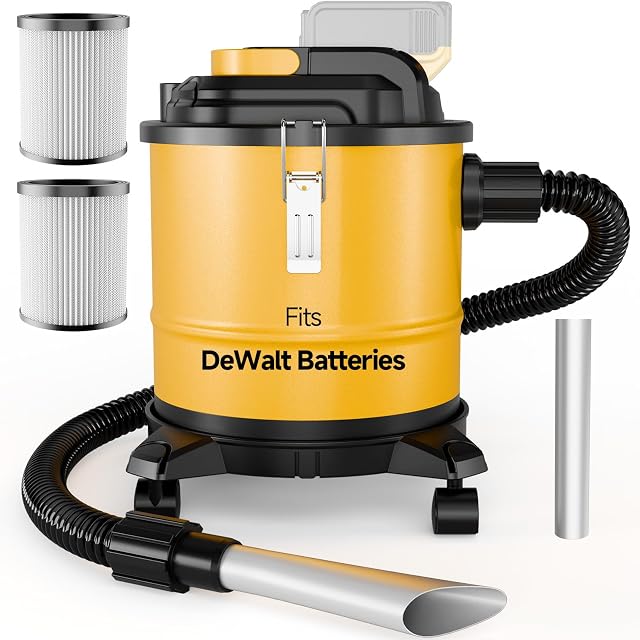
- “Powered by a 4 HP motor, this ash vacuum delivers robust suction to efficiently remove stubborn ash, soot, and debris”
- “designed specifically for fireplaces, wood/coal stoves, pellet stoves, fire pits, and grills. It also functions as a multi-purpose vacuum, making it useful for cleaning corners and ash from car interiors”
- “This durable metal canister and hose combo, equipped with an aluminum extension wand, safely cleans ash below 40℃ (104℉). The 4-ft hose, extension wand, and 8-ft power cord provide a 12-ft flexible cleaning range”
- “The 4-gallon metal canister offers ample storage for ash and sawdust… A patented filter system efficiently captures fine ash and dust particles, preventing them from escaping through the exhaust pipe. The washable and reusable filter screens ensure long-term performance”
- In the box: “DEWALT DXV04A Vacuum Cleaner × 1, 4-ft Metal Hose × 1, Aluminum Extension Wand × 1, Cartridge Filter × 1, Pre-Filter × 1, User Manual × 1”
- Catalog: 2994 g (105.6 oz) · 259 × 259 × 361 mm (10.2 × 10.2 × 14.2 in)
The only listing that adds up its own reach
“The 4-ft hose, extension wand, and 8-ft power cord provide a 12-ft flexible cleaning range.”
Twelve feet is not generous. What is unusual is that somebody did the arithmetic.
Across the shelf, reach is published in pieces and left for you to assemble:
BACOENG — 15 ft cord + 5 ft hose = 20 ft, the longest here
VEVOR 5.3 gallon — 13 ft + 5 ft = 18 ft
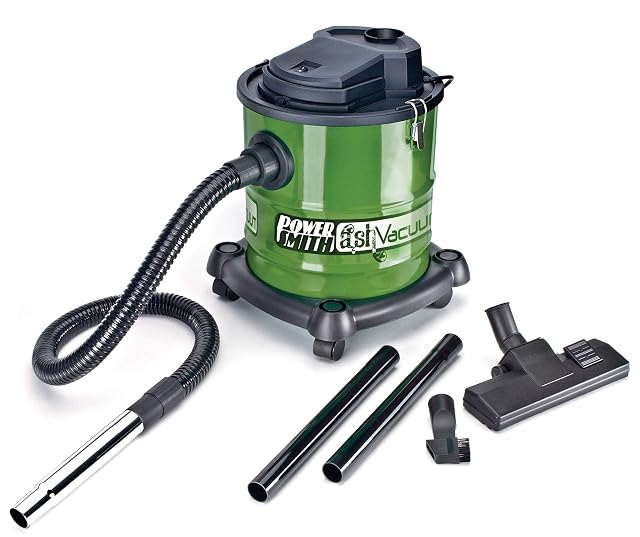
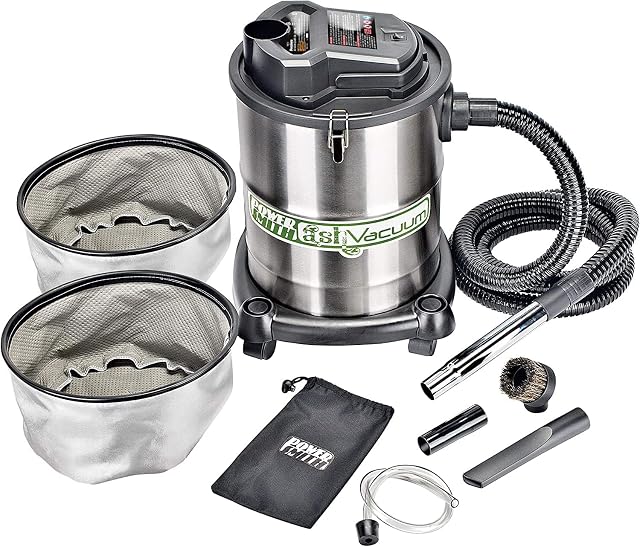
PowerSmith PAVC101 — a 16 ft cord, no hose figure
PowerSmith PAVC102 — a 10 ft hose, no cord figure
this — a published 12 ft
VEVOR 4 gallon — 8 ft + 4 ft = 12 ft
VANPORE green — “working radius 3.5 m”, which is 11.5 ft
Snow Joe — a 3.9 ft hose, no cord figure
SIPPON ×2 — a cord published as 31.5 inches, which is 80 cm and cannot be meant
Twelve feet covers a stove in the room you are in. It does not let the canister wait in the doorway, which is what the longer machines buy.
Four horsepower is not four horsepower
4 HP is 2983 W. A 120 V socket on a 15 A breaker supplies about 1800 W at best, and a vacuum motor is well under that.
So this figure is peak horsepower — a catalog convention, measured over an instant or at stall, not a power the machine sustains.
The shelf’s five units, for comparison:
1200 W — VEVOR ×2, VANPORE ×2, BACOENG
10 Amp — PowerSmith ×2, which on 120 V is 1200 W
800 W — SIPPON ×2
5 Amp, giving “up to 500 W of suction power” — Snow Joe, the only listing separating input from output
4 HP — here
10,000 Pa — ApexPower, the only suction pressure on the shelf
Input watts describe the electricity; pascals describe the ash. This listing publishes neither usefully, so judge it on the canister, the filter and the reach — all of which are stated properly.
Below 40 °C (104 °F), stated once and not contradicted
“safely cleans ash below 40℃ (104℉).”
That is all it claims, and the restraint is worth something.
Both SIPPON listings publish the same limit. Both VEVOR listings put it in words — “dry ash after the fire is fully extinguished”. The Snow Joe says “cold ash”.
Where the shelf gets muddled is the warm-ash claim. Both PowerSmith listings promise “warm and cool ash” and publish no limit at all. And two listings promise warm ash and give a number, which cancels out: the ApexPower (“both cold and warm… must be below 104℉/40℃”) and the BACOENG (“both warm (ash below 104F (40°C (104 °F))) and cool”).
Forty degrees is barely above body temperature. Ash at 40 °C is cold ash. This listing simply states the limit and makes no claim beyond it, which is the clearest position on the shelf after VEVOR’s.
2994 g, with a metal canister and a metal hose.
That combination is the quiet strength here. The shelf’s weights:
SIPPON ×2 2722 g · this 2994 g · VEVOR 4 gal 3198 g · VANPORE pellet 3992 g · VEVOR 5.3 gal 4100 g · VANPORE green 4672 g · BACOENG 5640 g · PowerSmith PAVC101 5897 g · PAVC102 6713 g
Only the two SIPPONs are lighter, and their published dimensions do not work — 279 × 203 × 127 mm (11 × 7.99 × 5 in) encloses 7.19 liters around a stated 9.84 liter canister.
Three kilograms with a steel drum is the lightest credible full-size machine here. It is carried rather than wheeled, which suits a stove on an upper floor — and this listing publishes no wheels, which at this weight is a choice rather than an omission.
A patented two-stage filter, washable
“A patented filter system efficiently captures fine ash and dust particles, preventing them from escaping through the exhaust pipe. The washable and reusable filter screens ensure long-term performance.”
The box list names both stages: “Cartridge Filter × 1, Pre-Filter × 1”.
Two stages is the standard this category converges on, and for a reason the VANPORE listing states best: “the bag filter prevents the pleated filter from clogging.” Wood ash packs into pleats in minutes unless something coarse takes the bulk first — which is the whole difference between an ash vacuum and a shop vacuum.
Both elements here are washable and reusable, so a winter costs nothing in consumables. What is not addressed is drying time: a washed HEPA needs hours before it is safe to refit. The PowerSmith PAVC102 ships two filters and the ApexPower ships two with the explicit reason — “one operates while the other is cleaned or air-dried”. This one ships one of each.
And no flame rating is named for the element, which only the SIPPON pair and the BACOENG publish. The element is the single part of the ash path that is not metal.
A second use, modestly claimed
“It also functions as a multi-purpose vacuum, making it useful for cleaning corners and ash from car interiors.”
A fair claim and a small one. The PowerSmith PAVC101 goes further — “Casters and a 16 foot cord allows use as a regular shop vacuum” — and the PAVC102 further still, offering to connect to a drywall sander for dust collection.
What this listing does not offer is a blower, where eight of twelve listings here do: both VEVOR, both SIPPON, both PowerSmith, both VANPORE. On a machine that works a few weeks a year, that is a real narrowing.
What is not published
No suction figure, and the 4 HP does not substitute for one.
No noise figure. Two listings publish one: PowerSmith 79 dB called “quiet”, ApexPower 60 dB called “whisper-quiet”. Nineteen decibels is roughly eight times the sound pressure.
No distinction between tank size and ash capacity, where the PowerSmith PAVC101 publishes “Canister Size: 5.2 Gallons, Canister Ash Capacity: 3 Gallons” and the PAVC102 says “4 gallon Ash capacity”. A bare “4-gallon metal canister” here could mean either.
No blower, as above. No wheels. No fill indicator, which only the BACOENG has. No certification named, where the ApexPower publishes CE, CB and GS and the Snow Joe publishes ETL.
Availability
Read on the day this page was built: $90 at the American Amazon shop.
Read from Keepa on the day this page was last revised; stock and price both move without notice.
Prices quoted in this text were read on 2026-10-04. The live price is at the top of the page.