What the maker puts in writing
- “Canister Size: 5.2 Gallons, Canister Ash Capacity: 3 Gallons”
- “Specifically designed to clean warm and cool ash out of fireplaces, wood stoves, pellet stoves, and barbeque grills”
- “Washable and replaceable fire-resistant filter system filters out the finest dust and ash”
- “The washable, replaceable and heat-resistant 2-stage filter system with sonic welded seams captures the finest ashes”
- “Heat-resistant metal hose and metal canister. Quiet and Powerful 10 Amp motor” · “a noise level of only 79 db”
- “Additional Accessories, Casters and a 16 foot cord allows use as a regular shop vacuum”
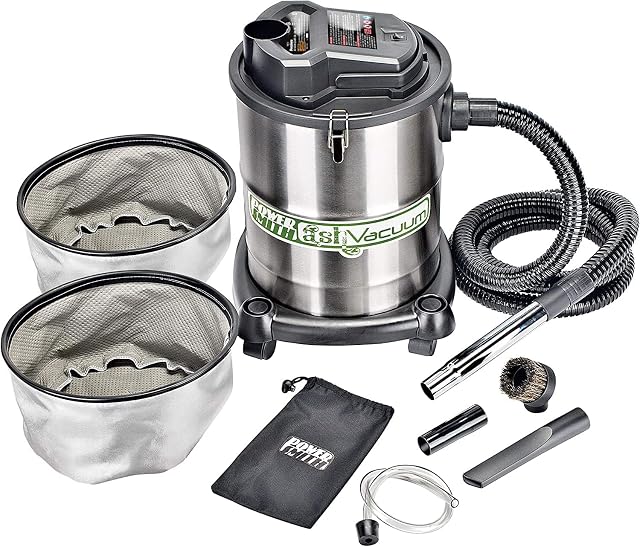
- “Includes: Metal hose, metal nozzle, wheeled base, (2) straight extension wands, brush nozzle, Turbo nozzle, and (1) Filter”
- Catalog: 5897 g (208 oz) · 356 × 356 × 381 mm (14 × 14 × 15 in)
The only listing that tells you what you can actually fill
“Canister Size: 5.2 Gallons, Canister Ash Capacity: 3 Gallons.”
Two point two gallons of that drum are the filter cage, the pleated element and the air space above the fill line. You can put three gallons of ash into a 5.2-gallon machine.
Nobody else on this shelf admits this, and once you have read it you cannot read the other listings the same way.
Eight of twelve publish a bare gallon number: both VEVOR listings (4 and 5.3), the DEWALT (4), the BACOENG (5.3), the ApexPower (4), and both SIPPON listings (2.6 in the bullets, though one title claims 4). None says whether that is the drum or the ash.
Three qualify it: this maker’s own PAVC102 (“4 gallon Ash capacity”), the Snow Joe (“stores up to 4.8 gallons of ashes”), and the VANPORE (“20 liters”, which matches its 5.2-gallon title).
So on real capacity the ranking is roughly Snow Joe 4.8, PAVC102 4, this 3 — and this listing appears worst exactly because it is the one being straight with you. Which is the sort of thing worth paying for, even when the number it reveals is smaller.
Ten amps is twelve hundred watts
The shelf measures power five ways, and two of them are the same figure:
1200 W — VEVOR ×2, VANPORE ×2, BACOENG
10 Amp — both PowerSmiths, which on 120 V mains is 1200 W
800 W — SIPPON ×2
5 Amp, giving “up to 500 W of suction power” — Snow Joe, the only input-versus-output distinction here
4 HP — DEWALT, which is 2983 W; a 120 V socket on a 15 A breaker caps near 1800 W, so it is a peak-horsepower convention
10,000 Pa — ApexPower, the only suction pressure on the shelf
So this sits at the top of the input range alongside the VEVOR and VANPORE machines, written in amps rather than watts. What no listing here except the ApexPower publishes is the figure that describes the work — pascals.
Sonic welded seams, which nobody else names
“a 2-stage filter system with sonic welded seams.”
The only construction detail of its kind on this shelf, and it addresses the real failure point.
A pleated filter leaks where its element is joined to its end caps. Glued or crimped seams open with heat cycling and with repeated washing, and once a seam leaks, fine ash goes straight through to the motor and out of the exhaust — which defeats the entire purpose of owning an ash vacuum rather than a brush.
Ultrasonic welding fuses the material rather than bonding it, so there is no adhesive to soften and no gasket to compress.
The element is also washable, replaceable and heat-resistant, and two filters ship with the PAVC102 sibling while one ships here.
That last point matters more than it looks: a washed HEPA needs hours to dry fully before refitting, and only the ApexPower solves it properly by shipping two so one can dry while the other works.
Heat-resistant metal hose. Metal canister.
Eight of twelve listings here are explicit about this, and it is the baseline rather than a feature. The argument is simple: even following the rules, one missed ember cannot melt its way out of steel.
What makes this listing’s claim weightier is what it leaves out — no temperature limit at all, on a product claiming “warm and cool ash”. It is one of only two on the shelf in that position, alongside its own sibling.
Everyone else gives you something. Both SIPPON listings and the DEWALT publish below 40 °C (104 °F). Both VEVOR listings say “dry ash after the fire is fully extinguished”. The Snow Joe says “cold ash”.
And the two listings that claim warm ash and give a figure prove the claim is hollow: the ApexPower and BACOENG both cap it at 40 °C (104 °F), which is barely above body temperature. Ash at 40 °C (104 °F) is cold ash.
So read “warm and cool” here as marketing, follow the VEVOR rule, and take the metal construction as insurance rather than permission.
Sixteen feet of cord, and a second job
“Additional Accessories, Casters and a 16 foot cord allows use as a regular shop vacuum.”
This is the most useful sentence in the listing after the capacity disclosure, because it changes what the money buys.
An ash vacuum works a few weeks a year. This one is sold as a canister vacuum that also does ash — with a 16 ft cord, casters, two straight extension wands, a brush nozzle and a turbo nozzle.
Reach across the shelf: BACOENG 15 ft cord + 5 ft hose = 20 ft; this 16 ft cord; VEVOR 5.3 gallon 13 ft + 5 ft = 18 ft; DEWALT a published 12-ft range; VEVOR 4 gallon 12 ft; VANPORE green a 3.5 m (11 ft) radius; both SIPPON listings a cord published as 31.5 inches, which is 80 cm (31.5 in) and cannot be meant.
At 5897 g (208 oz) the casters are not optional. That is the second heaviest machine here, behind only this maker’s own PAVC102 at 6713 g (236.8 oz).
What is not published
No suction figure, in pascals or inches of water.
No blower function. Its own sibling the PAVC102 publishes one — “Connecting the hose to the air outlet allows use as a blower” — and so do both VEVOR listings, both SIPPON listings and both VANPORE listings. This listing does not mention it.
No temperature limit, as above, on a listing claiming warm ash.
No fill indicator, which only the BACOENG offers — with the honest footnote that “you can still continue to vacuum, but the suction power will decrease”.
No certification named. The ApexPower publishes CE, CB and GS; the Snow Joe publishes ETL. Its own sibling carries a California Proposition 65 warning for “Cancer and Reproduction Harm”, which this one does not — a difference in what the seller posted, not in what the products contain. Wood ash does hold heavy metals and fine particulate, and that is the real reason the filter needs to be sealed.
Availability
Read on the day this page was built: $79 at the American Amazon shop.
Read from Keepa on the day this page was last revised; stock and price both move without notice.
Prices quoted in this text were read on 2026-10-04. The live price is at the top of the page.