What the maker puts in writing
- Title: “800W 2.6 Gallon” — and the bullets agree
- “The suction power of this ash vacuum cleaner has a powerful power of 800W”
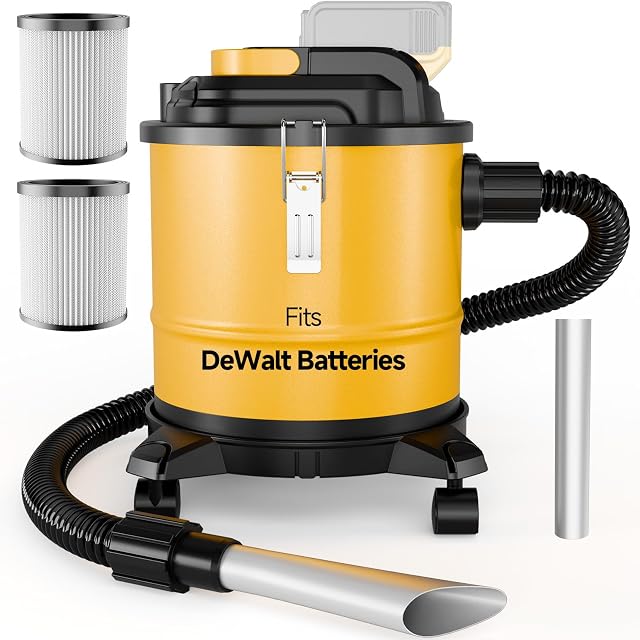
- “a 2.6-gallon metal canister that holds enough debris such as ash, sawdust, and wet ashes”
- “The HEPA filters are cleverly designed and sealed to prevent dust from exiting the vacuum’s exhaust pipe. These filters can be easily cleaned and reused”
- “a heat-resistant hose and 2.6-gallon canister combo paired with a flame-retardant filter”
- “NOTE: Use when the ash temperature is below 104°F (40°C) and there is no flame”
- Catalog: 2722 g (96 oz) · 279 × 203 × 127 mm (11 × 7.99 × 5 in) · Reference SPBJC2312JN
Two dollars for a title that is true
The other SIPPON on this shelf costs $56.99 and titles itself “1000W,4 Gallon”. Its own bullets publish 800 W and 2.6 gallons.
That is power overstated by a quarter and capacity by more than half, inside the listing that states them.
This one, at $59.45, titles itself “800W 2.6 Gallon” and says the same everywhere.
The machines are the same. 2722 g (96 oz) on both. 279 × 203 × 127 mm (11 × 7.99 × 5 in) on both. The same five bullets, word for word. References SPBJC2312JN and BJC2312 — one base model.
So the only thing $2.46 buys is a page that reports its own product correctly. On something that will sit beside a stove for ten winters, that is the cheaper purchase.
Two point six gallons, and why the bigger numbers here mislead
2.6 US gallons is about 9.8 liters, and wood ash is light — a stove burning daily produces a few liters a week. For a pellet stove or a weekly fireplace this is enough.
What makes it look small is the rest of the shelf, and the rest of the shelf is not measuring the same thing.
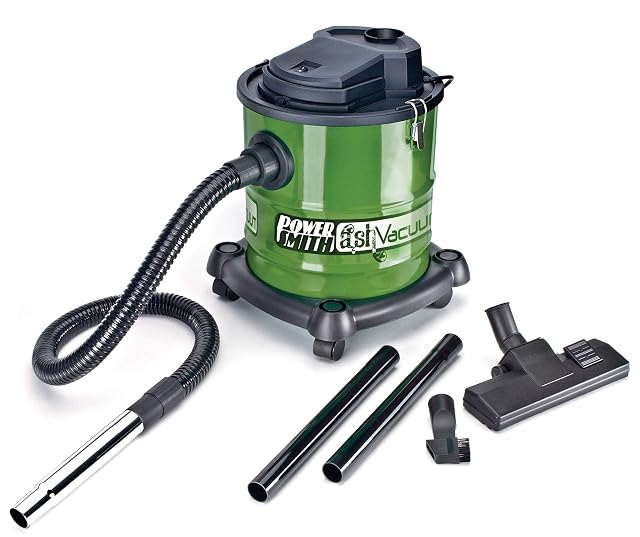
The PowerSmith PAVC101 is the only listing here that separates the two possible meanings: “Canister Size: 5.2 Gallons, Canister Ash Capacity: 3 Gallons.” The filter assembly takes the top of the drum, so a 5.2-gallon canister holds 3 gallons of ash.
Three listings qualify their figure: the PAVC102 (“4 gallon Ash capacity”), the Snow Joe (“stores up to 4.8 gallons of ashes”), and the VANPORE (“20 liters”, consistent with its 5.2-gallon title).
The rest — including both VEVOR listings, the DEWALT, the BACOENG and the ApexPower — publish a bare gallon number. Against a 5.2-gallon drum that really holds 3, a stated 2.6 is much closer than the labels suggest.
Eight hundred watts, the lowest here, and matched to the tank
Input power across twelve listings, in five units:
1200 W — VEVOR ×2, VANPORE ×2, BACOENG
10 Amp — PowerSmith ×2, which on 120 V mains is the same 1200 W
800 W — both SIPPONs
5 Amp, yielding “up to 500 W of suction power” — Snow Joe, the only listing separating input from output
4 HP — DEWALT, which is 2983 W and cannot come from a 120 V socket capped near 1800 W
10,000 Pa — ApexPower, the only pressure figure on the shelf
Eight hundred watts is the bottom of that list, and it is coherent: a 2.6-gallon canister does not need the airflow a 5.3-gallon drum does. What no listing here except the ApexPower provides is the figure that would settle it — suction, in pascals.
The filter is the part that could burn
“a heat-resistant hose and 2.6-gallon canister combo paired with a flame-retardant filter.”
Worth more attention than the wattage.
Everything else in the ash path is metal: the canister, the hose lining, the aluminum extension tubes. The element is fabric and paper, in moving air, with ash packed against it. If something live is drawn in, that is where it arrives.
Only two listings on this shelf name a rating for it: this SIPPON pair, and the BACOENG with its “fire-retardant cloth filter & HEPA”. The other ten describe metal canisters and heat-resistant hoses and leave the element unsaid.
And the filters here are sealed — so ash does not leave by the exhaust, which is the whole reason to use an ash vacuum rather than a brush — and reusable, so a winter costs no consumables.
The best version of that idea on the shelf is the ApexPower, which ships two HEPAs so “one operates while the other is cleaned or air-dried”. A washed HEPA takes hours to dry fully, and refitting a damp one is how people ruin them.
Below 104 °F, and what the shelf really means by “warm ash”
“Use when the ash temperature is below 104°F (40°C) and there is no flame.”
Numbered, unambiguous, on both SIPPON listings.
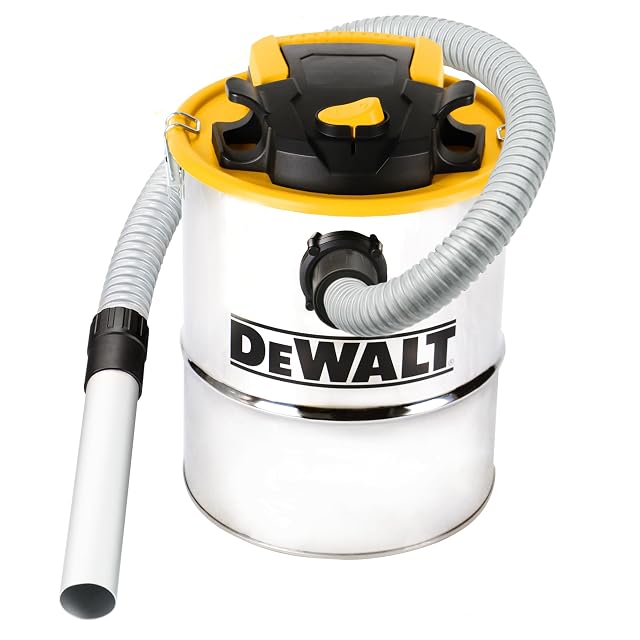
The shelf splits three ways. The VEVOR pair are strictest in words: “dry ash after the fire is fully extinguished”. The DEWALT matches this at 40 °C (104 °F). The Snow Joe says “cold ash”. Both PowerSmith listings claim “warm and cool ash and publish no limit at all.
And two listings claim both at once — the ApexPower (“both cold and warm ash… must be below 104℉/40℃”) and the BACOENG (“both warm (ash below 104F (40°C (104 °F))) and cool”).
Forty degrees is barely above body temperature. Ash at 40 °C is cold ash. So “warm-ash capable” is not a capability anyone here is really selling, and the rule to follow on every machine on this shelf is the one the VEVOR listings write plainly.
Aluminum tubes, and a base that keeps them
“aluminum hoses can even enter the tightest corners of the wood stove” and “all accessories are neatly installed in the designated slots on the base.”
A rigid aluminum extension reaches the back corner of a firebox where a flexible hose folds, and it does not soften against residual heat.
Attachments that seat in the base are attachments you still have next autumn — the VANPORE and BACOENG make the same point, and it is the kind of detail that only matters after a summer in a garage.
What is not published
No suction figure in pascals or inches of water.
No noise figure. Two listings publish one: PowerSmith 79 dB, called “quiet”, and ApexPower 60 dB, called “whisper-quiet”. Nineteen decibels is about eight times the sound pressure.
No wheels. Most of the shelf publishes casters — VEVOR 5.3 gallon, both VANPORE, BACOENG with three, ApexPower with four detachable, both PowerSmith. At 2722 g, the lightest here, it matters less.
No fill indicator, which only the BACOENG has.
No certification. ApexPower publishes CE, CB and GS; Snow Joe publishes ETL.
And the dimensions do not work. 279 × 203 × 127 mm encloses 7.19 liters, around a stated canister of 9.84 liters — before the motor, filter, hose and wheels. Both SIPPON listings carry the same pair. Use the 2722 g, which is plausible, and ignore the box.
Availability
Read on the day this page was built: $59 at the American Amazon shop.
Read from Keepa on the day this page was last revised; stock and price both move without notice.
Prices quoted in this text were read on 2026-10-04. The live price is at the top of the page.