What the maker puts in writing
- “Bagless electric canister ash vacuum designed for cold ash pickup from wood stoves, pellet stoves, fireplaces, firepits, and BBQ grills”
- “Reusable fine dust cartridge filter resists clogging and is easy to clean”
- “Dual Filtration System: Pre-filter pleated filter to clean ashes dust-free”
- “Extra-large metal canister stores up to 4.8 gallons of ashes; Powerful 5-amp motor generates up to 500 W of suction power”
- “Flexible, metal-reinforced suction hose (3.9 feet) with aluminum intake nozzle (11.8 inches); ETL approved”
- Catalog: 330 × 318 × 368 mm (13 × 12.5 × 14.5 in)
“5-amp motor generates up to 500 W of suction power.”
That sentence is the most useful on this shelf, because it separates two things every other listing runs together.
Five amps on 120 V mains is 600 W going in. The listing then states what comes out as suction. Nobody else here does that:
1200 W — VEVOR ×2, VANPORE ×2, BACOENG: input only
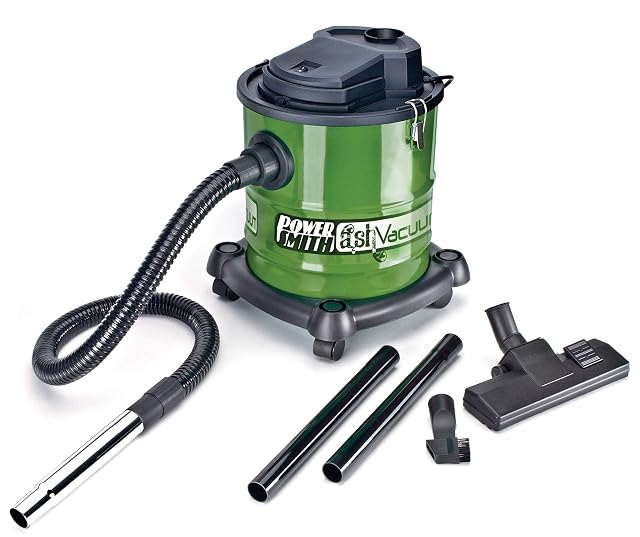
10 Amp — PowerSmith ×2: the same 1200 W on 120 V, input only
800 W — SIPPON ×2: input only
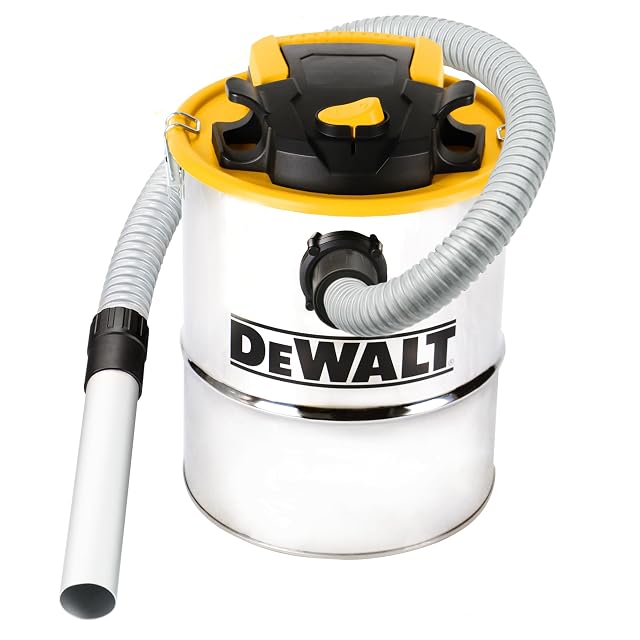
4 HP — DEWALT: 2983 W, which a 120 V socket on a 15 A breaker cannot supply; a peak-horsepower figure
10,000 Pa — ApexPower: the only pressure figure on the shelf, and pressure is what lifts ash
So the honest reading: this is the smallest motor here, roughly half the common figure, and it is the only one whose listing lets you think about it at all.
What a smaller motor really costs is margin as the filter loads. Ash packs into an element and airflow falls; a 600 W machine runs out of usable suction before a 1200 W one does. Which is exactly where this listing puts its engineering.
A cartridge that resists clogging, behind a pre-filter
“Dual Filtration System: Pre-filter pleated filter” and “Reusable fine dust cartridge filter resists clogging.”
Two stages, which is the standard this category converges on, and for a specific reason the VANPORE listing states best: “the bag filter prevents the pleated filter from clogging.”
Wood ash is fine, light and abrasive. It packs into pleats within minutes, and then the motor is loud and the nozzle is picking up nothing. A coarse stage in front leaves the fine element doing fine dust only.
This one is bagless, which is the meaningful difference from the VEVOR pair and the VANPORE pair, who use a cloth or paper bag as the coarse stage. Bagless means no consumable — nothing to run out of, nothing to order in November. It also means the coarse stage is a washable cartridge rather than something you throw away with the ash, which is messier to empty and cheaper to own.
What this listing does not name is a flame rating for the element. Only the SIPPON pair (“flame-retardant”) and the BACOENG (“fire-retardant”) do, and the element is the one part of the path that is not metal.
Four point eight gallons, and it says “of ashes”
“stores up to 4.8 gallons of ashes.”
Three words that most of this shelf leaves out, and they matter.
The PowerSmith PAVC101 is the only listing here that spells out why: “Canister Size: 5.2 Gallons, Canister Ash Capacity: 3 Gallons.” The filter assembly occupies the top of the drum, so the hole you fill is much smaller than the drum.
Which casts doubt on every bare gallon figure on this shelf — the VEVOR pair, the DEWALT, the BACOENG, the ApexPower all publish an unqualified number.
Three listings qualify it: this one, the PAVC102 (“4 gallon Ash capacity”) and the VANPORE (“20 liters”, which matches its 5.2-gallon title).
So 4.8 gallons of ashes is among the largest real capacities here, and it is the second largest stated after the PAVC101’s 5.2-gallon drum — which holds three.
3.9 feet of hose with an 11.8 inch aluminum nozzle, and no cord length published.
That is the weak point. Reach is cord plus hose, and this listing gives you one half of the sum:
BACOENG — 15 ft cord + 5 ft hose = 20 ft, the longest here
VEVOR 5.3 gallon — 13 ft + 5 ft = 18 ft
PowerSmith PAVC101 — 16 ft cord
DEWALT — does the arithmetic and publishes a 12-ft cleaning range
VEVOR 4 gallon — 8 ft + 4 ft = 12 ft
VANPORE green — “working radius 3.5 m”
SIPPON ×2 — a cord published as 31.5 inches, which is 80 cm and cannot be meant
At 3.9 feet, the hose is the shortest on the shelf, which means the canister comes to the hearth rather than waiting in the doorway. The metal-reinforced construction is the right choice for a hose that will sit against a warm firebox, and the 11.8 inch aluminum nozzle is long enough to reach the back of a grate without putting a hand in it.
No blower, where most of this shelf has one
At least eight of the eighteen listings here convert to a blower by moving the hose to the outlet: both VEVOR, both SIPPON, both PowerSmith, both VANPORE.
This one does not mention it, and neither do the DEWALT, the ApexPower or the BACOENG.
For a machine used a few weeks a year, a second use is worth something — leaves, a patio, a workbench. Its absence is a real narrowing of what you are buying.
What is not published
No weight. The shelf runs from 2722 g (both SIPPONs) to 6713 g (PowerSmith PAVC102, the only stainless one). With dimensions of 330 × 318 × 368 mm this sits mid-pack in size, but the figure is missing.
No noise. Two listings publish one — PowerSmith 79 dB called “quiet”, ApexPower 60 dB called “whisper-quiet” — and nineteen decibels is roughly eight times the sound pressure.
No cord length, as above.
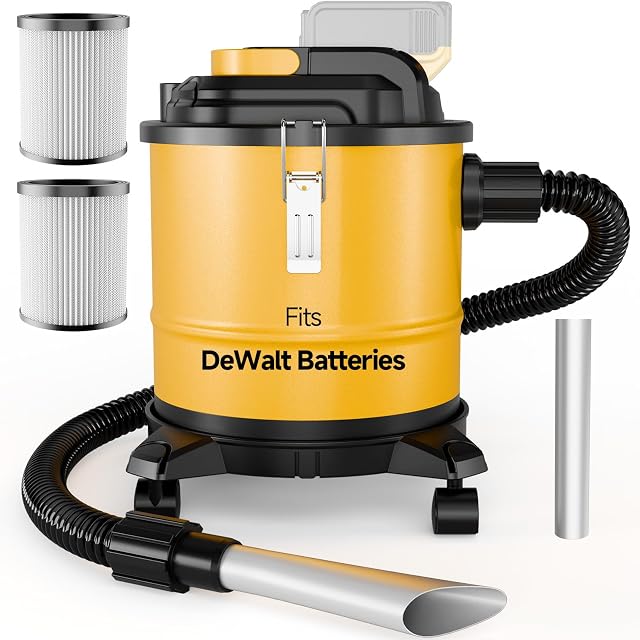
No wheels mentioned, where the VANPORE pair publish three, the ApexPower four detachable swivels, and the BACOENG three universal.
No fill indicator, which only the BACOENG offers — and which honestly adds that “you can still continue to vacuum, but the suction power will decrease”.
Availability
Read on the day this page was built: $66 at the American Amazon shop.
Read from Keepa on the day this page was last revised; stock and price both move without notice.
Prices quoted in this text were read on 2026-10-04. The live price is at the top of the page.