What the maker puts in writing
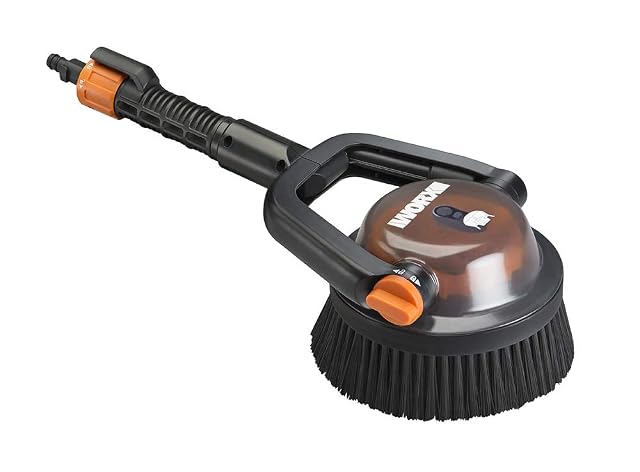
- “A HARD SCRUB WITHOUT THE WORK: Water-powered rotary brush with hard bristles for an intense cleaning of hard surfaces”
- “SO MANY USES: For a thorough deep cleaning of all your outdoor surfaces, like patios, windows, deck furniture, even siding”
- “EASY ADJUSTMENTS: Adjust the angle of the brush with the dual articulating points on the side”
- “Compatibility: Compatible with all Hydroshot models”
- Description: “When water pressure alone, or hand scrubbing, won’t get your hard surfaces clean, then add the power of the Hydroshot Outdoor Power Scrubber with Hard Bristles” · “Make your brickwork look like new” · “takes the tough stuff off the undercarriage of your cars or trucks (though keep this brush away from the paint job, we have a softer brush for that)” · “The outer, stationary bristles provide the first level of scrubbing, and then the rotating inner bristles do the hard work”
- Reference WA1821 · Catalog: 454 g (16 oz), 165 × 107 × 406 mm (6.50 × 4.21 × 16 in)
It tells you to keep it off your paint
“takes the tough stuff off the undercarriage of your cars or trucks (though keep this brush away from the paint job, we have a softer brush for that).”
A maker steering you off its own product toward its sibling is the most honest sentence on this shelf.
That softer brush is the WA1820, here at the same $44.99, the same 454 g (16 oz), the same 165 × 107 × 406 mm (6.50 × 4.21 × 16 in) — the same body with different bristles.
This one, hard: “for an intense cleaning of hard surfaces”, “Clean gross, stubborn dirt and debris off the deck. Make your brickwork look like new.”
The WA1820, soft: “without damaging paint or chrome”, “Some brushes can leave a mark”, and “It spins at a moderate speed to prevent damage to your finish.”
So the division is published rather than guessed: hard for brick, decking, fences and an undercarriage; soft for anything with a finish.
Read the rest of the shelf against it and some claims look thinner.
The Sun Joe SPX-RB1 at $25.99 says “fine bristles scrub away stubborn residue” — two halves pulling against each other. The Kuuleyn at $27.39 and the Hyuduo at $29.31 both name stucco in the same sentence as painted vehicles, and a soft PP brush on stucco wears out faster than the stucco does. The Kärcher at $32.65 names “RVs, cars, boats, patio furniture” and no bristle material at all.
Only WORX makes hardness a specification, and it is the specification that decides where a brush may go.
The two-stage design, which every brush here uses and only this one explains
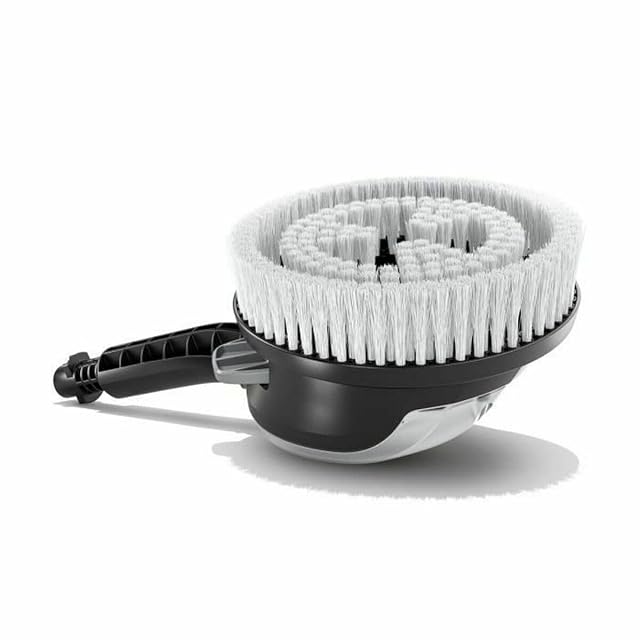
“The outer, stationary bristles provide the first level of scrubbing, and then the rotating inner bristles do the hard work.”
Four other listings describe the same architecture without saying why:
Kuuleyn — “gently rotate a set of internal brushes”
TUHUT — “spin a set inner brushes”
Hyuduo — “rotate a set of internal brushes”
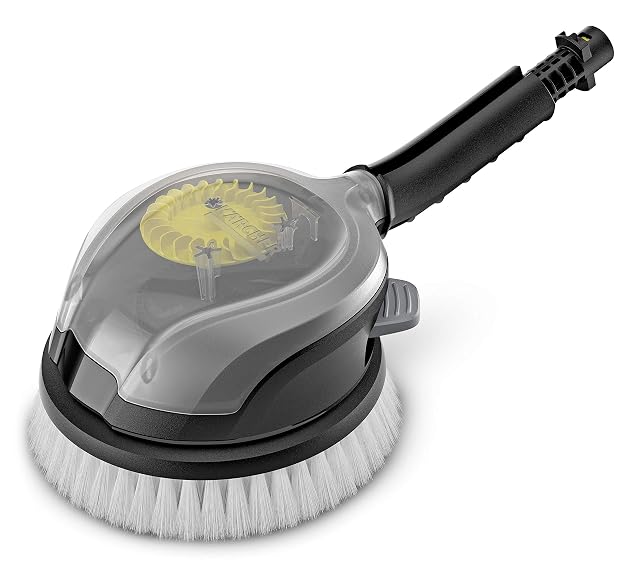
Kärcher — “Incoming water causes inner brushes to rotate”
What the outer ring is for is stability. A quick-connect coupler lets an attachment swivel freely — the TUHUT is the only listing candid enough to publish it, “it get a 360 degree freedom on it” — so without something to bear against, a spinning head wanders across the surface.
The static ring presses on the surface and holds the face square while the center does the cutting. It also means the first thing to touch the surface is not moving, which is why a brush like this can be held against brick without skating off.
The practical consequence: let the outer ring take your weight, and do not lean on the head to make the inner disc work harder — on a water-driven turbine, pressing harder only slows the rotation.
And the articulating points add the other half of the control: “Adjust the angle of the brush with the dual articulating points on the side.” Its soft sibling’s description spells out what that means — “an adjustment knob on the side so you can lock it in place at a particular angle” — and this pair is the only one on the shelf that does it. The only other adjustable brush here is the Sun Joe SPX-ACS-MAX at $49.97, whose head moves 0° to 180°.
Brick, decking and an undercarriage
“Clean gross, stubborn dirt and debris off the deck. Make your brickwork look like new.”
“it makes patio furniture look like new, cleans up your fences, and takes the tough stuff off the undercarriage of your cars or trucks.”
“It’s a great tool to use up at the cabin or campsite.”
Every one of those is a hard or porous surface, and that consistency is what makes the page credible.
And the argument for a brush over a jet is stated properly, which almost nothing on this shelf manages:
“When water pressure alone, or hand scrubbing, won’t get your hard surfaces clean, then add the power of the Hydroshot Outdoor Power Scrubber with Hard Bristles… Any scrubbing job that would normally require hours of manual labor is now easier.”
Here is the trade. The alternative to agitation is pressure, and on timber that is where damage happens: a jet strong enough to lift grey off cedar raises the grain, and on composite boards it furs the surface — which is why composite manufacturers routinely cap the pressure permitted on them.
A hard brush at low pressure removes what a jet would remove, without the jet. And on a Hydroshot — a battery washer — the pressure behind it is modest by design.
The caution the page does not give: hard bristles still abrade soft timber, and the softer the wood the more they raise fibers. Work along the grain rather than across it, keep the head moving, and test a hidden board first.
For the chemical alternative, the detergent shelf of this site has the Simple Green Oxy Solve — “peroxide-powered”, EPA Safer Choice Certified — where peroxide oxidizes the grey pigment rather than abrading it off. Chemistry and agitation are the two ways to clean wood; pressure is the one to avoid.
The undercarriage job is the other good one here, and worth separating from the paint warning: under a truck there is no finish to protect, the soil is baked road grime and salt, and you cannot reach it by hand. A hard brush on an articulating mount is the right tool, and the Sun Joe SPX-ACS-MAX attacks the same job differently, with a “TURBO NOZZLE + 20” ROD” and a 90° angled head.
Hydroshot only, and what that means
“Compatible with all Hydroshot models.”
A Hydroshot is WORX’s battery-powered portable washer, so this is a low-pressure attachment — which its soft sibling’s description states outright: “supported by a low-pressure water flow”.
No pressure rating is published, and here the machine sets it instead, which is a reasonable substitute. Only two listings on this shelf publish a figure: the Kärcher — “up to 4000 PSI / 4.0 GPM”, and it is the GPM that drives the rotation — and the Sun Joe SPX-ACS-MAX — “up to 3500-PSI”.
The shelf, by fitting:
Universal 1/4 inch quick connect — the TUHUT at $15.99, Kuuleyn at $27.39, Hyuduo at $29.31, and the Kärcher at $32.65, which also ships adaptors for its own bayonet and threaded connections — the most complete statement here
Worx Hydroshot only — this, the WA1820, and the WA4042 at $22.79, which names its five models outright: “WG625, WG629, WG630, WG640, and WG644 series”
Sun Joe SPX only — the SPX-RB1 at $25.99 and the SPX-CCK at $54.97
Garden hose, 1/2 inch — the KUJOBUY at $27.99, which fits no washer at all
Three of eleven items on this shelf fit one brand only, and the WORX trio is all three. Which also means the sensible WORX purchase is more than one: this for hard surfaces, the WA1820 for paint, the WA4042 for rims — the same quick snap, the same machine.
“Easy on, easy off” is the shared line, and on a mixed job it earns its place: brush the deck, swap, rinse.
What is not published
No bristle material. “Hard” is asserted and no fiber is named, which on an abrasive brush is the figure that would tell you how hard. The Kuuleyn and Hyuduo specify PP; the KUJOBUY “PVC filaments on the edge and chenille in the middle”; the Sun Joe SPX-RB1 “fine”, the SPX-CCK “soft”, the SPX-ACS-MAX “feathered”; and WORX’s own WA4042 “soft”.
No brush diameter. Its soft sibling publishes “the attachment is 6.5 inches long”; the Sun Joe SPX-ACS-MAX the only diameter on the shelf, 5.7 inches; the Kuuleyn an overall “22.5 x 11.5 x 15cm / 8.9 x 4.5 x 5.9in”, correctly converted.
No pressure rating, as above.
No surface exclusion list beyond paint. The warning covers paintwork, and bullet three then names “windows” among the uses — which is the one surface on that list a hard brush should not touch. Glass scratches, and a hard bristle carrying grit across a windscreen is a worse outcome than a dirty windscreen. Use the WA1820 for glass.
No detergent function, which two listings on this shelf name: the Kärcher — “The brush automatically dispenses soap from the pressure washer” — and the TUHUT — “Ideal for dispensing pressure washer detergent.” A rotary brush is a low-pressure attachment, which is exactly the condition a washer needs in order to siphon soap; the detergent shelf of this site explains why, and the Sun Joe concentrate there is the only one of eleven bottles to spell out the soap nozzle requirement. On brick and decking a detergent does most of the work, so this is a real omission.
No replacement bristles, on a $44.99 attachment whose bristles are the wearing part — and a hard brush wears faster than a soft one.
No warranty.
Availability
Read on the day this page was built: $45 at the American Amazon shop.
Read from Keepa on the day this page was last revised; stock and price both move without notice.
Prices quoted in this text were read on 2026-10-05. The live price is at the top of the page.