What the maker puts in writing
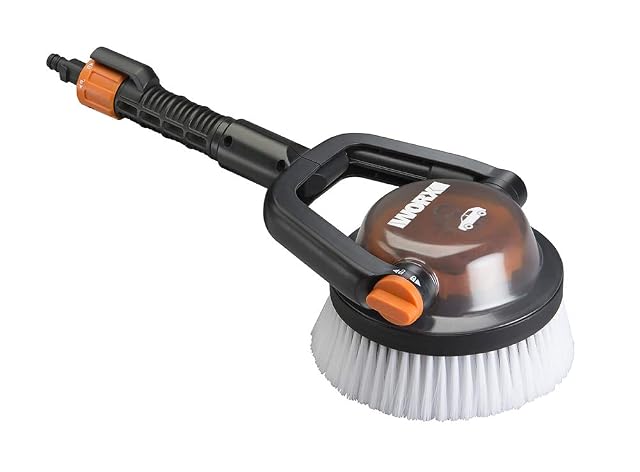
- “CAR OR BOAT CLEANING: Water-powered rotary brush with soft bristles for a thorough cleaning without damaging paint or chrome”
- “NO SCRATCHES: Some brushes can leave a mark, make sure you’re getting a deep clean without scratching your vehicle’s finish”
- “EASY ADJUSTMENTS: Adjust the angle of the brush with the dual articulating points on the side”
- “QUICK SNAP CONNECTION: Easy on, easy off, so you can switch between cleaning accessories quickly”
- Description: “The attachment is 6.5 inches long and has an adjustment knob on the side so you can lock it in place at a particular angle” · “The rotary brush is supported by a low-pressure water flow… It spins at a moderate speed to prevent damage to your finish” · “Made for cars, trucks, SUVs, RVs, bikes, motorcycles” · “great for cleaning showers or tile, delicate patio furniture, even windows or the walls of your house”
- Reference WA1820 · Catalog: 454 g (16 oz), 165 × 107 × 406 mm (6.50 × 4.21 × 16 in)
Soft and hard, at the same price, and WORX tells you which
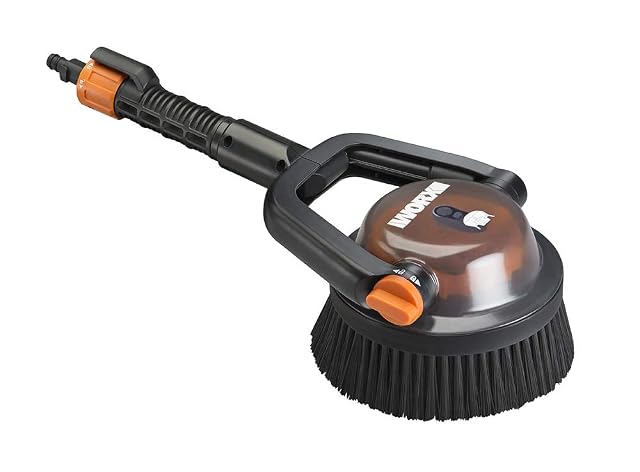
This and the WA1821 are the same body at the same $44.99, the same 454 g (16 oz), the same 165 × 107 × 406 mm (6.50 × 4.21 × 16 in) — one soft, one hard.
This one: “for a thorough cleaning without damaging paint or chrome”, “Some brushes can leave a mark, make sure you’re getting a deep clean without scratching your vehicle’s finish”, and “It spins at a moderate speed to prevent damage to your finish.”
The WA1821: “for an intense cleaning of hard surfaces” — and then, in its own description:
“takes the tough stuff off the undercarriage of your cars or trucks (though keep this brush away from the paint job, we have a softer brush for that).”
A maker steering you off its own product toward its sibling is unusual, and it is the most useful sentence on this shelf.
Because this is the division everything here should be read by. Soft for anything with a finish — paint, chrome, glass, polished alloy, delicate furniture. Hard for brick, decking, fences and an undercarriage. No single brush does both, and when a listing on this shelf claims both it is describing the softer job.
Which is worth applying elsewhere. The Sun Joe SPX-RB1 at $25.99 says “fine bristles scrub away stubborn residue” in one sentence — two halves that pull against each other. The Kuuleyn and Hyuduo both name stucco alongside painted vehicles, and a soft PP brush on stucco wears out faster than the stucco does.
The locking angle, which only this pair has
“Adjust the angle of the brush with the dual articulating points on the side”, and “an adjustment knob on the side so you can lock it in place at a particular angle.”
Here is why it matters. A quick-connect coupler is a round fitting with a retaining ball, so anything on it can rotate freely about the axis of the lance.
The TUHUT at $15.99 is the only listing candid enough to publish the consequence: “Due to the 1/4’ coupler, it get a 360 degree freedom on it.” On a flat brush head that means the face rolls off square under its own weight the moment you stop holding the lance exactly right.
A locked angle means the brush meets a roof panel, a sill or the side of a van flat, with the lance at whatever angle your arms are comfortable at. On a car roof, that is the difference between scrubbing and scraping one edge of the head across the paint.
The only other adjustable brush here is the Sun Joe SPX-ACS-MAX at $49.97, whose head moves 0° to 180° — a wider range, though its page does not say whether it locks.
Everything else relies on the static outer bristle ring to hold the head, which the WA1821 is the only listing on this shelf to explain: “The outer, stationary bristles provide the first level of scrubbing, and then the rotating inner bristles do the hard work.”
A moderate speed, offered as a feature
“The rotary brush is supported by a low-pressure water flow that works in concert with the bristles to dislodge dirt and grime. It spins at a moderate speed to prevent damage to your finish.”
Two things are being admitted and one is being claimed.
The admission: a Hydroshot is a battery washer, so the flow behind this is modest, and the brush will not spin as fast as the same head on a petrol machine at 4 GPM — the figure only the Kärcher at $32.65 publishes, “4000 PSI / 4.0 GPM”.
The claim: that this is the right speed anyway. And on paint it is defensible. A fast-spinning brush loaded with grit is a lapping tool; a slower one carries dirt away in the bristles rather than grinding it in.
Nothing else on this shelf discusses rotation speed at all. The other brushes spin at whatever your machine’s flow delivers, with no setting and no stated range — and the figure that governs it is GPM, which nine of eleven listings do not publish.
So this is the one brush here whose drive is matched to its bristles on purpose, and the compatibility restriction cuts both ways: it fits only a Hydroshot, and a Hydroshot is what it was designed around.
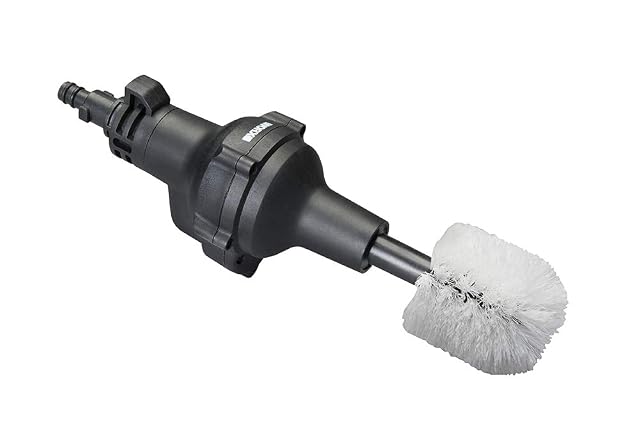
Six and a half inches, and the fitting restriction
“The attachment is 6.5 inches long.”
One of only three dimensional figures on this shelf: the Sun Joe SPX-ACS-MAX publishes a 5.7 inch brush diameter, and the Kuuleyn an overall “22.5 x 11.5 x 15cm (8.9 × 4.5 × 5.9 in) / 8.9 x 4.5 x 5.9in”, correctly converted. No diameter is given here, which is the figure that decides how many passes a door takes.
And it fits Hydroshots only. Bullet six on the hard sibling says “Compatible with all Hydroshot models”; the WA4042 at $22.79 goes further and names five — “WG625, WG629, WG630, WG640, and WG644 series”.
The shelf, by fitting:
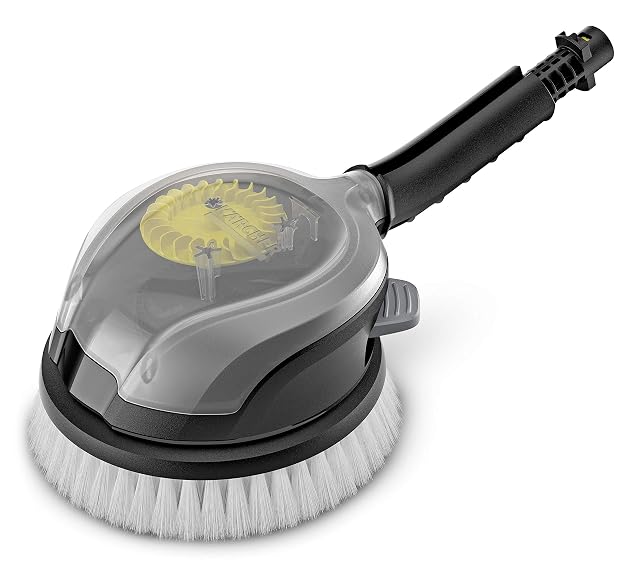
Universal 1/4 inch quick connect — the TUHUT at $15.99, Kuuleyn at $27.39, Hyuduo at $29.31, and the Kärcher at $32.65, which also ships adaptors for its own bayonet and threaded connections and is the most complete statement here
Worx Hydroshot only — this, the WA1821 and the WA4042
Sun Joe SPX only — the SPX-RB1 at $25.99 and the SPX-CCK at $54.97
Garden hose, 1/2 inch — the KUJOBUY at $27.99, which fits no washer at all
The quick snap connection is the WORX constant — “Easy on, easy off, so you can switch between cleaning accessories quickly and get onto the next job” — and on a car wash that is the right feature, because the sequence is brush, swap, rinse.
Cars and motorcycles, and the half of the list people miss
“Made for cars, trucks, SUVs, RVs, bikes, motorcycles, all sorts of recreational equipment.”
Motorcycles are the hardest case on that list and the best argument for a soft brush. A bike is polished aluminum, anodized fittings, a plastic screen, decals and spoked wheels — all of it closer to the water than on a car, and none of it forgiving.
And bugs are the specific soil: “They’re great at getting bugs out of the grill or off the windshield.” Insect residue is protein bonded to paint by heat, and blasting a grille harder does not shift it — it needs soaking and agitation, which is exactly this. The Kärcher names the same job: “loosen bugs, mud & other debris.”
Then the second half of the description is the part worth reading twice:
“great for cleaning showers or tile, delicate patio furniture, even windows or the walls of your house. Anytime you have something you would normally scrub by hand, that you don’t want to damage, you can use this instead.”
That is the honest general case for the whole shelf. A rotary brush replaces hand scrubbing, not pressure — and the surfaces it suits are the ones where you would not turn the pressure up anyway.
One caution the page does not give, which applies to every soft brush here: the risk is grit, not bristles. Road grit trapped between a fiber and clear coat is what leaves swirl marks. Rinse the panel before you brush it, and rinse the brush when you move from a wheel arch to a door.
And the saving the description claims
“Save yourself the $10 at the gas station carwash, or the $60 at the full-service places. By paying half of that, just once, you can do a better and quicker job whenever you like.”
Worth noting because no other listing on this shelf makes a cost argument at all, and this one is roughly right in shape: $44.99 against a $60 full-service wash is less than one visit, and against a $10 machine wash it is four or five.
The qualification it leaves out is that you also need the Hydroshot, which this does not work without.
What is not published
No bristle material. “Soft” is asserted and no fiber is named. The Kuuleyn and Hyuduo both specify PP — polypropylene; the KUJOBUY “PVC filaments on the edge and chenille in the middle”, which is the most considered head on this shelf for paint; the Sun Joe SPX-RB1 “fine”, the SPX-CCK “soft”, the SPX-ACS-MAX “feathered”.
No brush diameter, as above.
No pressure rating, though the Hydroshot sets it instead, which is a reasonable substitute. Only the Kärcher (“up to 4000 PSI / 4.0 GPM”) and the Sun Joe SPX-ACS-MAX (“up to 3500-PSI”) publish one.
No detergent function, which two listings here name: the Kärcher — “The brush automatically dispenses soap from the pressure washer” — and the TUHUT — “Ideal for dispensing pressure washer detergent.” A rotary brush is a low-pressure attachment, which is exactly the condition a washer needs in order to siphon soap: the detergent shelf of this site explains why, and the Sun Joe concentrate there is the only one of eleven bottles to spell out the soap nozzle requirement. On a battery machine the siphon arrangement may differ, and the page says nothing either way.
No replacement head, and nothing about whether the bristles can be renewed on a $44.99 attachment.
No wheel or rim tool, where WORX’s own WA4042 at $22.79 is built for exactly that — “PERFECT FOR RIMS & WHEELS… it’ll also polish the chrome” — and fits the same machines. The two together are the sensible Hydroshot pair.
No warranty.
Availability
Read on the day this page was built: $45 at the American Amazon shop.
Read from Keepa on the day this page was last revised; stock and price both move without notice.
Prices quoted in this text were read on 2026-10-05. The live price is at the top of the page.