What the maker puts in writing
- “COMPATIBLE WITH Worx Hydroshot models: WG625, WG629, WG630, WG640, and WG644 series”
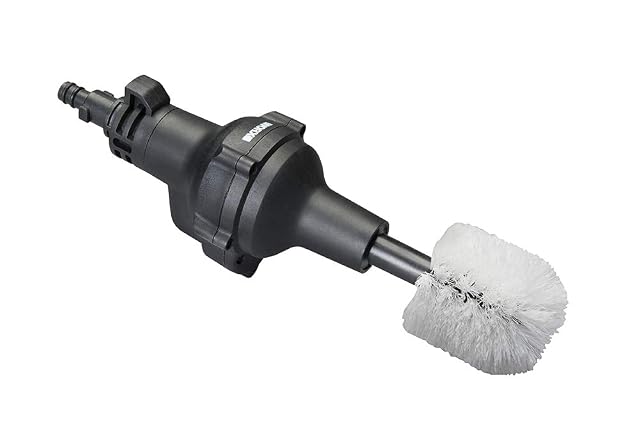
- “PERFECT FOR RIMS & WHEELS: Your car, truck, motorcycle, or bike wheels will look like new. Not only does this brush clean in-between the rims, but it’ll also polish the chrome”
- “CLEAN IN TIGHT SPACES: This water-powered spinning brush cleans all the tight spaces you never thought you’d be able to get into”
- “SOFT BRISTLES: It’s also great for delicate surfaces because the soft bristles won’t damage paint, finish, or chrome”
- “COMPACT SIZE: It may look fluffy, but this brush collapses down and really gets in there”
- Description: “This thing was made for shining rims. Not only does it get in-between the spokes, but the soft bristles buff the face of your rims, too… window sills, between deck and fence slats, any place that you thought was too tight clean”
- Reference WA4042 · Catalog: 454 g (16 oz), 89 × 74 × 279 mm (3.50 × 2.91 × 11 in)
Five model numbers, which is the best compatibility statement here
“COMPATIBLE WITH Worx Hydroshot models: WG625, WG629, WG630, WG640, and WG644 series.”
No other listing on this shelf is that specific. The two WORX scrubbers at $44.99 say only “all Hydroshot models”; the two Sun Joe kits say “all SPX series”; the Kärcher says “most Karcher & most non-Karcher gas power pressure washers rated up to 4000 PSI”; the three cheap brushes say “1/4 inch quick disconnect” and leave it there.
And what matters is what a Hydroshot is. It is a battery-powered portable washer, not a mains or petrol machine. So this is a low-pressure attachment by design — WORX’s own WA1820 description on this shelf says the brush is “supported by a low-pressure water flow” and “spins at a moderate speed”.
So the shelf really divides four ways by fitting:
1/4 inch quick connect, universal — the TUHUT at $15.99, the Kuuleyn at $27.39, the Hyuduo at $29.31, the Kärcher at $32.65
Worx Hydroshot only — this, the WA1820 and the WA1821
Sun Joe SPX series only — the SPX-RB1 at $25.99 and the SPX-CCK at $54.97
Garden hose, 1/2 inch — the KUJOBUY at $27.99, which fits no pressure washer at all
Three of eleven items fit one brand only, and this is the most honestly labeled of them. If you own a conventional washer, this is not for you and the page says so plainly in bullet seven.
Built for the gap between the spokes
“PERFECT FOR RIMS & WHEELS… Not only does this brush clean in-between the rims, but it’ll also polish the chrome.”
“It may look fluffy, but this brush collapses down and really gets in there.”
Here is the problem it solves. Everything else on this shelf is a flat disc.
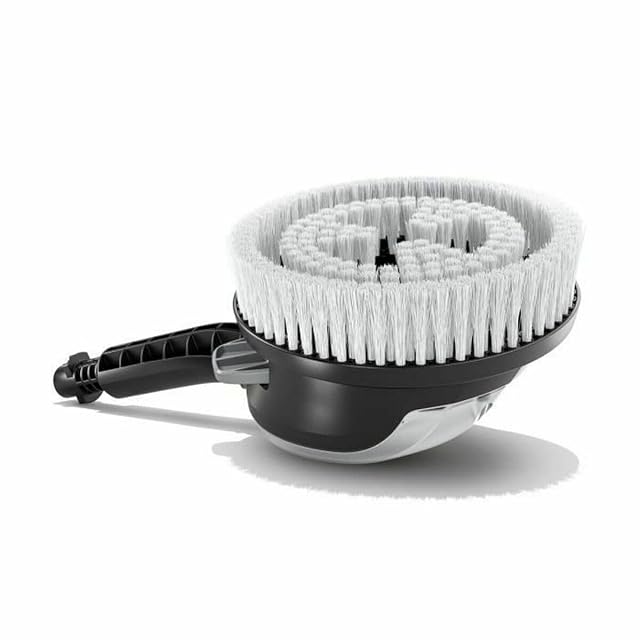
The Kuuleyn, TUHUT and Hyuduo all name “flat surfaces” in their own bullets. The Sun Joe SPX-ACS-MAX publishes a 5.7 inch diameter face.
A five-and-a-half-inch disc will clean the face of an alloy wheel and nothing behind it — and the space between the spokes is exactly where brake dust collects and bakes on.
So the real comparison is not with the other brushes here but with the wheel brushes in two of the kits: the Sun Joe SPX-ACS-MAX at $49.97 includes a “WHEEL + RIM BRUSH”, and the SPX-CCK at $54.97 includes the SPX-WB1 Wheel Rim Brush. Both cost roughly twice this, and both need an SPX machine.
The other uses named are the same geometry by another name: “window sills”, “between deck and fence slats”, “any place that you thought was too tight clean”. Those are all gaps rather than faces, and they are jobs no flat brush on this shelf can do.
The second claim — that it buffs the chrome as well as reaching between the spokes — is a soft-bristle claim, and worth taking as polishing rather than cutting: a spinning soft brush with water will bring a shine up on clean chrome and will not remove anything from it.
Soft bristles, and no material named
“great for delicate surfaces because the soft bristles won’t damage paint, finish, or chrome.”
The right claim, and no fiber, no diameter and no hardness scale anywhere on the page — which is the pattern across this entire shelf.
WORX’s own range is the clearest statement here, and it is worth borrowing. The WA1820 at $44.99 is sold as soft: “without damaging paint or chrome”, and “It spins at a moderate speed to prevent damage to your finish.” The WA1821, the same body at the same price, is sold as hard — and its description sends you away from paint in so many words:
“takes the tough stuff off the undercarriage of your cars or trucks (though keep this brush away from the paint job, we have a softer brush for that).”
A maker steering you off its own product toward its sibling is the most useful sentence on this shelf, and it tells you WORX treats hardness as the specification that decides where a brush may go.
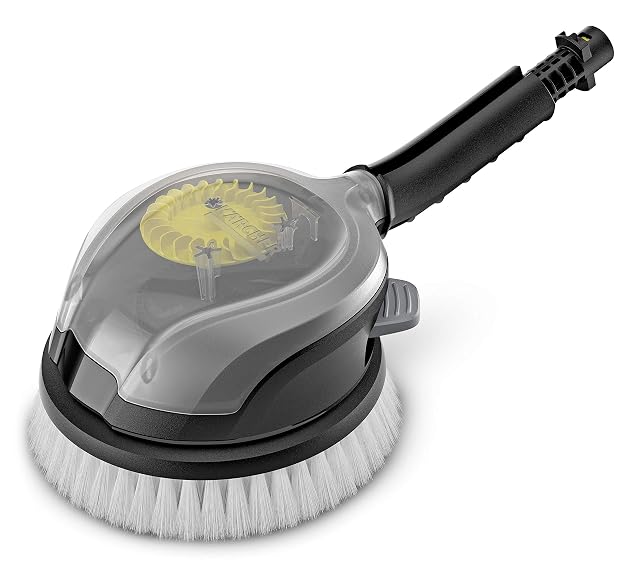
What the others declare: the Kuuleyn and Hyuduo specify PP — polypropylene, “soft and does not hurt the surface”; the KUJOBUY “PVC filaments bristle on the edge and chenille in the middle”; the Sun Joe SPX-CCK “soft”, the SPX-RB1 “fine”, the SPX-ACS-MAX “feathered”; the Kärcher and TUHUT nothing at all.
The practical caution on wheels is grit, not bristles. Brake dust is abrasive, and any brush dragged across a rim carries it. Rinse the wheel before you brush it, and rinse the brush between wheels — a soft bristle loaded with dust is a lapping tool.
Water-powered, which is the appeal of the whole shelf
“This water-powered spinning brush.”
The water is already moving; a turbine in the head converts some of that flow into rotation. Nothing to charge, nothing to plug in, nothing to keep out of the water — which beside a car on a wet drive is a real advantage over a cordless drill brush.
The others make the same point in their own words: the Kuuleyn and Hyuduo say “without electricity”, the KUJOBUY “No Extra Electricity Needed”, the Sun Joe SPX-RB1 “Pressure powered for maximum results with minimum effort”.
What it costs is control. The speed is whatever your machine’s flow gives, with no setting — and on a Hydroshot that flow is modest, which is why the WA1820 describes a “moderate speed”. On this particular job that is the right end of the range: you want a rim polished, not scoured.
The quick snap adapter is the other WORX constant — “Easy on, easy off, so you can get onto the next accessory and the next cleaning job” — and it is the same sentence on the WA1821. Which matters on a wheel job, because the sequence is brush the rims, swap, rinse the car.
What is not published
No pressure rating, though here the Hydroshot sets it instead, which is a reasonable substitute. Only two listings on this shelf publish a figure: the Kärcher (“up to 4000 PSI / 4.0 GPM”) and the Sun Joe SPX-ACS-MAX (“up to 3500-PSI”).
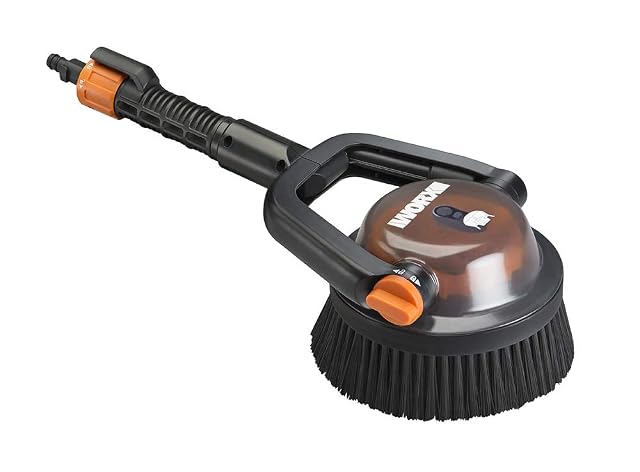
No angle adjustment, where both WORX scrubbers have “dual articulating points on the side” and the WA1820 adds a knob that locks the angle. On a rim brush that matters less — you are working into a gap rather than holding a face square — but the Sun Joe SPX-ACS-MAX brush adjusts 0° to 180°, which would help reaching the inner barrel.
No brush diameter, and on a tool sold for tight spaces that is the one dimension you would want. The catalog box is 89 × 74 × 279 mm, so the head is small, and the 454 g weight is identical to both WORX scrubbers.
No bristle material, as above.
No detergent function, which two listings here name: the Kärcher (“The brush automatically dispenses soap from the pressure washer”) and the TUHUT (“Ideal for dispensing pressure washer detergent”). A rotary brush is a low-pressure attachment, which is exactly the condition a washer needs to siphon soap — so this very likely does it, and the page does not say. The KUJOBUY carries its own soap dispenser with a 3-gear foam knob because it has no siphon to borrow.
No warranty.
Availability
Read on the day this page was built: $23 at the American Amazon shop.
Read from Keepa on the day this page was last revised; stock and price both move without notice.
Prices quoted in this text were read on 2026-10-05. The live price is at the top of the page.