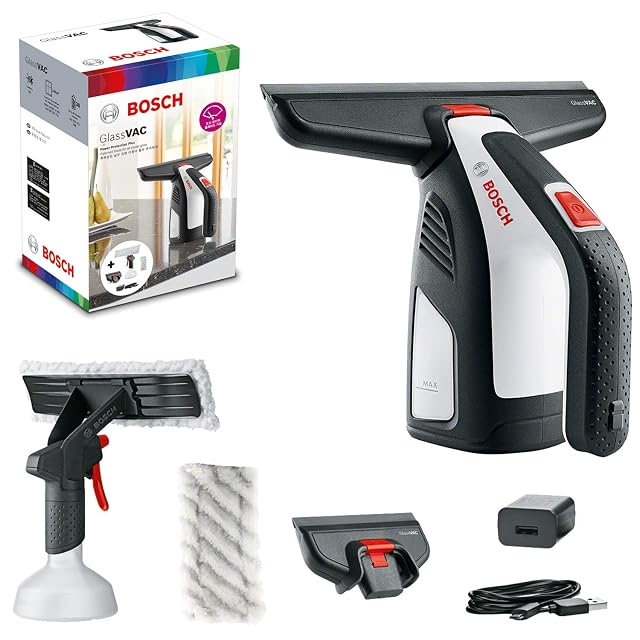
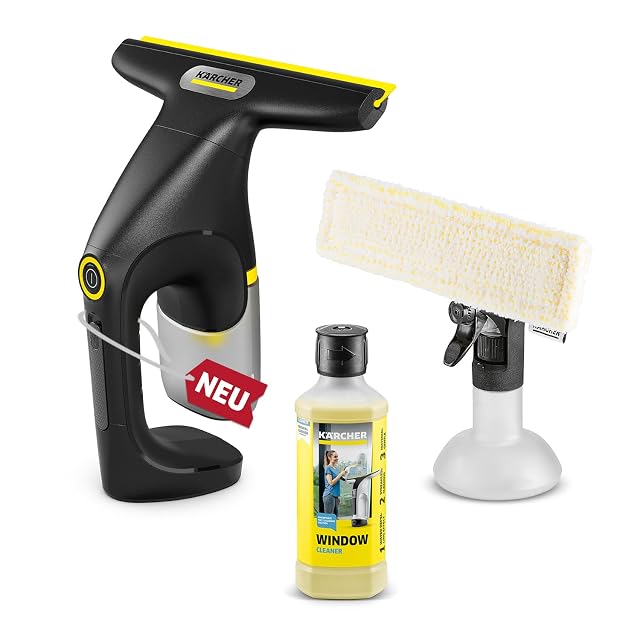
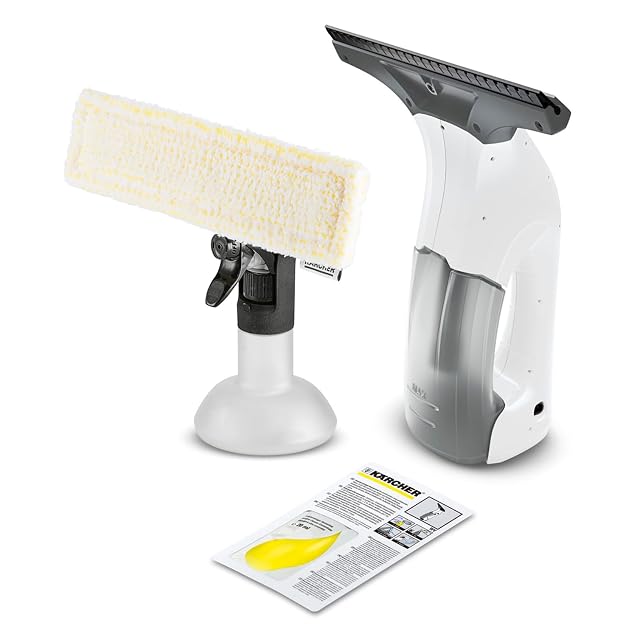
What the maker puts in writing
- “2000Pa Strong Suction & Fast Drying: …2000Pa suction power, effectively sucking up residual water and cleaning solution from glass surfaces, allowing you to clean glass, tiles, and mirrors quickly in one pass without repeated wiping.”
- “200ML Large Capacity Tank: This electric squeegee adopts removable water tank design, which is convenient to empty and clean. The 200ml large capacity avoids frequent draining work. It also comes with spray bottle and detachable washable microfiber cloth”
- “280MM Wide Cleaning Blade: Featuring 11-inch broad squeegee head, this window vacuum cleaner extends cleaning coverage”
- “Equipped with 2200mAh rechargeable battery, this electric window vacuum squeegee delivers steady power… so you can tackle multiple rooms without hassle.”
- “Effortless one-touch operation… Perfect for windows, shower doors, mirrors, countertops, tiles and car windshields”
- Title: “3-in-1… with 2200Pa Strong Suction, 2200mAh Rechargeable Battery & 200ml Water Tank” · Catalog reference field: “Window Vacuum”
Two hundred milliliters, and why that is the real specification
The tank is what stops you, and this has the biggest one here.
this — 200 ml · SOMZOKY — 150 ml · GARYOG — 150 ml · Kärcher WV 2 — “5 fl. oz.”, about 148 ml · HAUSHOF — 100 ml · ArtnPlan and Kärcher WV 1 Plus — not published
A third more than the next machine, and twice the cheapest.
That matters because the water has to go somewhere, and working wet is correct technique rather than carelessness. The Kärcher WV 1 Plus listing says so twice — “keep surfaces generously wet while cleaning” — because a dry or barely damp surface is exactly what makes a squeegee streak.
The HAUSHOF shows the squeeze from the other end: a 300 ml spray bottle feeding a 100 ml tank, so one bottle of solution is three trips to the sink.
And bullet two gets the design point right as well as the number: “removable water tank design, which is convenient to empty and clean”. A tank that comes off rinses under a tap in seconds. One that does not grows a film inside — and the water that comes out of a window vacuum is genuinely dirty, carrying whatever was on the glass plus the detergent.
In use the difference is a bathroom and a landing in one go, rather than interrupting yourself halfway through.
And then the title and the first bullet disagree
Title: “2200Pa Strong Suction”.
Bullet one: “2000Pa suction power”, twice in one sentence.
The bullet is the more detailed statement and it is also the figure the rest of this shelf publishes:
SOMZOKY — 2000 Pa · ArtnPlan — 2000 Pa · GARYOG — 2000 Pa · HAUSHOF — “2 kPa”, which is the same number · this, in the bullets — 2000 Pa
Five machines, one figure. And both Kärcher machines publish no suction figure at all.
Which is the more interesting fact. The specification five listings put in their titles is the one on which they are all identical, so it cannot be what separates them — and the brand that invented the category does not quote it.
What 2000 Pa is doing: about two per cent of atmospheric pressure, enough to hold a column of water roughly 20 centimeters high. Ample, because this is not lifting dust against gravity. It is drawing a thin film of water off flat glass through a slot pressed against the surface.
The seal does most of the work. The motor only has to move water the last few millimeters into the tank — which is precisely why Kärcher lead on how the head behaves rather than on a pascal figure. Two hundred pascals either way is nothing you could feel.
So the contradiction does not change the machine. It does tell you how carefully the page was written.
Eleven inches, and the case the listings never make
“280MM Wide Cleaning Blade: Featuring 11-inch broad squeegee head… extends cleaning coverage.”
Straightforward arithmetic: a wider blade means fewer passes.
But 280 mm (11 in) is the shelf standard, not an advantage over it — the SOMZOKY, ArtnPlan, HAUSHOF and GARYOG are all 280 mm (11 in). Neither Kärcher publishes a width.
And there is a cost nobody here mentions. A wide blade is worse on small panes. On a Georgian sash, a divided patio door or a car’s quarter-light, eleven inches will not fit inside the pane and you cannot seal into the corners.
Kärcher are the only ones on this shelf who acknowledge it: the WV 2 description offers a “separately available smaller nozzle accessory to comfortably fit narrow window panes and divided glass doors”.
Bullet five also names “tiles”, and that deserves the caution only one listing here gives. The Kärcher WV 1 Plus: “When cleaning textured tile, apply light pressure and glide slowly for an optimal vacuum seal.” A squeegee needs a flat plane to seal against, and a grout line breaks the vacuum — so a smooth tiled shower wall works, and a textured or heavily grouted one works poorly.
No blade material is given, where the HAUSHOF specifies “soft silicone… preventing scratches or stains” and the GARYOG “soft rubber”. Silicone stays supple; a blade that has hardened with age is what streaks, because it skips rather than conforming.
Twenty-two hundred milliamp-hours, and no minutes
Bullet four publishes the capacity and then only words: “delivers steady power… lowers the frequency of repeated charging”.
The shelf supplies the figure, and shows why a capacity on its own is not much use:
SOMZOKY — 2200 mAh → “45+ minutes”
GARYOG — 2200 mAh → “up to 40 minutes”
Kärcher WV 2 — 35 minutes, lithium-ion, no capacity given
HAUSHOF — 2000 mAh → “up to 30 minutes”
Kärcher WV 1 Plus — 25 minutes
this — 2200 mAh → nothing
ArtnPlan — 2200 mAh → nothing
So a 2200 mAh machine of this type runs around 40 minutes, and that is the fair expectation here.
Note the HAUSHOF line, though: 9 per cent less battery, 33 per cent less declared runtime. Both cannot follow from capacity alone, so either the motors draw differently or one claim is generous. Milliamp-hours are not runtime — and the two Kärcher listings, which publish minutes and no capacity, have it the more useful way round.
In practice any of these is enough, because the motor runs in bursts of seconds: spray, wipe, vacuum, move on.
What is in the box, and the one thing that is not
“comes with spray bottle and detachable washable microfiber cloth, making it a practical glass cleaning kit.”
That is the “3-in-1” of the title: three pieces, not three functions. The SOMZOKY, ArtnPlan and HAUSHOF all supply the same three.
And it maps exactly onto what the tool is. Every listing on this shelf describes the same sequence: spray, wipe, vacuum.
A window vacuum does not clean the glass. It removes the water. The microfibre cloth does the cleaning; the machine takes the dirty solution off before it dries into a film.
So “in one pass without repeated wiping” in bullet one applies to the third step only — one pass of the vacuum, after two passes of your hand. Which is still much faster and far less messy than chasing water with paper towels, and it is why the Kärcher listings claim “3x faster” for the whole job. It is just not a one-step machine, and the titles on this shelf do not make that clear.
What is not in the three: the cleaning solution. The bottle arrives empty.
Both Kärcher machines ship 16.9 fl. oz. of concentrated glass cleaner, and the WV 1 Plus publishes the dilution — “20 ml of cleaner on 250 ml of water”. At that rate, 500 ml of concentrate makes about 25 bottles, roughly 6.75 liters of solution. That is a real difference in the value of what arrives, and none of the five cheap listings on this shelf includes any detergent at all.
One-touch operation is worth a line, since it is the only control any of these machines has: a single switch, no suction settings, nothing to set. The HAUSHOF says the same — “a one-button switch”. On a tool with one job that is the right amount of interface.
What is not published
No weight. You hold this at arm’s length with a full tank in it, often above shoulder height, and a 200 ml tank is the heaviest load on this shelf when full. The published figures elsewhere: Kärcher WV 1 Plus 1.1 lb / 499 g · Kärcher WV 2 1.4 lb · HAUSHOF “about 1.7 lb” · ArtnPlan 907 g at the catalog · GARYOG claims 1.1 lb for the handset against a catalog figure of 1225 g that most likely covers the whole kit with its pole.
No runtime, as above.
No blade material.
No spare blade, and no statement that the blade is replaceable — it is the wear part that will end the machine’s life. Two listings here include a spare: the SOMZOKY at $45.99 (“two identical 11-inch blades — one for daily use, one as a spare”) and the GARYOG at $66.30.
No pole. Two machines here have one, both 31–40 inches: the SOMZOKY and the GARYOG. Kärcher sell one separately for the WV 2. Without a pole this reaches as far as your arm, which covers a shower screen and not a transom.
No detergent, as above.
No bottom-edge or inverted use, which is the question the cheap end of this shelf ignores. Every window has a bottom edge where the water gathers, and reaching it means working the tool sideways or upside down. The Kärcher WV 2 claims it outright — “360° Comfort!Clean technology to work sideways or completely upside down… without streaks or leaks” — and the Kärcher WV 1 Plus explains why it is hard, calling its own seal gravity-fed and telling you to turn the unit sideways for the bottom edge.
No charging time or charger type.
No warranty.
And no reference. The catalog field reads “Window Vacuum” — the product category rather than a part number. Which means there is nothing to quote if you ever need a blade or a tank for it. For comparison: WV111 on the SOMZOKY, HH25016 on the HAUSHOF, JX-EW-01 on the GARYOG, and 1.633-609.0 and 1.633-723.0 on the two Kärchers.
Availability
Read on the day this page was built: $40 at the American Amazon shop.
Read from Keepa on the day this page was last revised; stock and price both move without notice.
Prices quoted in this text were read on 2026-10-04. The live price is at the top of the page.