What the maker puts in writing
- “The powerful 2000Pa suction instantly removes water and cleaning solution, leaving your windows, mirrors, and glass surfaces dry and crystal clear in just one pass”
- “The built-in 2200mAh rechargeable battery provides ample power for your entire cleaning session, allowing you to tackle multiple rooms without the hassle of frequent recharging”
- “The Streak-free 280mm (11 in) extra-wide window vacuum squeegee blade covers more surface per swipe. Clean large glass panels, patio doors, or shower enclosures faster”
- “This cordless electric window cleaner tool includes a spray bottle, microfiber pad, and charger. Simply apply solution, wipe, and vacuum away dirt and excess water effortlessly. Its lightweight, compact design ensures comfortable, one-handed use”
- “Perfectly designed for Car windows, home Glass, Mirror, Shower doors, tiles, and counter tops”
- Reference WV-1 · Catalog: 907 g (32 oz), 279 × 279 × 320 mm (11 × 11 × 12.6 in)
Three specifications, and three other machines here have the same three
2000 Pa. 280 mm. 2200 mAh.
Those are this page’s three numbers, and they are not this machine’s numbers. Set them against the shelf:
Suction — 2000 Pa: also the SOMZOKY, the GARYOG, the HAUSHOF (as “2 kPa”, the same figure), and the Oqioprd, whose bullet says 2000 while its own title says 2200. Five of seven. Both Kärcher machines publish no suction figure at all.
Blade — 280 mm / 11 inches: also the SOMZOKY, the Oqioprd, the HAUSHOF, the GARYOG. Five of seven. Neither Kärcher publishes a width.
Battery — 2200 mAh: also the SOMZOKY, the Oqioprd, the GARYOG. Four of seven. The HAUSHOF has 2000 mAh; neither Kärcher gives a capacity.
So the five cheap machines on this shelf converge on the same three figures, and what distinguishes them is everything else — the tank, the pole, the spare blade, the detergent. On those four, this page is quiet about all of them.
Which is not an argument against buying it. It is an argument against buying it for its specification, because the specification is the shelf’s.
What 2000 Pa is actually doing
About two per cent of atmospheric pressure — enough to hold a column of water roughly 20 centimeters high.
Ample, and that is the point. A window vacuum is not lifting dust against gravity; it is drawing a thin film of water off a flat surface through a slot pressed against the glass.
The seal does most of the work. The motor only has to move water the last few millimeters into the tank, which is why the brand that invented the category does not quote a number: how well the blade sits on the glass matters more than how hard the suction pulls.
And on the blade, this page says the width and not the material — where the HAUSHOF specifies “soft silicone… gentle on surfaces, preventing scratches or stains” and the GARYOG “soft rubber”. Silicone stays supple, and a blade that has hardened is exactly what streaks, because it skips instead of conforming.
Two hundred and eighty millimeters, and when wide is wrong
“covers more surface per swipe. Clean large glass panels, patio doors, or shower enclosures faster.”
True, and simply arithmetic: the number of passes falls in proportion to the width.
But “extra-wide” is the shelf standard, not an advantage over it — five of seven machines here are 280 mm (11 in).
And there is a case the listings do not make. A wide blade is worse on small panes. On a Georgian sash, a divided patio door or a car’s quarter-light, eleven inches will not fit the pane and you cannot seal into the corners.
Kärcher are the only ones on this shelf who acknowledge it: the WV 2 description offers a “separately available smaller nozzle accessory to comfortably fit narrow window panes and divided glass doors”.
So: wide for the surfaces bullet three names, awkward for divided glass, and nothing here helps with the second case.
Twenty-two hundred milliamp-hours, and no minutes
Bullet two publishes the capacity and then describes it in words only: “ample power for your entire cleaning session… without the hassle of frequent recharging.”
The shelf supplies the missing figure, and in doing so shows why capacity alone is not much use:
SOMZOKY — 2200 mAh → “45+ minutes”
GARYOG — 2200 mAh → “up to 40 minutes”
Kärcher WV 2 — 35 minutes, lithium-ion, no capacity given
HAUSHOF — 2000 mAh → “up to 30 minutes”
Kärcher WV 1 Plus — 25 minutes
this — 2200 mAh → nothing
Oqioprd — 2200 mAh → nothing
So a 2200 mAh machine of this kind runs around 40 minutes, and that is the fair expectation here.
But look at the HAUSHOF line: 9 per cent less battery, 33 per cent less declared runtime. Both cannot follow from capacity, so either the motors draw differently or one of the claims is generous.
Milliamp-hours are not runtime. A capacity means nothing without the current the motor pulls — and the two Kärcher listings, which publish minutes and no capacity, have it the more useful way round.
Thirty to forty-five minutes is all the same enough for the job. This is a tool used in bursts: spray, wipe, vacuum, move on. The motor runs for seconds at a time.
Nine hundred and seven grams, from the catalog rather than the page
The bullets say “lightweight, compact design ensures comfortable, one-handed use” and give no figure. The catalog says 907 g (32 oz).
That is 2.0 lb, and it puts this at the heavy end of the shelf:
Kärcher WV 1 Plus — 1.1 lb / 499 g, published and consistent
GARYOG — “only 1.1 lb” claimed for the handset, against a catalog figure of 1225 g that most likely covers the whole kit including the pole
Kärcher WV 2 — 1.4 lb
HAUSHOF — “about 1.7 lb”, around 771 g
this — 907 g at the catalog, unstated on the page
SOMZOKY and Oqioprd — nothing
Weight matters on this tool for one specific reason: you hold it up at arm’s length, with a full tank of water in it, often above shoulder height. Four hundred grams between the lightest and the heaviest here is noticeable over a room of windows, and it is one reason Kärcher lead with the figure.
279 × 279 × 320 mm is the shipping box, not the tool.
What the kit is, and what it is not
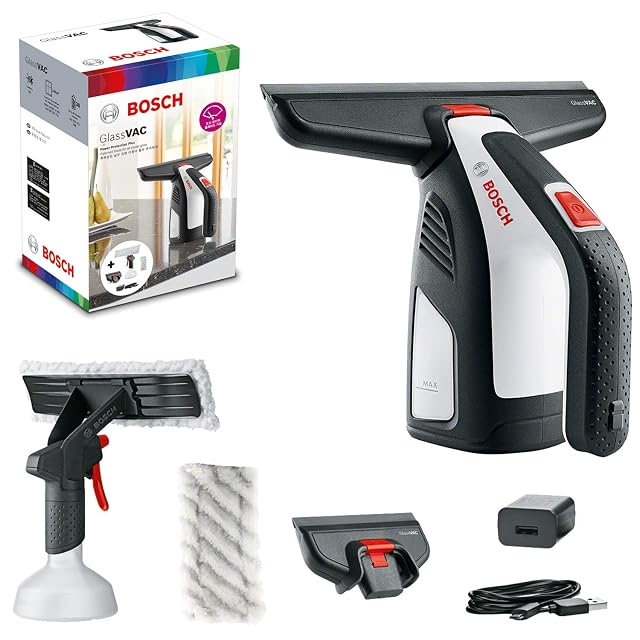
“includes a spray bottle, microfiber pad, and charger.”
That is the standard cheap-machine kit on this shelf — the SOMZOKY, Oqioprd and HAUSHOF all supply the same three things, in some order.
And it is worth being clear about what the three steps are, because the title obscures it:
“Simply apply solution, wipe, and vacuum away dirt and excess water.”
A window vacuum does not clean the glass. It removes the water. The microfibre pad does the cleaning; the machine takes the dirty solution off before it dries into a film.
So the “in just one pass” in bullet one refers to the third step only — one pass of the vacuum, after two passes of your hand. Which is still genuinely faster and cleaner than chasing water with paper towels, and it is why the Kärcher listings claim “3x faster” for the whole job. It is just not a one-step tool.
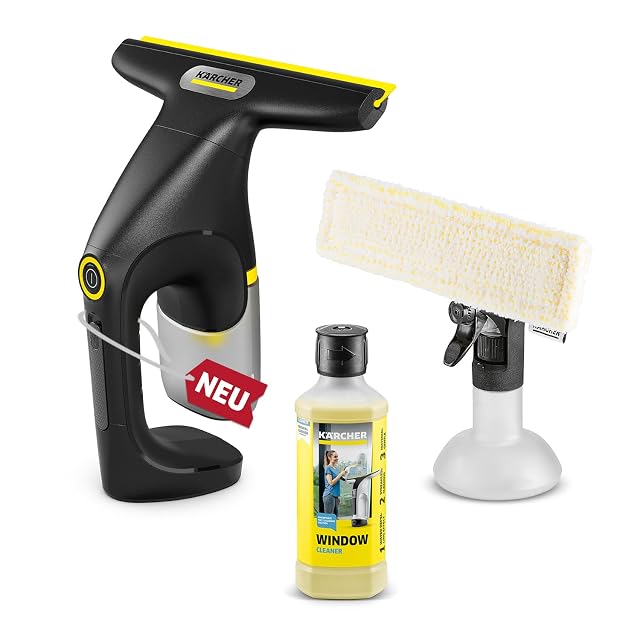
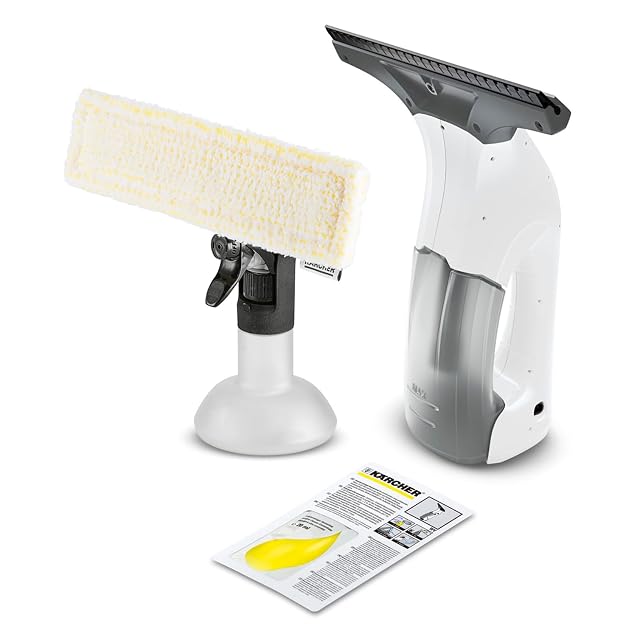
What is not in the box is the solution itself. The spray bottle arrives empty. Both Kärcher machines ship 16.9 fl. oz. of concentrated glass cleaner, and the WV 1 Plus publishes the dilution — “20 ml of cleaner on 250 ml of water” — which works out at roughly 25 bottles, about 6.75 liters of made-up solution. None of the five cheap listings here includes any detergent at all.
A note on the model code
The catalog reference is WV-1.
Kärcher’s machine on this same shelf is the WV 1 Plus, at $72.99, and Kärcher’s own part number for it is 1.633-609.0. The second Kärcher here is the WV 2 Universal, part number 1.633-723.0.
So this machine’s model code is the designation of the market leader’s product in the same category. Worth knowing when searching for spares or a replacement blade, because the two are not related and the searches will cross.
For the record, the other codes on this shelf: WV111 on the SOMZOKY, HH25016 on the HAUSHOF, JX-EW-01 on the GARYOG, and on the Oqioprd a reference field that reads “Window Vacuum” — which is the product category rather than a reference.
What is not published
No tank capacity, the only machine here to omit it — and the tank is what interrupts you. Five of the others publish one, from 100 ml to 200 ml.
No runtime, as above.
No blade material.
No spare blade, and no statement that the blade is replaceable. It is the wear part that will end the machine’s life, and two listings here include a spare: the SOMZOKY and the GARYOG.
No pole. Two machines here have one, both 31–40 inches: the SOMZOKY and the GARYOG. Kärcher sell one separately for the WV 2. Without a pole, this reaches as far as your arm.
No detergent, as above.
No weight on the page, as above.
No textured-surface caution, though bullet five names “tiles”. Only the Kärcher WV 1 Plus addresses it: “When cleaning textured tile, apply light pressure and glide slowly for an optimal vacuum seal.” A squeegee needs a flat plane to seal, and a grout line breaks the vacuum.
No bottom-edge or inverted use. This is the question the cheap end of the shelf ignores: every window has a bottom edge where the water gathers, and reaching it means working the tool sideways or upside down. The Kärcher WV 2 claims it — “360° Comfort!Clean technology to work sideways or completely upside down… without streaks or leaks” — and the Kärcher WV 1 Plus explains why it is hard, calling its own seal gravity-fed and telling you to turn the unit sideways for the bottom edge.
No charging time, and no charger type; the Kärcher WV 2 uses USB-C.
No warranty.
Availability
Read on the day this page was built: $38 at the American Amazon shop.
Read from Keepa on the day this page was last revised; stock and price both move without notice.
Prices quoted in this text were read on 2026-10-04. The live price is at the top of the page.