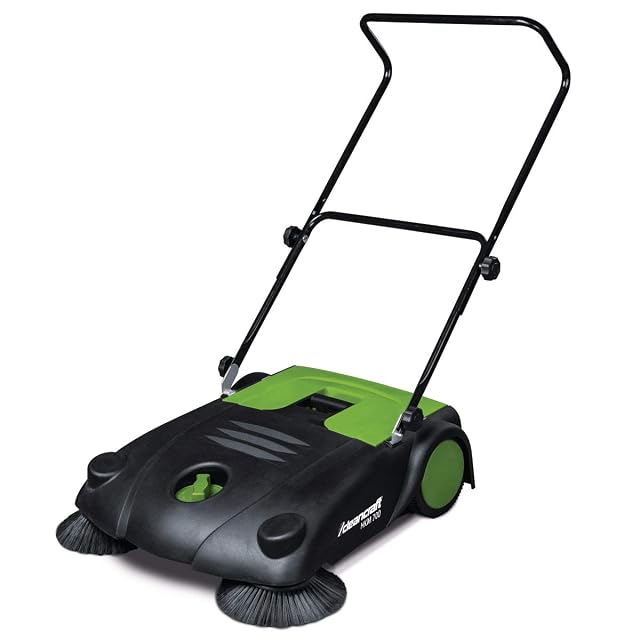
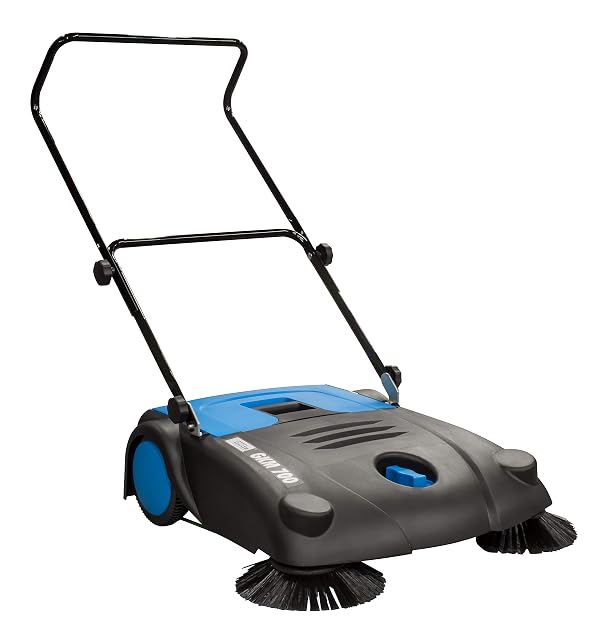
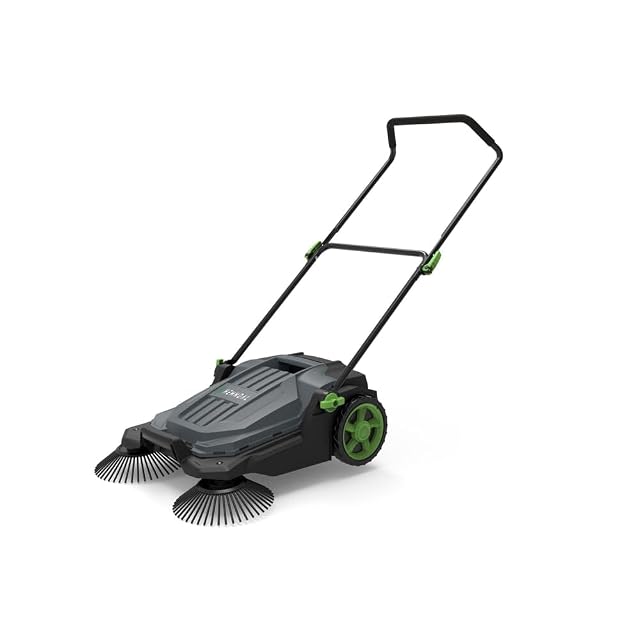
What the maker puts in writing
- “Featuring a 25.6-inch (650mm) sweeping width and high-density brushes, this walk-behind floor sweeper cleans up to 5x faster than traditional brooms. No electricity or fuel is required - clean anytime, anywhere with low maintenance”
- “Designed with large wear-resistant rear wheels and a 20.1 lbs lightweight design, this hand push floor sweeper glides smoothly around corners, edges, and uneven hard surfaces”
- “This yard path sweeper supports 2-level height and flexible angle adjustment… After use, simply fold the handle for compact storage”
- “Boasting a 5 gallons large-capacity waste container, this manual push floor sweeper can collect leaves and debris while sweeping”
- “this non-electric floor sweeper quickly collects leaves, fine particles, weeds, and other dry debris”
- Catalog: 9099 g (321 oz) · 1110 × 1060 × 650 mm (43.7 × 41.7 × 25.6 in)
The one weight on this shelf you can act on
The bullet says 20.1 lbs. The catalog says 9099 g (321 oz), which is 20.06 lb.
A tenth of a pound apart, and that makes this the only listing here where two independent figures agree.
Its sibling, the VEVOR at $72.99, publishes 9100 g (321 oz) — one gram away, as you would expect from the same machine.
Now the rest of the shelf. The IDEALHOUSE at $69.99, the Garvee at $74.99, the Garvee at $79.99 and the Garvee at $74.99 with the bag all publish 11,000 g (388 oz) — the identical figure, to the gram, across four separate listings — and not one of them states a weight in its own bullets.
Four matching catalog entries with no corroboration is a shared shipping weight, not four measurements.
The Dapper at $119.95 states “at just 20 pounds” and publishes no catalog weight. The TEXLIFT at $510 publishes neither, on a machine 43 inches wide.
So: 20.1 lb here and on the cheaper VEVOR, against a nominal 24.25 lb on the four Garvee-family listings.
Four pounds is what you feel lifting it into a car boot, hanging it on a garage hook, or carrying it down a step. On a shelf where six listings describe the same sweeper, it is one of the few differences worth deciding on.
Six hundred and fifty millimeters, which explains half this shelf
“a 25.6-inch (650mm) sweeping width.”
This is the only listing that publishes the conversion, and it unlocks the catalog data everywhere else.
650 mm is exactly 25.6 inches. So the 650 that appears in the IDEALHOUSE’s 650 × 580 × 300 mm, in the Garvee-with-bag’s 650 × 670 × 980 mm, and in both VEVOR strings is the sweeping width entered as if it were a dimension of the machine.
Which means those figures are not footprints and cannot tell you whether the sweeper fits a corner.
The two VEVOR listings publish the same three numbers in different orders — 1110 × 650 × 1059 and 1110 × 1060 × 650 — and the 1110 mm (43.7 in) length is the only plausible overall dimension published anywhere on this shelf.
One listing, the Garvee at $74.99, publishes 15 × 15 × 15 mm (0.59 × 0.59 × 0.59 in): a cube an inch and a half on a side, for a sweeper 25.6 inches wide.
For planning storage, work from 25.6 inches of width, roughly 1110 mm (43.7 in) of length, and a handle that folds.
Thirteen dollars for a sentence about weight
Set this against the VEVOR at $72.99 and the published specifications are the same machine.
Both: 25.6 inch width · 5 gallon container · two-gear or two-level handle adjustment · folding handle · non-electric · 9099 and 9100 g (321 oz).
What this listing adds in words: “high-density brushes”, the 650 mm (25.6 in) conversion, “large wear-resistant rear wheels”, and the stated 20.1 lbs.
What the cheaper one adds that this omits: a 5-step assembly process, “quality plastic and metal materials with surface paint treatment”, a hidden front wheel in its wheel description, and a longer surface list including marble and linoleum.
So two listings describe one machine from two angles, and the thirteen dollars buys the weight in print — which the cheaper sibling’s catalog figure confirms anyway.
Across all six clones at this width, the cheapest is the IDEALHOUSE at $69.99, sixteen dollars below this, with the same published specification and a nominal weight four pounds higher.
Dry debris, which is the honest boundary
“quickly collects leaves, fine particles, weeds, and other dry debris.”
That last phrase is the most useful qualification on this shelf after the TEXLIFT’s “loose debris”.
A mechanical sweeper has two side brushes flicking material inward and a roller throwing it into a hopper. So it takes what is lying free and dry on a hard surface — and the two words together bound it properly.
Dry matters because damp leaves clump and jam a roller rather than feeding into it, and wet grit smears instead of bouncing.
Weeds needs a caveat the listing does not give: a pulled weed lying on the ground is collected, a rooted weed in a paving joint is brushed over, and repeated passes wear the bristles rather than the weed.
Fine particles is a fair claim and the one a brush does better than a vacuum on rough concrete, because a bristle reaches into the surface texture where airflow skims over it.
Elsewhere on the shelf the Garvee at $79.99 claims use “on hard surfaces & lawns”, which the mechanism does not support: a fixed-height brush on soft, uneven turf either scalps the grass or rides over the tufts.
High-density brushes, and the figures nobody gives
“high-density brushes.”
An adjective, and on this shelf that is the norm rather than the exception.
Only one listing publishes the dimensions that matter. The TEXLIFT at $510 gives a “19 in main roller brush” and a side brush “Diameter: 14 in”, alongside its 43 inch width.
Those two figures answer what a width alone cannot:
Main roller length decides how much of the swept path is genuinely lifted into the hopper rather than pushed along in front of the machine.
Side brush diameter decides how far ahead of the wheels the brushes reach, which is what gets a curb edge, a wall corner, or the gap beside a garage door.
Seven listings here, this included, describe a brush system and measure none of it.
What density should mean is bristle count per unit area, and more of it does help on fine dust — at the cost of more drag, which on a hand-pushed machine you pay for directly in effort.
Two-level adjustment, and wear-resistant rear wheels
“supports 2-level height and flexible angle adjustment… simply fold the handle.”
Two positions covers most adults, and a handle at the wrong height turns a chore into a backache. Five rivals at this width publish the same two positions; the Dapper at $119.95 publishes no handle adjustment at all, which on a pushed tool is the ergonomic basic.
“large wear-resistant rear wheels… glides smoothly around corners, edges, and uneven hard surfaces.”
Wear-resistant is worth noting because the wheels do two jobs here: they carry the machine and they drive the brushes through a gear. A worn or glazed wheel slips, and a slipping wheel means brushes that turn more slowly than your pace — so the sweeping gets worse without anything appearing to be broken.
Corners and edges is where the side brushes earn their keep, reaching beyond the wheel track. And uneven hard surfaces is the hard case for any of these machines, because none except the TEXLIFT can adjust its brush height: on uneven ground a fixed brush either drags on the high spots or skims the hollows.
No power, and the rate that follows from it
“No electricity or fuel is required - clean anytime, anywhere with low maintenance.”
All eight listings make this case, and it is the real argument for the category.
No battery to degrade, which is what ends most powered garden machinery after a few years. Nothing to service. No running cost. No noise — and the alternative on a drive is a petrol blower at 95 to 105 dB.
Because the brushes are geared off the wheels, the sweeping rate is proportional to your walking pace. Which is exactly why the only two productivity figures on this shelf resolve to walking speeds: the TEXLIFT’s 39,600 ft²/h across 43 inches divides out to 1.26 mph, a slow deliberate walk.
This publishes no rate. “5x faster than traditional brooms” appears on five listings here and is not a measurement — though the arithmetic is defensible, since a broom sweeps a sixteen-inch path back and forth where this covers 25.6 inches forward only.
What is not published
No productivity rate, as above. The Dapper publishes 27,900 “ft/Hour” — which must mean square feet — and also contradicts its own width, printing 25.5 inches in its title and 21 inches in bullet two.
No brush height adjustment, which only the TEXLIFT has.
No roller or side brush dimensions.
No bin release method. The Garvee at $79.99 publishes an “easy-release & empty design”, the Dapper says its container “is easily removable and can be emptied without direct contact with the dirt” — the clearest statement on the shelf — and the TEXLIFT a “removable 14.5-gallon debris hopper”, nearly three times anything else here.
No finish or coating. The cheaper sibling publishes “surface paint treatment”; the IDEALHOUSE and two Garvee listings publish a “surface coating” for rust and corrosion resistance, which is the stronger commitment of the two on a machine that lives in a shed.
No warranty. Only the Dapper publishes one, at a year.
Availability
Read on the day this page was built: $86 at the American Amazon shop.
Read from Keepa on the day this page was last revised; stock and price both move without notice.
Prices quoted in this text were read on 2026-10-04. The live price is at the top of the page.