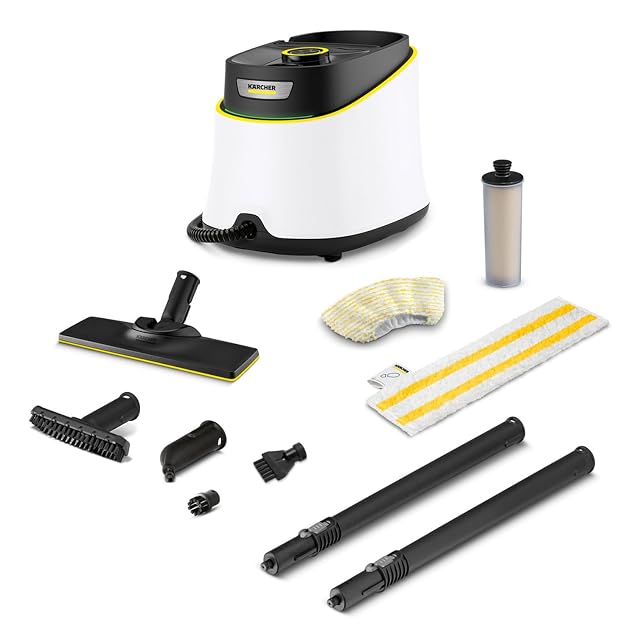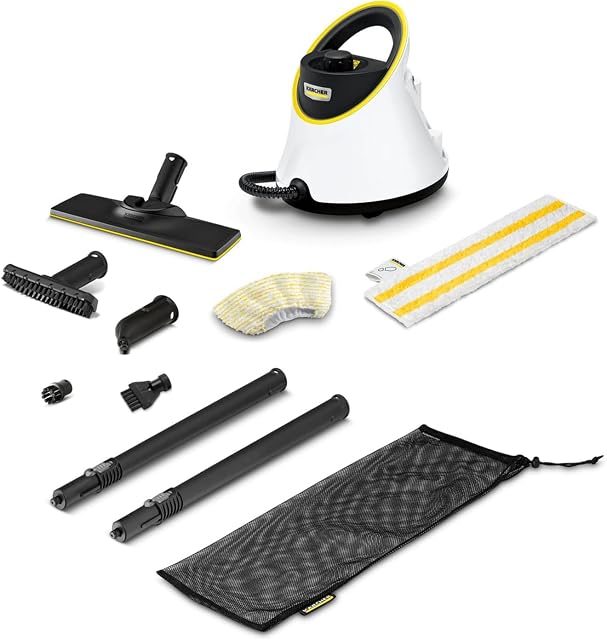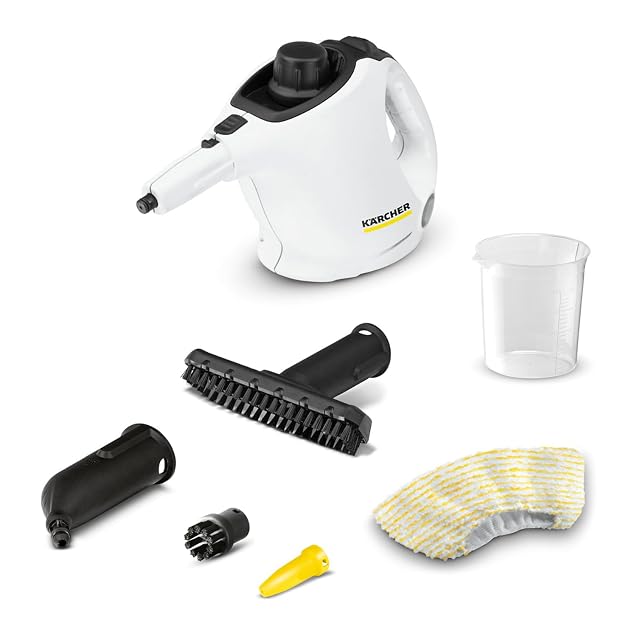
Kärcher SC 1
3 bar · 3 min heat-up · 200 ml · 1.58 kg (3.5 lb)
A handheld for taps, tiles and hobs — and honest about the twenty square meters it covers.
Best for: Taps, sinks, wall tiles, mirrors, extractor hoods and hobs — detail work, not floors
Heat instead of chemicals · review
Handle controls, 45 minutes, and the only reach figure here that checks out.
Where this ends up The only listing on this shelf whose reach arithmetic adds up, and one of only two that says the word sealed. Its two hundred and twelve degrees is exactly the boiling point of water, which is what three bar of steam cannot be.
78 inches of cord plus 78 inches of hose is 156 inches, which is 13.0 feet. The listing publishes “about 13.2 FT”.
That is the only reach arithmetic on this shelf you can check and find correct, and it is worth dwelling on because the rest do not fare as well.
McCulloch — 18 ft cord + 7 ft hose = 25 ft, correctly totalled and the longest here Mecmic — 7.6 ft hose + 8.2 ft cord, published as “up to 16 ft”, which is right ODSD — 4.98 ft hose + 6.5 ft cord = 11.5 ft, with no total offered Aspiron and HawKam — “5M power cord + 1.5M cleaning hose + 1M extension rod” covering “a diameter of 11M”. But 5 + 1.5 + 1 is 7.5 meters of radius, which is 15 meters of diameter. The eleven does not follow from anything.
The same care shows in the dimensions. The bullet says “about 9 × 6 × 7 IN” and the catalog says 234 × 157 × 183 mm (9.21 × 6.18 × 7.20 in) — which is 9.2 × 6.2 × 7.2 inches. They agree.
Compare the Mecmic, whose dimensions also match its bullet but whose catalog weight is 454 g (16 oz) — exactly one pound, for a machine with a 1.6 liter tank, where the water alone weighs 1600 g (56.4 oz).
Small consistencies, and on a shelf like this one they are the signal worth reading.
“handle mounted controls with 3 adjustable steam levels for different cleaning tasks.”
Three steam levels where you are working, and nothing to power them.
That is the middle position between two rivals at the same money, and both have a catch.
The ODSD at $49.99 also puts the controls in the nozzle — and “Requires 2 AAA batteries, not included”. A flat cell leaves you with no adjustment at all on a sealed appliance.
The Mecmic at $59.99 is the other extreme, and admirably direct about it: “Note: The steam level control is located on the main unit, not on the handle. The handle does not have a trigger.” So its steam runs continuously once on, and every change is a walk back.
This has the controls in your hand and no consumable behind them.
Three levels is the right number for the work: a low setting for upholstery and sealed wood, a middle one for worktops and glass, full output for grout and oven grease. The Mecmic offers six and maps them — “gentle sanitizing of fabric toys (Level 1–3) to blasting away tough kitchen grease (Level 4–6)” — which is more granular than most people will use.
212 °F is 100 °C, the boiling point of water at atmospheric pressure.
Steam temperature and pressure are locked together. At 1 bar, water boils at 100 °C (212 °F). At 4 bar absolute, saturated steam reaches about 144 °C (291 °F) / 291 °F.
So a machine publishing 212 °F is producing steam at essentially atmospheric pressure, whatever the “up to 3 Bar” beside it suggests.
The architecture explains it, and the listing states it plainly: this “reaches working temperature in about 15 seconds”.
Heating 1.69 quarts to boiling needs roughly a megajoule, which takes ten minutes at 1600 W. Fifteen seconds is not a tank heating up — it is a flash boiler, vaporizing a trickle of water as it passes the element. The 3 bar is the pump driving water through, not the pressure of the steam leaving the nozzle.
Two other 15-second machines here show the same mismatch:
ODSD — 221 °F at 3 bar. 221 °F corresponds to about 1.2 bar. Mecmic — 250 °F at 45 PSI. 250 °F corresponds to about 15 PSI.
The one consistent pair on this shelf belongs to the Aspiron at $149.98: 293 °F at 4 bar, which matches the steam tables — and which is a real tank boiler taking 4 to 6 minutes to come up.
None of this makes 212 °F useless. It is boiling water as vapor, it dissolves grease, and it kills what boiling water kills. It is simply not high-pressure superheated steam, and the two figures should not be read together.
1.69 quarts — 1.6 liters — giving up to 45 minutes.
Divide it out and this uses 35.6 ml a minute, which is the highest consumption on the shelf:
McCulloch — 1.89 L / 120 min = 15.8 ml/min Mecmic — 1.6 L / 60 min = 26.7 ml/min Aspiron and HawKam — 1.5 L / 50 min = 30 ml/min this — 1.6 L / 45 min = 35.6 ml/min ODSD — 1.69 QT, no runtime published
The McCulloch uses less than half as much, and it has “variable steam control” and an “optional steam lock” to explain it — a tank boiler on a low setting sips.
A flash boiler at full output does not. Which is the trade for the fifteen seconds: you start sooner and stop sooner.
Forty-five minutes is a kitchen and a bathroom, or a car interior. It is not a whole house, whatever any listing on this shelf implies — and the transparent water tank here means you can see it coming, which the integrated ABS housing bullet mentions almost in passing and which matters: running a boiler dry is how the element dies.
“suitable for compatible surfaces such as tile, grout, sealed hardwood, laminate flooring, glass, kitchen surfaces, bathroom fixtures, upholstery, carpet, furniture, mattresses, and vehicle interiors.”
That one word is the most useful caution on this shelf, and only two of eight listings give it — this and the McCulloch at $218.99, which says “a wide range of sealed surfaces”.
What it excludes:
Unsealed timber, where steam swells the fiber and raises the grain. Waxed wood, where it strips the wax. Unglazed stone and terracotta, which absorb. Unsealed grout, which erodes under repeated steaming. Laminate with open joints, where water gets under the surface layer and lifts it.
Steam does this faster than a wet cloth would, because it carries far more energy per gram than hot water — which is the whole point of the tool and also its one risk.
The safe list remains wide, and this is the longest and most specific on the shelf: twelve surface types named, including mattresses and vehicle interiors, both of which are genuinely good steam jobs because there is nothing to rinse afterwards.
Nylon brushes, brass brushes, extension tools, a glass squeegee, gloves, cleaning towels.
The shelf by count: McCulloch 23 · Aspiron and HawKam 21, fully itemized · Mecmic 18 · this 15 · ODSD 12 · This Hill itemized without a count · EurHomePlus two brush heads.
Three items here are worth separating.
Brass brushes are the aggressive option, for oven racks, grill bars and baked-on carbon. Brass is softer than steel so it cuts deposit without scoring the metal underneath — and it should stay off anything plated or painted.
A glass squeegee is the attachment most owners end up using most. Steam plus a rubber blade clears a window or a shower screen with no chemical and no streaking, and it is the job where a steam cleaner most obviously beats the alternative.
Gloves, included rather than optional, which four listings here supply. The attachments reach boiling and are changed mid-job; that is the one real burn risk in using one of these.
What is absent against the fuller kits is a floor brush and a carpet glider, both of which the Aspiron and McCulloch include. With an extension tool but no floor head, this is a detailing machine rather than a mop — consistent with its 2858 g (100.8 oz) and its nine-inch body.
No wattage. The listing publishes a heat-up time, a temperature and a pressure, and never says how much power produces them. Four rivals do: the Mecmic 2500 W — which at 120 V is 20.8 amps, more than a standard 15 A American circuit supplies — the EurHomePlus 1700 W, the ODSD 1600 W, and the This Hill 1500 W on its steam side.
No descaling or rinse function. The Mecmic is the only listing on this shelf with one: “a one-touch rinse function that clears potential clogs instantly”. Limescale in the nozzle and the boiler is what ends most steam cleaners in a hard-water area, and on a machine with no such function the answer is distilled or filtered water from the start.
No child lock, which the Aspiron and HawKam both publish.
No low-water protection, which the Mecmic publishes as a “low-water alert” and the EurHomePlus as a “surge thermostat that provides water shortage protection”. The transparent tank here is the manual version of the same safeguard.
No warranty. The Mecmic at $59.99 publishes three years and lifetime support, and is the only listing on this shelf with a term; the McCulloch says “warrantied for use only in the U.S.” without one.
Read on the day this page was built: $60 at the American Amazon shop.
Read from Keepa on the day this page was last revised; stock and price both move without notice.
Prices quoted in this text were read on 2026-10-04. The live price is at the top of the page.
| Reach | 78 in cord + 78 in hose = 13.0 ft, published as about 13.2 ft — the only sum here that works |
|---|---|
| Sealed surfaces | Names sealed hardwood and laminate specifically — one of only two listings to do so |
| Controls | Handle-mounted, with three steam levels |
| Tank | 1.69 quarts, transparent, giving up to 45 minutes |
| Heat-up | About 15 seconds |
| Temperature | 212 °F, which is exactly 1 bar — see the FAQ |
| Pressure | Up to 3 bar |
| Body | Integrated ABS, with the unit, handle and tank in one structure |
| Size | About 9 × 6 × 7 inches, and the catalog agrees at 234 × 157 × 183 mm (9.21 × 6.18 × 7.20 in) |
| Weight | 2858 g (100.8 oz) |
| Accessories | Fifteen, including nylon and brass brushes, a glass squeegee and gloves |
| Wattage | Not published |
| Warranty | Not published |
| Amazon reference | B0H7RNV3VB |
| EAN | 0726899537983 |
Because it tells you what the three bar is not. Steam temperature and pressure are locked together: at 1 bar water boils at 100 °C (212 °F) — exactly 212 °F — and at 4 bar absolute saturated steam reaches about 144 °C (291 °F) / 291 °F. So a machine publishing 212 °F is producing steam at atmospheric pressure, whatever the pressure figure beside it says. The explanation is the architecture, and the listing gives it away: this "reaches working temperature in about 15 seconds". Heating a 1.69 quart tank to boiling takes several minutes at any domestic wattage, so it is not heating the tank — it is a flash boiler, vaporizing a trickle of water as it passes the element. The 3 bar is therefore the pump pressure driving water through, not the pressure of the steam leaving the nozzle. Two other 15-second machines here do the same: the ODSD at $49.99 publishes 221 °F at 3 bar, and the Mecmic at $59.99 250 °F at 45 PSI. The only consistent pair on this shelf is the Aspiron at $149.98 — 293 °F at 4 bar — which is a genuine tank boiler taking 4 to 6 minutes.
It is the one caution that prevents damage, and only two of eight listings on this shelf give it. This publishes "sealed hardwood, laminate flooring" among its suitable surfaces; the McCulloch at $218.99 publishes "a wide range of sealed surfaces". Everybody else lists floors, tile, grout and furniture and leaves it there. What the word excludes: unsealed timber, where steam swells the fiber and raises the grain; waxed wood, where it strips the wax; unglazed stone and terracotta, which absorb; unsealed grout, which erodes; and laminate with open joints, where water gets under the surface layer and lifts it. Steam does this faster than a wet cloth would, because it carries far more energy per gram than hot water. The safe list is still wide — glazed tile, sealed grout, glass, enamel, stainless steel, upholstery, car interiors, mattresses, all of which this listing names. The point is knowing where it stops, and this is one of two pages here that tells you.
All three are 15-second flash boilers around sixty dollars, and each publishes something the others do not. This gives handle-mounted controls with three steam levels and no batteries, a verifiable 13.2 ft reach, a published 2858 g (100.8 oz) weight, dimensions that match its own bullet, a 45 minute runtime, and the word sealed. The ODSD at $49.99 gives 1600 W, 221 °F, a visible tank with a status display, and three steam levels — but the nozzle controls "require 2 AAA batteries, not included", and it publishes no runtime, no weight and no dimensions. The Mecmic at $59.99 gives six steam levels, 18 accessories, 250 °F, 16 ft of reach, a one-touch rinse against clogs, a low-water alert and a three-year warranty — and admits "the handle does not have a trigger", so steam runs continuously. So: this for a handle you control without batteries and surfaces you can trust, the Mecmic for the warranty and the descaling, the ODSD for the lowest price.
cleaning machines from the same category, at nearby prices. Only what all of them publish is shown: a column with holes compares nothing.
| Model | Price | Reach | Temperature | Warranty |
|---|---|---|---|---|
| Gautye Steam Cleaner | $60 | 78 in cord + 78 in hose = 13.0 ft, published as about 13.2 ft — the only sum here that works | 212 °F, which is exactly 1 bar — see the FAQ | Not published |
| Mecmic STEAM CLEANER | $60 | 7.6 ft hose + 8.2 ft cord = up to 16 ft, plus an extension rod | 250 °F at a stated 45 PSI, which do not match as saturated steam | Three years with lifetime support — the only warranty on this shelf |
| ODSD 40SC-920 | $50 | 4.98 ft hose + 6.5 ft cord = about 11.5 feet, the shortest here | 221 °F, which does not match 3 bar — see the FAQ | Not published |
| EurHomePlus 1700W | $110 | Not published — neither hose nor cord | NOT PUBLISHED — the only listing here without one | Not published |
Details checked on October 4, 2026.
Grout, glass and worktops in a flat, where fifteen seconds beats twelve minutes
Amazon reports what buyers took in the month before this page was last checked: at least 4,000.
The figure is a floor, rounded by Amazon, and read through Keepa — it says what buyers picked, not what a maker claims.
Specifications: the manufacturer sheet for cleaning machines and the matching Amazon product page. Prices and availability: Keepa. Every figure on this page names its source.
3 bar · 3 min heat-up · 200 ml · 1.58 kg (3.5 lb)
A handheld for taps, tiles and hobs — and honest about the twenty square meters it covers.
Best for: Taps, sinks, wall tiles, mirrors, extractor hoods and hobs — detail work, not floors
3.5 bar · 30 s heat-up · 1 l refillable tank · 1,900 W
The one that refills like a kettle: thirty seconds to steam and no waiting for a boiler to cool.
Best for: Kitchens and bathrooms cleaned regularly, where the machine is picked up for twenty minutes at a time
3.2 bar · 6.5 min heat-up · 1 l tank · 1,500 W
The same coverage as the SC 3 for less money, and six and a half minutes of waiting to get there.
Best for: Planned cleaning sessions rather than quick jobs — where a six-minute wait is acceptable because you were going to be there an hour anyway