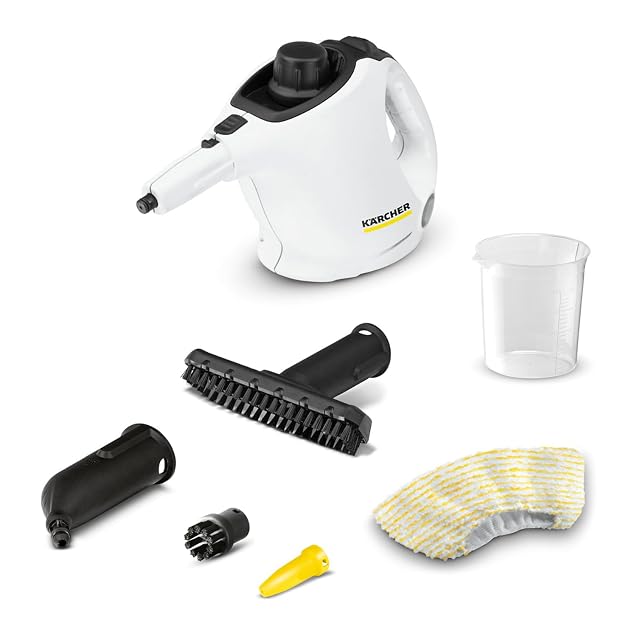
Kärcher SC 1
3 bar · 3 min heat-up · 200 ml · 1.58 kg (3.5 lb)
A handheld for taps, tiles and hobs — and honest about the twenty square meters it covers.
Best for: Taps, sinks, wall tiles, mirrors, extractor hoods and hobs — detail work, not floors
Heat instead of chemicals · review
Cold water, hot water or steam from one machine, at 1700 watts.
Where this ends up A hundred and ten dollars for three modes — cold water, hot water or steam — which nothing else on this shelf offers. It publishes its pressure in pascals, where three and a half pascals would not move a grain of dust.
“can reach a pressure of 3-3.5 Pa.”
A pascal is a very small unit. Atmospheric pressure is 101,325 Pa, so three and a half pascals is the pressure of air moving gently across a room. It would not lift a grain of dust, let alone cut kitchen grease.
The intended unit is almost certainly bar, and read that way the figure becomes ordinary and plausible: 3 to 3.5 bar is 43.5 to 50 PSI, which sits squarely among the rest of this shelf.
Aspiron, HawKam and McCulloch — 4 bar, the McCulloch helpfully giving both units as “4 bar (58 PSI)” ODSD and Gautye — 3 bar Mecmic — 45 PSI this — 3 to 3.5, unit unclear
So on pressure this machine is probably unremarkable rather than exceptional.
What makes the slip worth dwelling on is what sits beside it: this is the only listing on the shelf that publishes no temperature at all, on a product titled “High Heat Steam Cleaner” whose first bullet is headed “High-Temperature Steam”.
Two headline claims, and neither is given a number you can use.
For reference, what the others publish: Aspiron and HawKam 293 °F · Mecmic 250 °F · ODSD 221 °F · Gautye 212 °F · McCulloch “over 200ºF”.
“This high pressure steamer can adjust cold water, hot water or steam.”
This is the genuine reason to consider the machine, and it follows directly from the jobs it names.
Steam loosens grease and leaves it on the surface as a softened film. On a worktop you wipe that off with a cloth and the job is done.
But inside a kitchen extractor hood, or around a car engine — the two uses this listing leads with — there is nowhere to wipe. You need to flush the loosened deposit out, and a steam-only machine cannot.
A unit that switches to a cold or hot water jet does the loosening and the rinsing in one session, without changing tools.
Everything else on this shelf is steam only. The nearest comparison is the This Hill at $269.99, which puts a 1500 W steamer and a 3000 PSI electric pressure washer in one body — a far more capable version of the same idea at two and a half times the price, and with GFCI protection published, which this does not have.
Two cautions this listing omits. Water near an engine bay needs the electrical connectors, the alternator and the air intake covered first. And an extractor hood should be isolated at the wall before anything wet goes near it.
The “360 degrees” claim in the first bullet means the unit works at any angle without the pickup tube losing contact with the water — useful when you are reaching up into a hood, and the sort of thing only a handheld needs to say.
“The nylon brush head is suitable for scrubbing the shell, and the wire brush head is suitable for scrubbing the grease stains inside the hood.”
A real distinction, clearly stated, and the listing is better here than anywhere else on the page.
Nylon flexes and cleans without marking — correct for a painted or stainless exterior.
Wire cuts hardened deposit and will scratch anything polished, which is exactly why it is assigned to the inside of a hood, where the baffles and filter housing carry carbonized grease that nothing softer will shift.
Two warnings the listing does not give.
A wire brush on stainless steel leaves fine scratches that then collect dirt, so keep it off anything you look at.
And if the bristles are steel rather than brass, loose particles left on aluminum will corrode it later. Which is why both the Gautye at $59.97 and the Aspiron at $149.98 supply brass brushes — brass being softer than most of what you clean, so it cuts deposit without scoring the metal underneath.
Two heads is also the smallest accessory count on this shelf by a wide margin:
McCulloch 23 · Aspiron and HawKam 21, fully itemized · Mecmic 18 · Gautye 15 · ODSD 12 · This Hill itemized without a count · this 2
No glass squeegee, no floor head, no extension tube, no gloves. On a machine whose attachments reach above boiling and get changed mid-job, gloves are the omission worth noting — four listings here include them.
“equipped with a surge thermostat that provides water shortage protection, making it more durable and longer-lasting.”
Running a boiler dry is how the element burns out, and it is the easiest mistake to make on a machine that publishes no tank capacity and no runtime — because you have no way of knowing how long you have.
A thermostat that cuts the heater when the water runs low is the right safeguard, and three listings here address the same risk differently:
this — a surge thermostat with water shortage protection Mecmic, $59.99 — a “low-water alert” ODSD, $49.99 and Gautye, $59.97 — a transparent tank, which is the manual version: you look
The Aspiron and HawKam address the opposite risk instead, with a system that “will directly release the steam when the steam pressure in the boiler is too high”.
And the adjustable steam volume is worth having, with the right reason given: “You can adjust the steam to different volumes according to the different things you will be cleaning. This will protect your things from damage and also can achieve the purpose of cleaning.”
That is the honest argument for a variable setting — a lower output for upholstery or sealed wood, full output for an oven. Though “the knob inside the box” suggests it is on the body rather than the handle, as on the Mecmic, whose own note says “the handle does not have a trigger”.
No temperature, as above — the single figure a steam cleaner most needs, absent from the one listing here titled “High Heat”.
No tank capacity. Five rivals publish one: the McCulloch 64 oz, the Mecmic 1600 ml, the Aspiron and HawKam 50.7 oz, the ODSD and Gautye 1.69 quarts.
No runtime. Four publish one — McCulloch 120 minutes, Mecmic 60, Aspiron and HawKam 50, Gautye 45 — and from tank and runtime together you can work out consumption, which ranges from 15.8 ml a minute on the McCulloch to 35.6 on the Gautye.
No heat-up time. This is the figure that reveals the architecture everywhere else on this shelf: the McCulloch takes “under 12 minutes” and the Aspiron pair 4 to 6, because they pressurize a whole tank; the ODSD, Gautye and Mecmic all claim 15 seconds, which means they are flash boilers vaporizing a trickle on demand. At 1700 W and this size, this is very likely the second kind — but the listing does not say.
No reach. Neither hose nor cord length, where the McCulloch publishes 25 feet, the Mecmic 16, the Gautye 13.2 and the ODSD 11.5.
No weight, though the catalog dimensions of 236 × 185 × 236 mm describe a cube about nine inches on a side — comparable to the Gautye at “about 9 × 6 × 7 IN” and 2858 g.
No sealed-surface warning, which only the McCulloch and Gautye give. Steam on unsealed timber or unglazed stone drives hot water into the material, and that is the one way these machines do damage.
No warranty, where the Mecmic at $59.99 publishes three years.
Read on the day this page was built: $110 at the American Amazon shop.
Read from Keepa on the day this page was last revised; stock and price both move without notice.
Prices quoted in this text were read on 2026-10-04. The live price is at the top of the page.
| Three modes | Cold water, hot water OR steam — the only machine here that does all three |
|---|---|
| Heater | 1700 W |
| Stated pressure | 3 to 3.5 Pa — which must mean bar, see the FAQ |
| Steam volume | Adjustable by a knob inside the box |
| Brush heads | Two — nylon for shells, wire for grease inside an extractor hood |
| Protection | A surge thermostat providing water shortage protection |
| Stated uses | Kitchen grease, refrigerators, air conditioners, car engines |
| Dimensions | 236 × 185 × 236 mm (9.29 × 7.28 × 9.29 in) |
| Temperature | NOT PUBLISHED — the only listing here without one |
| Tank capacity | Not published |
| Runtime | Not published |
| Reach | Not published — neither hose nor cord |
| Warranty | Not published |
| Amazon reference | B0D8S3TSKL |
| EAN | 0764909311888 |
No — that figure is out by a factor of about a hundred thousand, and the intended unit is almost certainly bar. The bullet reads: "This 1700w portable steamer can reach a pressure of 3-3.5 Pa." A pascal is a very small unit: atmospheric pressure is 101,325 Pa, so 3.5 Pa is the pressure of a light draft and would not move a grain of dust, let alone cut kitchen grease. Read as 3 to 3.5 bar, it becomes 43.5 to 50 PSI, which puts it squarely in the range the rest of this shelf occupies: the ODSD and Gautye publish 3 bar, the Mecmic 45 PSI, and the Aspiron, HawKam and McCulloch all 4 bar — the McCulloch helpfully giving both units, "4 bar (58 PSI)". So the machine is probably ordinary rather than remarkable on pressure. What makes the slip worth noting is what sits beside it: this is also the only listing on the shelf that publishes no temperature at all, on a product whose title is "High Heat" and whose first bullet is "High-Temperature Steam". Two claims, neither quantified correctly.
The ability to rinse, which no other machine on this shelf can do — and on the jobs this listing names, that is the point. The bullet publishes: "This high pressure steamer can adjust cold water, hot water or steam. You can choose the right mode according to your cleaning needs." Why it matters: steam loosens grease and leaves it on the surface as a softened film. On a worktop you wipe that away with a cloth. But inside a kitchen extractor hood or around a car engine — the two uses the listing names — there is nowhere to wipe, and you want to flush the loosened deposit out. A machine that switches from steam to a cold or hot water jet does the loosening and the rinsing in one session. Everything else on this shelf is steam only, and the nearest comparison is the This Hill at $269.99, which pairs a 1500 W steamer with a 3000 PSI pressure washer in one body — a far more capable version of the same idea at two and a half times the price. The caution on both: water near an engine bay or an electrical fitting needs the connectors covered.
Baked-on grease inside an extractor hood, and the listing is unusually specific: "The nylon brush head is suitable for scrubbing the shell, and the wire brush head is suitable for scrubbing the grease stains inside the hood." That is a real distinction. Nylon flexes and cleans without marking — right for a painted or stainless exterior. A wire brush cuts hardened deposit and will scratch anything polished, which is why it is named for the inside of a hood, where the baffles and the filter housing carry carbonized grease that nothing softer shifts. Two cautions the listing does not give. A wire brush on stainless steel leaves fine scratches that then hold dirt, so keep it off visible surfaces. And if the bristles are steel rather than brass, they can leave particles on aluminum that corrode later — the Gautye at $59.97 and the Aspiron at $149.98 both supply brass brushes for that reason, brass being softer than most of what you clean. Two heads is also the smallest accessory count on this shelf, against 23 on the McCulloch and 21 on the Aspiron.
cleaning machines from the same category, at nearby prices. Only what all of them publish is shown: a column with holes compares nothing.
| Model | Price | Warranty |
|---|---|---|
| EurHomePlus 1700W | $110 | Not published |
| Aspiron CA019 | $150 | Not published |
| Gautye Steam Cleaner | $60 | Not published |
| Mecmic STEAM CLEANER | $60 | Three years with lifetime support — the only warranty on this shelf |
Details checked on October 4, 2026.
A kitchen extractor hood and an engine bay, where rinsing matters as much as steaming
Specifications: the manufacturer sheet for cleaning machines and the matching Amazon product page. Prices and availability: Keepa. Every figure on this page names its source.
3 bar · 3 min heat-up · 200 ml · 1.58 kg (3.5 lb)
A handheld for taps, tiles and hobs — and honest about the twenty square meters it covers.
Best for: Taps, sinks, wall tiles, mirrors, extractor hoods and hobs — detail work, not floors
3.5 bar · 30 s heat-up · 1 l refillable tank · 1,900 W
The one that refills like a kettle: thirty seconds to steam and no waiting for a boiler to cool.
Best for: Kitchens and bathrooms cleaned regularly, where the machine is picked up for twenty minutes at a time
3.2 bar · 6.5 min heat-up · 1 l tank · 1,500 W
The same coverage as the SC 3 for less money, and six and a half minutes of waiting to get there.
Best for: Planned cleaning sessions rather than quick jobs — where a six-minute wait is acceptable because you were going to be there an hour anyway