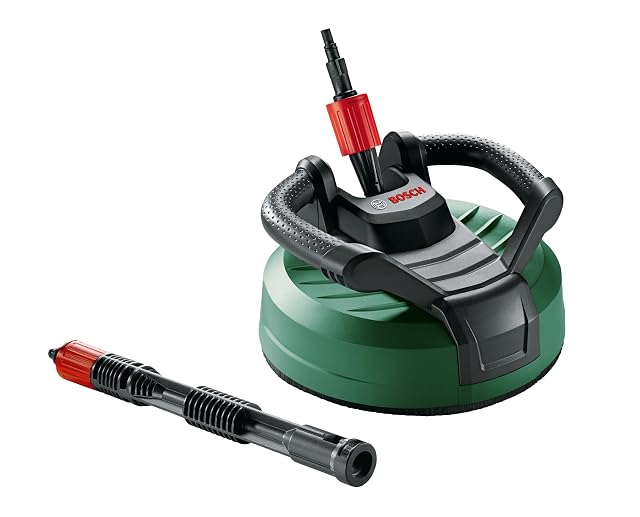
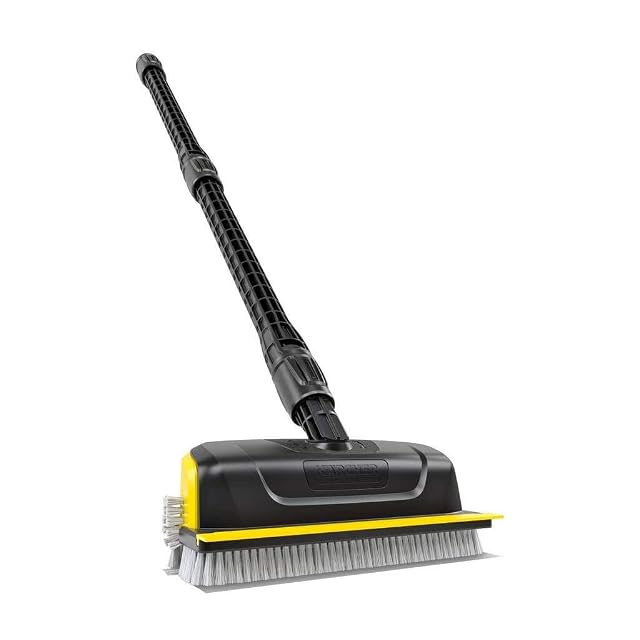
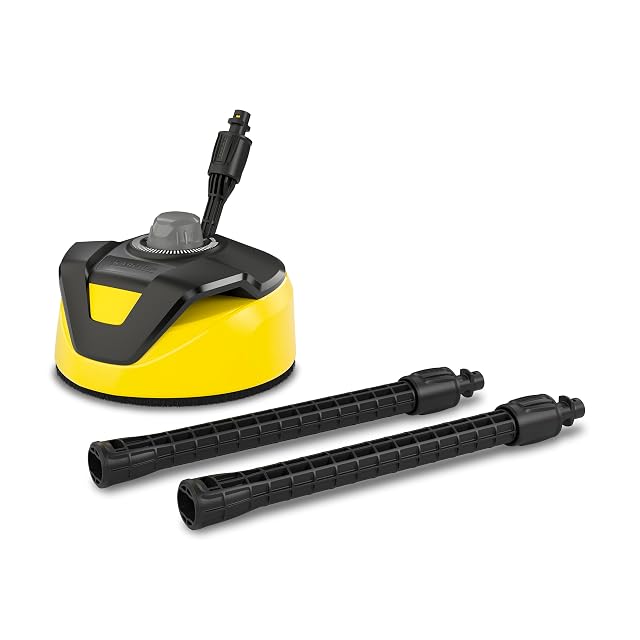
What the maker puts in writing
- “Achieve Professional-Level Cleaning Results with This 16.5” Surface Cleaner, with Up To 4400 PSI of Pressure for Easy Cleaning of Flat Surfaces Like Decks, Patios, Driveways, Walls and More”
- “Seamlessly Switch Between Attachments with 1/4” Quick-Connect Fitting, Compatible with Most Gas and Electric Pressure Washers”
- “Get Powerful Cleaning with This Durable Stainless Steel 16.5 inch Surface Cleaner”
- “This Product is Backed by a 180-Day Limited Warranty”
- Description: “ideal for powerful cleaning of various surface materials like brick, wood, concrete, and more… will make quick work of large, flat areas both horizontally and vertically”
- Catalog: 419 × 419 × 102 mm (16.5 × 16.5 × 4.02 in)
Four thousand four hundred PSI, which is the highest ceiling here
If you own a large gas washer, this is the reason to look at this listing.
The shelf’s ceilings:
Westinghouse 16.5” — 4400 PSI
JANZ, TOR, JaxonBilt, Simpson — 4000
Westinghouse 15” — 3400
Kärcher, Hiclean — 3200
Westinghouse 12” — 3000
MEKOH — “2000+”
both Greenworks — nothing published
So a 3600 to 4400 PSI machine narrows your choice to this and the 4000 PSI group, and rules the rest out.
What the rating does not do is make it clean better on a smaller machine, and the reasoning is worth following. A surface cleaner has no motor: its two nozzles sit on a swivel and are driven by the water leaving them, in reaction. A head built to survive 4400 PSI needs heavier bearings and a stiffer swivel, and heavy internals turn slowly when fed a modest flow.
That is exactly the argument the Hiclean 12” makes about its own electric-only design: other models “compromise performance in order to also be compatible with gas pressure washers.”
And this listing publishes no minimum — where its own cheaper 15-inch sibling publishes “minimum of 2500 PSI”, the Simpson 16.5” publishes “minimum 2000 PSI and 2.5 GPM”, and the Kärcher publishes a 2600–3200 window.
On a 2000 PSI electric washer, a 16.5-inch head with a 4400 PSI bearing is the wrong tool, and nothing on this page tells you that.
Stainless steel, and the one head that argues against it
Stainless puts this with the JANZ, TOR, JaxonBilt and Simpson — five of twelve. The TOR makes the case: “Unlike cheap plastic or thin aluminum competitors.”
The counter-argument comes from the top of the shelf and deserves a hearing. The MEKOH 20” at $209.99 is built from “PP material, solid brass and fully sealed bearing”, and claims what the steel heads cannot: “great heat and chemical resistance. Cold water, hot water, even soap water are all available.”
Meanwhile the Simpson, in stainless, publishes the opposite: “Surface cleaner is only for cold water use; max temp 140° F.”
So for cold-water domestic use at high pressure, stainless is the right material — stiffer, heavier, and it will not craze at the swivel. For hot water or strong detergents, it is not, and this listing publishes no temperature limit either way.
The Hiclean 12” splits it sensibly by putting metal only where the load is: an “all-metal rotating spinner” in an otherwise light body.
Sixteen and a half inches, and what that demands
The second widest head on this shelf, behind the MEKOH’s 20 inches.
Eight listings here state a jet count and all eight say two. Nobody publishes three.
So at equal flow, a wider head spreads the same water over a bigger circle — energy per square inch falls as the disc grows. Wider is not stronger. Wider needs more flow.
The shelf follows that pattern exactly. The three 12-inch heads are the electric ones: the Westinghouse 12” states “not intended for use with gas units”, the Hiclean that it is “exclusively for electric”. The 20-inch MEKOH sets a floor of “2000+ PSI & 2+ GPM”.
Which makes the absence of a flow figure here the real gap. The Simpson 16.5” — the direct comparison — publishes “2.5 GPM up to a maximum of 4 GPM”, so you know what it takes to feed 16.5 inches properly.
Five listings publish GPM: JANZ 1.8–3.7 · Simpson 2.5–4 · Kärcher up to 2.7 · Westinghouse 12” max 2.3 · MEKOH 2+.
Horizontal and vertical, on brick and wood
“will make quick work of large, flat areas both horizontally and vertically”, on “brick, wood, concrete, and more”.
Five listings mention vertical work, and the other four all publish a weight light enough to justify it: the Westinghouse 12” at a stated two pounds, the Westinghouse 15” at four, the Kärcher at 1724 g (60.8 oz).
This publishes no weight at all, which leaves the claim unanchored. A 16.5-inch stainless head is unlikely to be light — the Simpson 16.5”, also stainless, is 5375 g (189.6 oz), and the 14-inch stainless heads from JANZ and JaxonBilt are 3175 g (112 oz).
Nobody holds twelve pounds against a wall for long.
And one caution no listing here raises: used vertically there are no wheels on the wall. The whole anti-streak mechanism is wheels holding the nozzles at a fixed distance from the surface, and against brickwork you hold that distance by hand.
The surfaces named are right, though, and worth understanding. A bare wand concentrates everything into one jet that dwells wherever you hesitate, which is how people carve grooves into decking. A surface cleaner holds two nozzles at a fixed height and spins them, so nothing dwells — which is why wood appears on this list at all.
A hundred and eighty days
Three listings on this shelf publish a warranty. Both Greenworks heads give “3 YEAR WARRANTY”; this gives 180 days. Nine give nothing.
What fails is the bearing and the swivel seal — the rotating joint feeding high-pressure water into a moving arm. When the seal hardens it leaks upward at the operator.
Three listings advertise that part: a “heavy-duty bearing” on the JANZ, “heavy-duty bearings” on the TOR, a “fully sealed bearing” on the MEKOH claimed to “prevent leaking and blocking”. The Hiclean names the other half: plastic spinners “often break”.
Six months is thin cover for a component that typically fails after a season or two. It is still more than at least nine of the seventeen listings here offer.
What is not published
No minimum pressure, as above — the figure that decides whether the head spins at all.
No flow figure, as above.
No jet count, where eight listings state one.
No wheel count. Four listings publish four (JANZ, TOR, JaxonBilt, MEKOH) and the Hiclean three. Wheels are what hold the nozzle height constant, which is the anti-streak mechanism — so for a listing claiming professional results, saying nothing about them is an odd omission.
No weight, as above.
No skirt or shroud described. The Kärcher names both; the Simpson names a “stainless steel shroud” that “helps to prevent overspray”; the JANZ, TOR and Westinghouse 12” each name a skirt. Overspray is what puts grit on your car.
No inlet filter, which the JANZ and TOR have — and whose absence the Simpson concedes by shipping a nozzle cleaning tool with the note that “naturally-occurring buildup can gather in the nozzles over time”.
No accessories, where the JANZ ships seven items including two spare nozzles, the TOR five, and the JaxonBilt two extension wands.
No maximum water temperature.
Availability
Read on the day this page was built: $90 at the American Amazon shop.
Read from Keepa on the day this page was last revised; stock and price both move without notice.
Prices quoted in this text were read on 2026-10-04. The live price is at the top of the page.