What the maker puts in writing
- “Not suitable for boilers, stoves, hot ash or embers. Ashes must be cooled before vacuuming. If safety limits are exceeded, temperature control protection is activated”
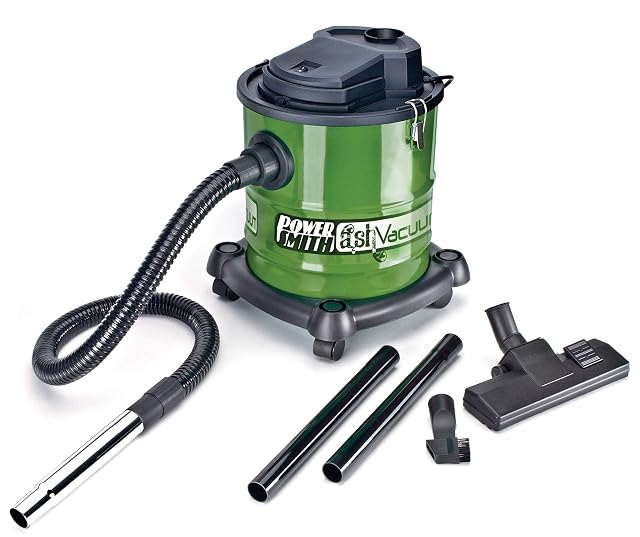
- “With 1200W powerful suction power, this green ash vacuum cleaner easily sucks both fine and coarse dirt… By connecting the hose to the outlet, the ash vacuum for fireplaces also becomes a blower”
- “The collection container is made of robust aluminum… With a capacity of up to 20 liters… Thanks to its quick fasteners, the container can be easily emptied and cleaned”
- “The combination of a washable HEPA fine filter and a bag filter captures even the finest particles… Even during heavy use and with large amounts of ash, the bag filter prevents the pleated filter from clogging. The HEPA fine filter is specifically designed for ash removal and protects the engine”
- “three swivel wheels and a carrying handle… a 2m (7 ft) power cord and a 1.5m (5 ft) suction hose for a working radius of 3.5m (11 ft). All accessories are inserted into the grooves of the base”
- Catalog: 4672 g (164.8 oz) · Reference BJ131
The only listing that bans hot ash in plain words
“Not suitable for boilers, stoves, hot ash or embers. Ashes must be cooled before vacuuming.”
No figure, no margin, no hedge — and across twelve listings this is the version worth following.
What the others say. Both PowerSmith listings claim “warm and cool ash” and publish no limit at all. The ApexPower offers “both cold and warm ash” then requires “below 104℉/40℃”. The BACOENG writes “both warm (ash below 104F (40°C (104 °F))) and cool”.
Those last two cancel themselves. Forty degrees is barely above body temperature. Ash at 40 °C (104 °F) is cold ash, so a warm-ash capability capped at 40 °C (104 °F) is not a capability.
Both SIPPON listings and the DEWALT give the 40 °C (104 °F) figure honestly and claim nothing extra. Both VEVOR listings say “dry ash after the fire is fully extinguished”.
This listing goes one step further than any of them, and the step matters: it rules out boilers and stoves as sources, not just hot ash. A stove shut down an hour ago still has hot internal surfaces and residual draft, and the ash at the front of the bed tells you nothing about the ash at the back.
And it backs the rule with a mechanism: “If safety limits are exceeded, temperature control protection is activated.” Only the BACOENG, with its “10-Amp motor with heating protection”, publishes anything comparable.
The clearest explanation of two-stage filtration on the shelf
“the bag filter prevents the pleated filter from clogging. The HEPA fine filter is specifically designed for ash removal and protects the engine.”
Almost every listing here has two stages. This is the one that says what they are for.
Wood ash is fine, light and abrasive. Put straight onto a pleated element it packs into the folds within minutes: airflow collapses, the motor gets loud, the nozzle stops picking anything up. That is the experience of using a shop vacuum on a fireplace, and it is the entire reason this category exists.
A coarse bag in front takes the bulk. The HEPA behind it then only handles what is genuinely fine — and, as the listing notes, protects the motor, which is downstream of everything.
Both elements are reusable after cleaning, so a winter costs nothing in consumables.
The one thing left unaddressed is drying time: a washed HEPA needs hours before it is safe to refit, and only the PowerSmith PAVC102 (two filters supplied) and the ApexPower (“one operates while the other is cleaned or air-dried”) solve it.
Twenty liters of aluminum, with quick fasteners
20 liters, robust aluminum, quick fasteners for emptying.
Twenty liters is 5.28 US gallons, which matches the 5.2-gallon title — one of only three capacity figures on this shelf you can take at face value.
The reason that is worth saying: the PowerSmith PAVC101 is the only listing here that separates drum from ash, and the gap is large — “Canister Size: 5.2 Gallons, Canister Ash Capacity: 3 Gallons”, because the filter assembly fills the top. Eight of twelve listings publish a bare gallon number with no indication which they mean. This one publishes a liter figure that is internally consistent, as do the Snow Joe (“4.8 gallons of ashes”) and the PAVC102 (“4 gallon Ash capacity”).
Aluminum rather than steel is an unusual choice and a defensible one: lighter, and it will not rust where an abrasive alkaline powder sits for eight months of the year. What it gives up is the sheer mass of a steel drum — and at 4672 g this is mid-weight on a shelf running from 2722 g to 6713 g.
Quick fasteners are the small thing that decides whether you empty it outdoors or over a bin in the kitchen.
Three and a half meters, which is the weak point
“a 2m power cord and a 1.5m suction hose for a working radius of 3.5m.”
That is about 11.5 feet, and it is near the bottom of the shelf:
BACOENG 15 ft + 5 ft = 20 ft · VEVOR 5.3 gallon 18 ft · PowerSmith PAVC101 a 16 ft cord · DEWALT a stated 12 ft · VEVOR 4 gallon 12 ft · this 11.5 ft · Snow Joe a 3.9 ft hose
A two-meter mains cord is short for any floor appliance. It means a socket in the same wall as the fireplace, or an extension lead.
Its own same-reference twin publishes a 157-inch cord — 3.99 m (13 ft), exactly twice this — which is one of four places the two listings disagree.
What softens it is the three swivel wheels and a carrying handle: the machine follows easily on a hard floor, and the attachments store “in the grooves of the base, just above the wheels”, so nothing is hunting for a nozzle next November.
Two listings, one reference, four disagreements
Both VANPORE listings here are $102.99, both titled 5.2 Gallon, both 1200W, both reference BJ131. And they publish:
Warm ash — this: “not suitable for… hot ash or embers”. The twin: “compatible with both warm and cool ash”.
Materials — this: “robust aluminum” container. The twin: “pure copper motor”, container material unstated.
Cord — this: 2 m, radius 3.5 m. The twin: 157 inches, which is 3.99 m.
Weight — this: 4672 g, no dimensions. The twin: 3992 g, 300 × 300 × 378 mm.
Six hundred and eighty grams apart on the same reference, with a cord of half the length and opposite advice on the one question that could start a fire.
The practical conclusion: buy the listing whose warning you intend to obey. This is the one that carries the stricter rule in writing.
What is not published
No suction figure. The 1200 W is input power — on 120 V mains the same as the “10 Amp” both PowerSmiths publish. Only the ApexPower publishes pressure, at 10,000 Pa, and only the Snow Joe separates input from output (“5 Amp motor generates up to 500 W of suction power”). The DEWALT’s “4 HP” is 2983 W and cannot come from a domestic socket at all.
No noise figure. Two listings give one: PowerSmith 79 dB called “quiet”, ApexPower 60 dB called “whisper-quiet”. Nineteen decibels is roughly eight times the sound pressure.
No dimensions, where its twin publishes 300 × 300 × 378 mm.
No flame rating for the filter, which only the SIPPON pair and the BACOENG publish — and the element is the one part of the ash path that is not metal.
No fill indicator, which only the BACOENG has.
No certification named, where the ApexPower publishes CE, CB and GS and the Snow Joe publishes ETL.
Availability
Read on the day this page was built: $105 at the American Amazon shop.
Read from Keepa on the day this page was last revised; stock and price both move without notice.
Prices quoted in this text were read on 2026-10-04. The live price is at the top of the page.