What the maker puts in writing
- “Heat-resistant hose & 5.2 gallon pellet stove vacuum (Model: BJ131) with flame-resistant filters are compatible with both warm and cool ash”
- “The BBQ ash vacuum cleaner’s pure copper motor provides a strong 1200W suction, doubling the power of other ash vacs”
- “Its durable, heat-resistant metal hose, 1.5 inches in diameter, minimizes ash buildup and clogs”
- “Patented HEPA filter system… can trap the finest particles of ash and dust. The filter screens with a perfectly sealed design prevent ashes from being expelled out of the vacuum’s exhaust pipe… the filter screens can be used repeatedly after cleaning”
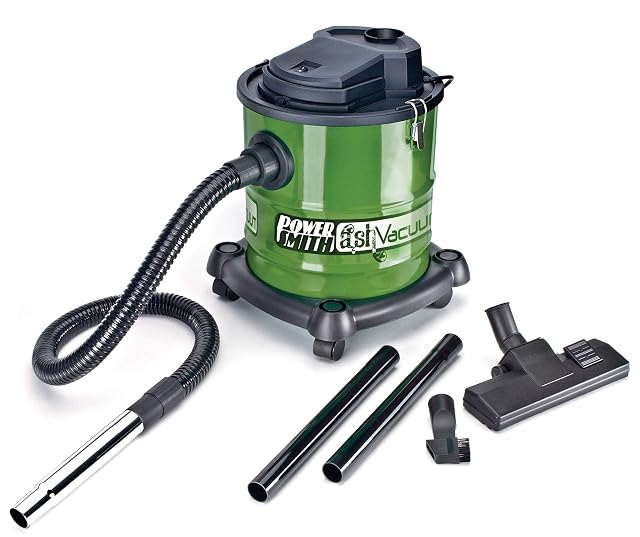
- “With wheeled base and extended flexible 157” cord, you can easily move the pellet grill ash vacuum… the small crevice brush access even the tightest corners of firebox, and big brush cleans the flat surfaces… All attachments can be pushed into slots in the base, located directly above the wheels”
- “The fireplace vacuum can also be switched to a blower… During the off-season, you can use it as a regular shop vac”
- Catalog: 3992 g (140.8 oz) · 300 × 300 × 378 mm (11.8 × 11.8 × 14.9 in) · Reference BJ131
One reference, two listings, four disagreements
This and the other VANPORE on this shelf are both $102.99, both titled 5.2 Gallon, both 1200W, both reference BJ131.
And they publish different things in four places:
Cord — this: a “157” cord”, 3.99 m. The twin: “2m power cord and a 1.5m suction hose for a working radius of 3.5m”.
Weight — this: 3992 g. The twin: 4672 g. Six hundred and eighty grams apart.
Dimensions — this: 300 × 300 × 378 mm. The twin: none.
Warm ash — this: “compatible with both warm and cool ash”. The twin: “Not suitable for boilers, stoves, hot ash or embers. Ashes must be cooled before vacuuming.”
The materials differ too: this names a “pure copper motor” and no container material; the twin names a “robust aluminum” container and no motor material.
On cord, weight and dimensions this is the more informative listing. On the question that could start a fire, the twin is the stricter, and the stricter one is the rule to follow whichever you buy.
Four meters of cable, which is the practical argument
157 inches is 3.99 m, or about thirteen feet.
Reach across the shelf, cord plus hose where both are published:
BACOENG 15 ft + 5 ft = 20 ft · VEVOR 5.3 gallon 13 + 5 = 18 ft · PowerSmith PAVC101 a 16 ft cord · this a 13 ft cord · DEWALT a stated 12 ft range · VEVOR 4 gallon 12 ft · VANPORE twin 11.5 ft · Snow Joe a 3.9 ft hose · SIPPON ×2 a cord published as 31.5 inches, eighty centimeters, which cannot be meant
Thirteen feet of cord means a socket on the other side of the room rather than the same wall as the hearth, and that is most of what reach is for.
Paired with a wheeled base, it also means the canister follows rather than being carried — and at 3992 g (140.8 oz) this is the lighter of the two VANPOREs by 680 g (24 oz), which makes the wheels a convenience rather than a necessity.
A pure copper motor, which is a durability claim
“pure copper motor provides a strong 1200W suction.”
No other listing on this shelf says anything about motor materials, and the distinction is real if modest.
Cheap motors often use copper-clad aluminum windings. Aluminum conducts at roughly 60% of copper, so for equal resistance the winding is bulkier, and it runs hotter and ages faster. On a vacuum whose cooling is its airflow, and whose filter progressively chokes that airflow, a cooler winding is a longer life.
So read it as longevity, not power. The “doubling the power of other ash vacs” in the same sentence is not supportable: 1200 W is the common figure on this shelf — both VEVOR listings, the BACOENG, and the “10 Amp” on both PowerSmiths, which on 120 V mains is 1200 W.
What nobody here publishes except the ApexPower is suction itself, at 10,000 Pa. The Snow Joe is the only other listing to separate input from output: “5 Amp motor generates up to 500 W of suction power”. And the DEWALT’s “4 HP” is 2983 W, which a 120 V 15 A socket cannot supply at all.
A hose bore, which only this listing gives
“heat-resistant metal hose, 1.5 inches in diameter, minimizes ash buildup and clogs.”
The only bore figure on the shelf, and bore is what decides blockages.
Ash itself flows. What blocks a hose is clinker, nails, charcoal lumps and the debris at the back of a grate — and clearing a blocked metal hose means taking it off and shaking it out over a bin.
One and a half inches is generous for a domestic machine: shop-vacuum territory rather than household. The trade, worth stating: a wider bore moves more air at lower velocity for the same motor, which lifts coarse debris well and scours fine dust off a flat surface slightly less aggressively.
The accessories cover the other end: a small crevice brush for the corners of a firebox, a big brush for flat surfaces — and both “pushed into slots in the base, located directly above the wheels”, which is why you still have them next November.
Sealed, patented, reusable screens
“The filter screens with a perfectly sealed design prevent ashes from being expelled out of the vacuum’s exhaust pipe… the filter screens can be used repeatedly after cleaning.”
That sentence names the real point of the category. A brush and a shovel put ash into the air you are standing in; a sealed canister with a filtered exhaust does not. If the seal fails, you have bought a machine that redistributes ash more efficiently than a brush.
The bullet also calls the filters flame-resistant, which puts this with the SIPPON pair (“flame-retardant”) and the BACOENG (“fire-retardant”) among the few listings naming a rating for the one component that is not metal.
Where its twin is clearer is on how two stages work: “the bag filter prevents the pleated filter from clogging” — the single best explanation on this shelf of why ash vacuums are built the way they are.
Neither VANPORE addresses drying. A washed element needs hours before refitting, and only the PowerSmith PAVC102 (two filters supplied) and the ApexPower (“one operates while the other is cleaned or air-dried”) solve it.
Warm ash, where its own twin forbids it
“compatible with both warm and cool ash.”
And its twin, same reference, says: “Not suitable for boilers, stoves, hot ash or embers.”
The shelf’s full spread on this question:
Strictest — both VEVOR listings, “dry ash after the fire is fully extinguished”, and the VANPORE twin, which also rules out boilers and stoves as sources
Numbered, no extra claim — both SIPPON listings and the DEWALT, all at below 40 °C
Cold only — the Snow Joe
Self-canceling — the ApexPower (“both cold and warm… must be below 104℉/40℃”) and the BACOENG (“both warm (ash below 104F (40°C)) and cool”), since 40 °C is barely above body temperature and ash at 40 °C is cold ash
Unqualified — both PowerSmith listings and this one: warm ash claimed, no limit published
So this is among the three least informative positions on the shelf, and its own twin provides the correction. Follow the twin.
Also a shop vacuum, out of season
“The fireplace vacuum can also be switched to a blower… During the off-season, you can use it as a regular shop vac.”
Eight of twelve listings here convert to a blower by moving the hose to the outlet: both VEVOR, both SIPPON, both PowerSmith, both VANPORE.
Fewer make the off-season argument explicitly — the PowerSmith PAVC101 does (“Casters and a 16 foot cord allows use as a regular shop vacuum”), and the BACOENG implies it with its upholstery and carpet nozzles.
On a machine that works a few weeks a year, a second job is a real part of the value.
What is not published
No suction figure, as above.
No noise figure. Only PowerSmith (79 dB, called quiet) and ApexPower (60 dB) publish one, and nineteen decibels is roughly eight times the sound pressure.
No distinction between drum and ash capacity. The PowerSmith PAVC101 is the only listing here that separates them — “Canister Size: 5.2 Gallons, Canister Ash Capacity: 3 Gallons” — so a bare 5.2 gallons could mean either. Its own twin publishes “20 liters”, which at 5.28 US gallons is at least internally consistent with the title.
No fill indicator, which only the BACOENG has.
No certification named, where the ApexPower publishes CE, CB and GS and the Snow Joe publishes ETL.
Availability
Read on the day this page was built: $105 at the American Amazon shop.
Read from Keepa on the day this page was last revised; stock and price both move without notice.
Prices quoted in this text were read on 2026-10-04. The live price is at the top of the page.