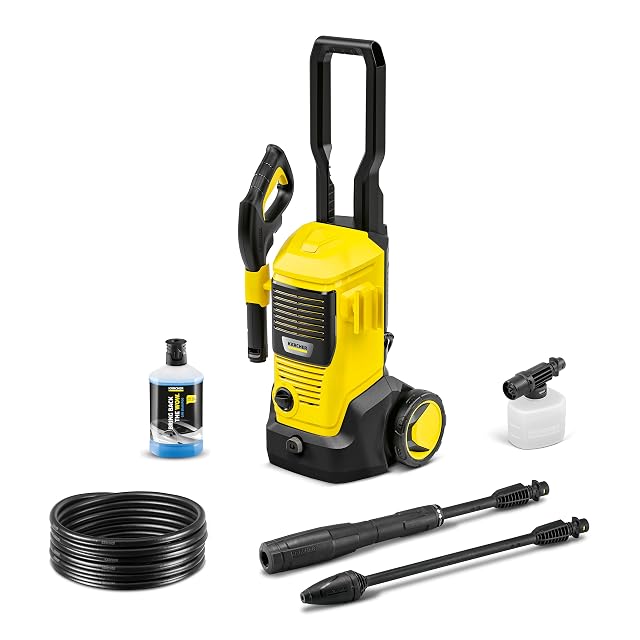
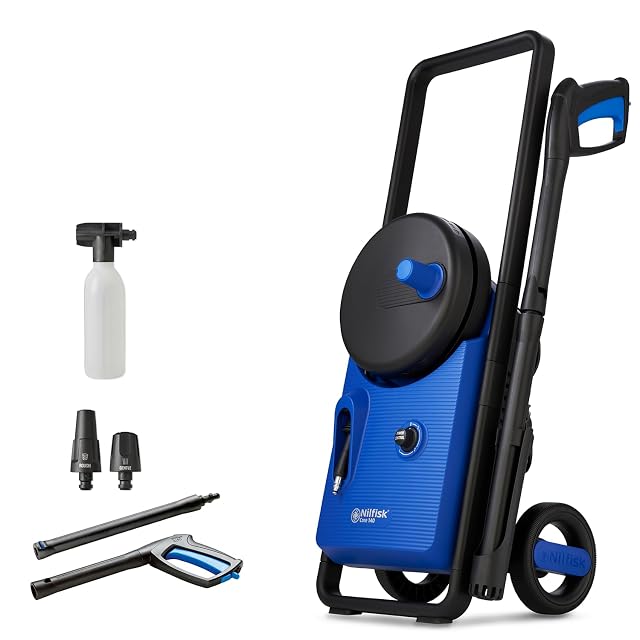
Pressure is fixed at the pump. Force at the surface is not — it falls off sharply with distance, which is why the same machine can strip concrete and be safe on a car.
The thirty-second test
Widest fan setting, one meter away, somewhere that does not matter. Close in a hand’s width at a time until dirt begins to lift. Stop. That is your distance for that material today; a weathered board and a new one behave differently.
Angle changes what the water does
Perpendicular drives water into the surface — behind render, into a mortar joint, under a lacquer edge. At 30 to 45 degrees the jet gets under the dirt and pushes it away. On timber, always along the grain.
Keep it moving
A stationary jet is a cutting tool. The marks people find afterwards are almost always where they paused — at the end of a pass, when the phone rang, when they changed hands.
And the nozzle
A rotary nozzle removes the distance safety margin entirely: its force is concentrated on a point. Hard mineral surfaces only.
The questions we hear
How do I find the right distance?
Start a meter away in an inconspicuous spot with the widest fan setting, and close in slowly until the dirt starts to move. Stop there. That is the working distance for that surface, and it will be different on the next one.
Does the angle matter as much?
On soft or jointed surfaces, yes. A jet held perpendicular drives water into the material; held at 30 to 45 degrees it lifts dirt off and carries it away. On decking, work along the grain, not across it.
Last reviewed 2026-08-15