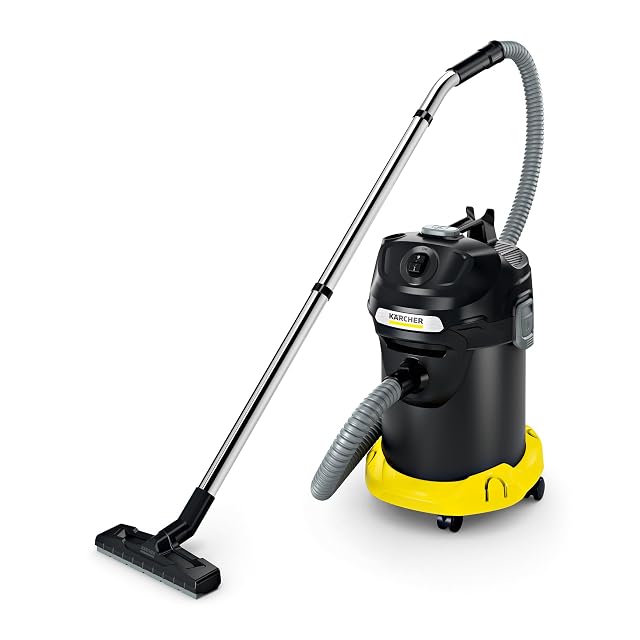
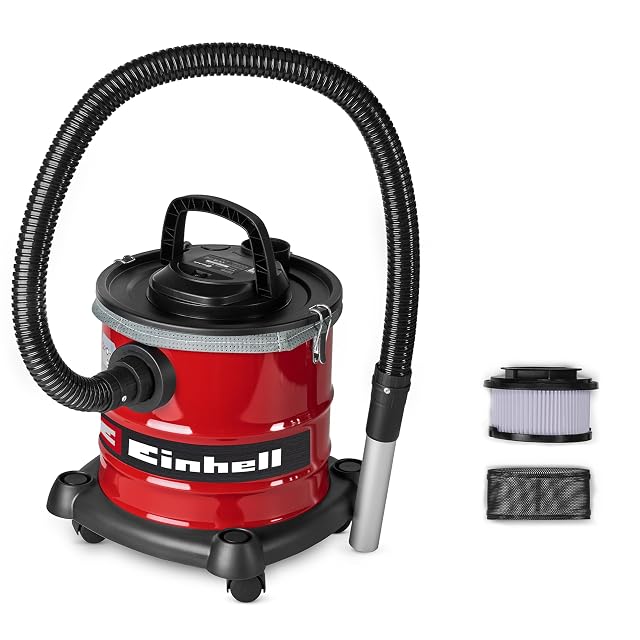
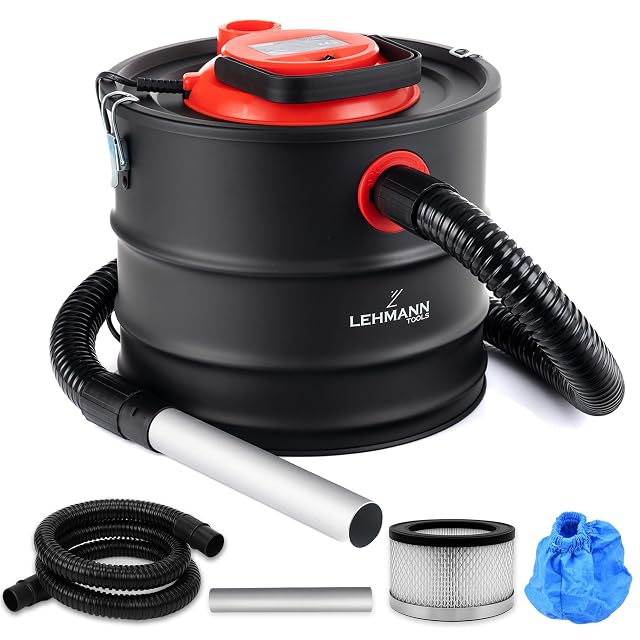
Everything else on an ash vacuum’s specification reduces the consequences of breaking this rule. Nothing removes the rule.
Why ash is different
It is fine enough to pass a standard cartridge filter and reach a motor; abrasive enough to score plastic; and insulating enough to keep embers alive for a day under a grey, cool-looking surface. A vacuum then supplies exactly what an ember needs: a flow of air.
What a real ash vacuum has
A metal drum, a metal hose end or tube, and a filter arranged so ash does not immediately blind it. Better machines add a flame-retardant body, an antistatic handle and a coarse pre-filter. These are margins of safety, not licenses.
Never use
A household vacuum, a workshop vacuum with a plastic drum, or a pre-separator connected to either. The listings for cheap “ash vacuums” often describe exactly that arrangement — check that the machine has its own motor.
And where the ash goes afterwards
A metal container with a lid, outdoors, away from anything combustible. Ash tipped into a plastic bin is how a garden shed catches fire two days after the fire went out.
The questions we hear
The surface is cold. Is it safe?
Not necessarily. Ash is an excellent insulator: the surface can be cool to the touch while embers remain alive in the middle of the bed. Twenty-four hours after the last burn is the standard minimum, and longer for a deep bed in a stove that has been running all evening.
One manufacturer publishes 40 °C (104 °F). Does that help?
It helps by being specific — Lehmann states ash up to 40 °C (104 °F), which is barely warm. Read it as a limit rather than as permission: a stove used the previous evening is not at 40 °C (104 °F) in the middle, however cool it feels on top.
Last reviewed 2026-08-15