What the maker puts in writing
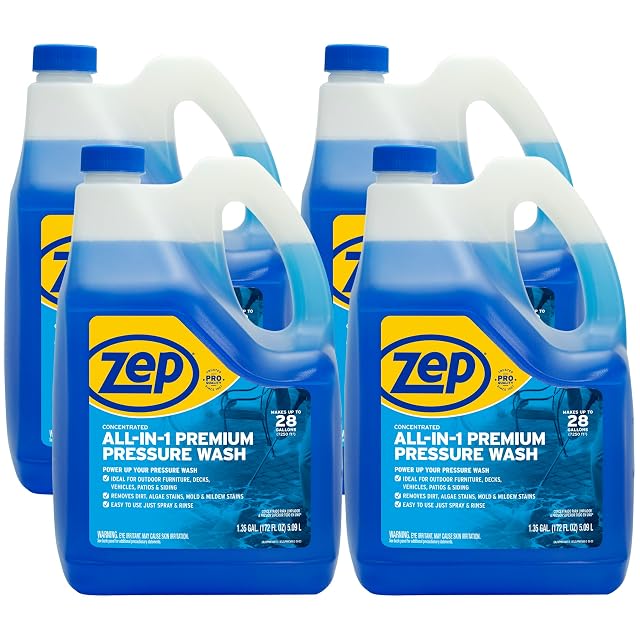
- “POWERFUL PRESSURE WASH FORMULA: Removes stains caused by algae, mold and mildew”
- “FOR USE ON: Ideal for cleaning siding, driveways, brick, wood, stucco and other surfaces”
- “CONCENTRATED FORMULA: Makes up to 26 gallons of cleaner”
- “FOR USE WITH: a pressure washer or manual applications”
- “FOR USE ON: vinyl, brick, stucco, wood, concrete, cement, asphalt, fiberglass, tile, stone, metal, plastics and vehicles”
- Title: “(Case of 4) - Concentrate” · Reference ZUPPWC160PH · Catalog: 22680 g (800 oz)
Twenty-six gallons — per bottle, or for four?
Bullet three: “Makes up to 26 gallons of cleaner.”
Title: “Case of 4.”
So either each bottle makes 26 gallons — 104 gallons for the case, which at $59.99 is 58 cents a gallon of solution — or the case makes 26 between them, which is $2.31 a gallon.
Nothing else on the page resolves it. No bottle size is published anywhere, and the only quantitative clue is the catalog weight: 22680 g, which is 50 lb exactly. A round pound figure reads as a shipping weight rather than a measurement, so it will not settle the question either.
Where the two answers land on this shelf, each listing at its own best published figure:
Simpson Heavy Duty — 5.4¢ · Simpson Green Formula — 5.9¢ · Simpson Multi-Purpose — 7.6¢ · Kärcher Vehicle — 36¢ · Kärcher Multi — 47¢ · this — 58¢ or $2.31 · Krud Kutter — 80¢ · Briggs 1-gallon — $1.24 · Briggs 32 oz — $3.56 · Sun Joe and Simple Green — not calculable in gallons
At 58 cents it is mid-table. At $2.31 it is the second most expensive solution here. A four-fold uncertainty on the only figure that makes a concentrate comparable with anything.
This is one of four listings on this shelf that leaves its own dilution ambiguous — both Kärchers say 40 gallons in a bullet and 20 in the description, Krud Kutter says 20 then 11 — and it is the only one where the ambiguity is about how many bottles.
The one listing whose ratio verifies from its own figures is Simpson: a US gallon is 128 fluid ounces, half an ounce goes into it 256 times, and that is the claim.
Algae, mold and mildew — the lead claim, with nothing behind it
“Removes stains caused by algae, mold and mildew.”
It is the right thing to lead with. Most exterior washing is not about dirt — it is about the green film on a north-facing wall, the black speckle on a deck, the grey bloom on render. That is organic growth, and it comes back, which is why this is the recurring job rather than the one-off.
And no chemistry is named.
A mold stain is biological pigment in or on the surface, and removing it means oxidizing it — which in practice means bleach or peroxide.
The shelf divides precisely there:
Simple Green, $23.99 — names it: “peroxide-powered formula”, plus EPA Safer Choice Certified in the title, the only third-party certification on this shelf
this — the strongest mold claim here, no chemistry
Both Briggs & Stratton bottles — claim mold stains, no chemistry
Krud Kutter, $15.98 and Sun Joe, $25.97 — declare themselves “bleach free” and make no mold-pigment claim; Krud Kutter targets “dirt, oil, grease, bird droppings, tree sap”
Simpson ×3 — “non-butyl degreaser”, for oil and grease, no mold claim
Kärcher ×2 — no chemistry declared, and no mold claim either
So this is the strongest mold claim on the shelf supported by the least information.
The practical consequence is a precaution rather than a verdict. If it is chlorinated: keep it off planting, rinse metal fittings afterwards, and flush the machine when you finish. Which is the thing only Krud Kutter puts in writing — “the water-based formula contains anti-corrosive agents to help safeguard pressure washer components” — and it matters because detergent is siphoned through the pump and hose on its way out, and a domestic pump contains aluminum and brass.
Thirteen surfaces, and three of them are telling
“vinyl, brick, stucco, wood, concrete, cement, asphalt, fiberglass, tile, stone, metal, plastics and vehicles” — plus siding and driveways from bullet two.
Second longest list on this shelf, and the composition says something.
Asphalt appears on no other listing here. It is the surface most cleaners avoid, because a solvent-bearing degreaser softens bitumen — so a page that names asphalt is implicitly saying this is not solvent-based. Which is consistent with it being an oxidizing cleaner rather than a degreaser.
Fiberglass is the boat-and-caravan surface, and gelcoat is easily dulled.
Stucco and cement are the porous surfaces where organic growth actually lives — the exact match for the algae-and-mildew claim.
Against the shelf: Krud Kutter names fifteen, including roofing shingles, gutters, pool areas and boat engines; Kärcher Multi eleven; Simple Green five plus composite; Sun Joe five; the Simpson Multi-Purpose five; the Simpson Heavy Duty no domestic surface at all; both Briggs bottles three.
What a long list does not supply is strength by surface. With no dilution guidance anywhere on the page, nothing says which end a stucco wall wants and which end a fiberglass hull does. That is the gap a thirteen-surface listing most needs to fill, and this is the shortest set of bullets on the shelf after Simple Green’s.
A case of four, which is the real proposition
It is the only multi-pack here, and that is worth taking at face value rather than as a quibble about price.
Exterior washing is seasonal and repetitive. Algae comes back, and the house, the drive, the fence and the patio are four jobs across a spring. Running out halfway through is the ordinary failure, and four bottles removes it.
And “All-In-1” is the other half of the same argument: one chemistry for thirteen surfaces means one bottle in the garage rather than a degreaser, a vehicle soap and a mold killer.
Which is where the shelf’s alternatives sit. The three Simpsons are degreasers. The Kärcher Vehicle Wash & Wax waxes a car. Simple Green is for wood and composite. Krud Kutter covers the widest range of soils but makes no mold claim. If you want one bottle for everything outdoors, this and the Kärcher Multi Purpose at $18.99 are the two that claim it, and this one adds the mold.
Manual use is stated — “a pressure washer or manual applications” — which nine of eleven items here offer and the two Briggs bottles do not. On stucco and shingle-adjacent work, brushing is often the only way.
What is not published
The bottle size, which is the figure that would resolve the 26-gallon question. Every other listing on this shelf states a volume: nine of them “1 Gallon”, and the Briggs 6832 “32-Ounce”.
Whether 26 gallons is per bottle or per case, as above.
No chemistry. Not bleach-free, not biodegradable, not non-butyl, not peroxide, no pH. Six listings here declare something; this declares nothing, while making the strongest stain claim.
No dwell time, and on an oxidizing claim this matters more than on a detergent, because breaking down pigment is slow. Krud Kutter is the only listing on this shelf with a published method: “allow product to remain on the surface for 3–5 minutes to penetrate”, “work in small sections”, “rinse thoroughly without allowing it to dry on the surface”. Borrow all three. Briggs supplies the other half: apply to a dry surface, then switch to a high pressure tip to rinse.
No soap nozzle note. The Sun Joe at $25.97 is the only listing here to explain the hardware: “may require the use of a soap nozzle. Other models may need to use a soap-sprayer attachment.” A pressure washer will not draw detergent through a high-pressure tip — the siphon is a venturi and only pulls at low pressure, which is exactly what the wide black soap nozzle on the lance shelf of this site exists for. Fit a 25° green tip and nothing comes through.
No surface coverage. Krud Kutter publishes 5,800 sq ft at $15.98 — about 0.276 cents a square foot — and Simple Green 6,400 sq ft at $23.99, about 0.375 cents. On a case lot, coverage would be the natural figure to give.
No certification, where Simple Green carries EPA Safer Choice and the Simpson Green Formula claims to meet “OSHA, USDA, EPA, DNR” requirements.
No anti-corrosive claim, as above.
No planting or runoff caution, on a product whose named surfaces — driveways, siding, stucco — all drain into borders and storm water, and whose lead claim is the one that usually implies chlorine. Krud Kutter and the Simpson Green Formula both claim biodegradable; this says nothing either way.
No foam cannon compatibility, which both Kärcher bottles name.
Availability
Read on the day this page was built: $60 at the American Amazon shop.
Read from Keepa on the day this page was last revised; stock and price both move without notice.
Prices quoted in this text were read on 2026-10-05. The live price is at the top of the page.