What the maker puts in writing
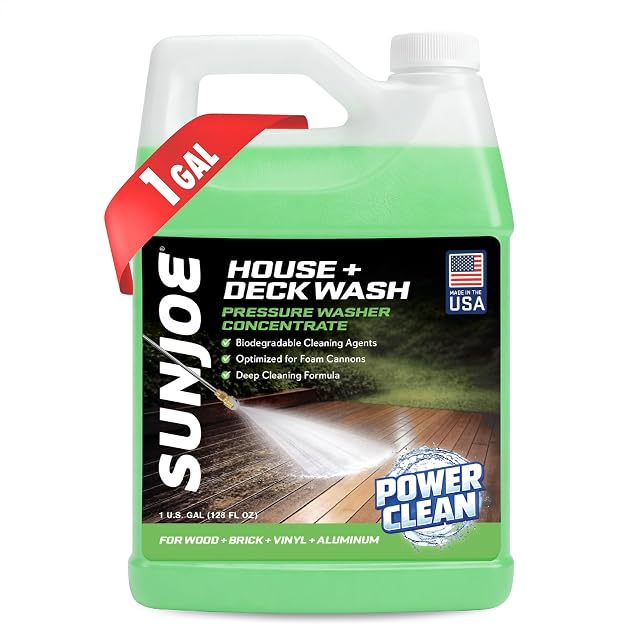
- “PROPER USE WITH PRESSURE WASHERS: Check your pressure washer’s manual to find specific instructions for using this detergent. In some cases, this power-washing detergent may require the use of a soap nozzle. Other models may need to use a soap-sprayer attachment. Dilute this pressure washer soap as recommended before applying.”
- “ALL-PURPOSE CONCENTRATED CLEANER: Work on removing dirt, grease, gunk, and grime from your deck, driveway, or siding… can also be used to clean vinyl, aluminum, wood, brick, and other materials.”
- “VERSATILE CLEANING: …You can also use this pressure washer detergent to prepare different surfaces for painting or staining.”
- “BLEACH-FREE FORMULA: …You can also apply the concentrated all-purpose cleaner with a brush or mop”
- Reference SPX-HDC1G · Catalog: 3629 g (128 oz)
The soap nozzle, and why this is the only page that mentions it
“In some cases, this power-washing detergent may require the use of a soap nozzle. Other models may need to use a soap-sprayer attachment.”
This is the commonest reason people believe a pressure-washer detergent does not work, and across eleven listings it is explained exactly once.
The mechanism. A pressure washer draws detergent by venturi — water rushing past a small port creates suction that pulls soap from a tank or a siphon tube.
A venturi only pulls at low pressure. Fit a high-pressure tip and the restriction downstream raises the pressure at the port, the suction collapses, and nothing comes through. No soap, no warning, no error — just clean water and a conclusion that the detergent is at fault.
The fix is the soap nozzle: the widest tip in the set, conventionally black and rated around 65°, which keeps the pressure low enough for the siphon to work.
Look at the lance shelf of this site and it is in every kit. The Xiny Tool ships “0, 15, 25, 40, 60 degree and soap nozzles”. Both Selkie sets ship 0, 15, 25, 40 and 65.
So the full sequence is: fit the soap tip, apply the detergent, then change to a 25° or 40° tip to rinse.
Which is exactly the half the Briggs & Stratton listings supply: “apply detergent to the dry surface then switch to a high pressure spray tip to rinse it all away.” Two tips, one job.
A “soap-sprayer attachment” is the alternative the same bullet names — a separate bottle-and-wand that fits the lance and feeds from its own reservoir, bypassing the machine’s siphon entirely. The foam cannon that both Kärcher bottles name is the same idea in its thicker form.
And the opening instruction is the right one: “Check your pressure washer’s manual.” At least nine of the thirteen listings here say something like it; this is the only one that says what you will find there.
And then it publishes no dilution at all
“Dilute this pressure washer soap as recommended before applying.”
Recommended by what is not stated, which leaves the label.
It is the only listing on this shelf that gives no ratio of any kind. Every other page gives something:
Simpson ×3 — 256 gallons at half an ounce per gallon, a ratio that verifies exactly, since a US gallon is 128 fluid ounces
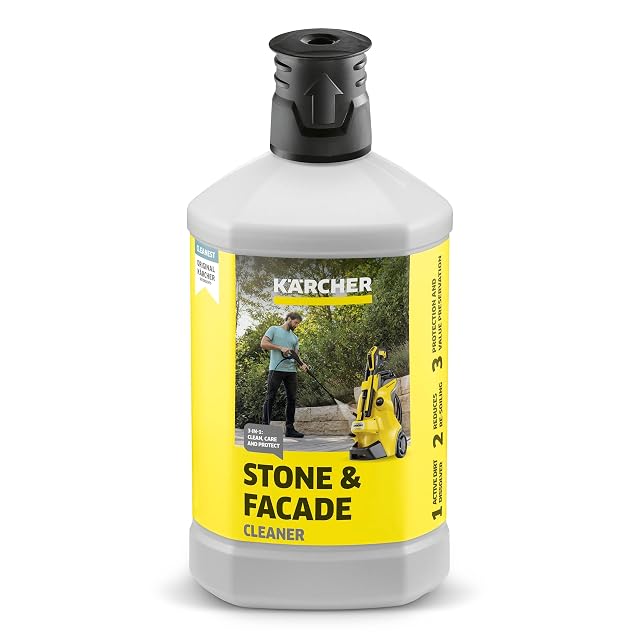
Kärcher ×2 — 40 gallons in a bullet, 20 in the description
Krud Kutter — 20 in a bullet, 11 in the description
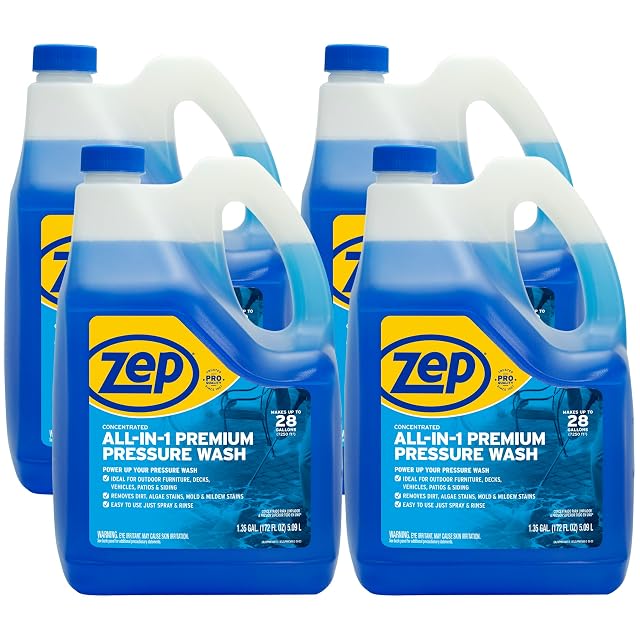
Zep — 26 gallons on a case of four, per bottle or per case unstated
Briggs ×2 — 16 gallons from one, consistently
Simple Green — coverage instead: 6,400 sq ft
So on the one basis that makes concentrates comparable — cost per gallon of ready-to-use solution — the shelf runs from 5.4 cents (Simpson Heavy Duty) to $3.56 (Briggs 32 oz), and this $25.97 bottle, the second most expensive here, cannot be placed on that scale at all.
That is the central criticism of the page. What you get instead is the guidance above and below — real, and not a number.
No coverage figure either, where Krud Kutter publishes 5,800 sq ft at $15.98 — about 0.276 cents a square foot — and Simple Green 6,400 sq ft at $23.99, about 0.375 cents.
Surface prep for paint and stain, which nothing else claims
“You can also use this pressure washer detergent to prepare different surfaces for painting or staining.”
A different job from cleaning, and a useful one to have named.
Paint and stain fail at the interface, and what makes them fail is whatever was left on the surface: dust, chalked old paint, mill glaze on new timber — and detergent residue.
So a cleaner sold as a prep step is implicitly promising to rinse away completely. Which is the opposite of what the Kärcher Vehicle Wash & Wax at $14.39 does: that one deliberately leaves a hydrophobic film, and a stain applied over it would not key at all.
The bleach-free claim fits the prep job too. Residual chlorine on timber interferes with some finishes and lightens the wood unevenly, so a non-chlorinated cleaner is the right choice before a stain.
What is missing is the instruction that completes it, and Krud Kutter at $15.98 has it: “rinse thoroughly without allowing it to dry on the surface.”
Detergent allowed to dry before a finish goes on is precisely the residue that causes a failure. If prep is the job: rinse hard, and let the surface dry fully — days, on timber — before the finish.
Bleach-free, and what it implies about the job
“BLEACH-FREE FORMULA.”
Only this and Krud Kutter at $15.98 make the claim on this shelf, and in both cases it travels with what the bottle does not promise.
This names dirt, grease, gunk and grime. It makes no mold or algae claim.
The shelf divides on exactly that:
Simple Green, $23.99 — “peroxide-powered”, plus EPA Safer Choice Certified in the title. Peroxide oxidizes pigment, which is what a mold or algae stain requires
Zep, $59.99 — leads with “algae, mold and mildew” and declares no chemistry
Both Briggs bottles — claim mold stains and declare no chemistry
this and Krud Kutter — bleach free, and no mold-pigment claim
Simpson ×3 — “non-butyl degreaser”, aimed at oil and grease
Kärcher ×2 — no chemistry declared
That coherence is a point in its favor. A bottle that says bleach-free and then claims to remove mold pigment is promising something hard; this one declines the claim.
And bleach-free matters for the machine as well, which is the point only Krud Kutter puts in writing: “the water-based formula contains anti-corrosive agents to help safeguard pressure washer components.” Detergent is siphoned through the pump and hose on its way out, a domestic pump contains aluminum and brass, and bleach is the ingredient most hostile to it. Sun Joe makes the machines as well as this bottle, so the absence of bleach reads as deliberate.
Brush or mop, and what the versatility is worth
“You can also apply the concentrated all-purpose cleaner with a brush or mop for remarkable results.”
Nine of eleven items here offer manual use; the two Briggs & Stratton bottles do not.
It matters more than it reads on the surfaces named. A deck rewards a brush, because the soil sits in the grain and a jet skates over it. Siding often needs a soft brush at the top courses where a lance cannot be held steady. And on a prep job before paint, a brush is how you reach what the washer cannot.
The surfaces named are “deck, driveway, siding” plus “vinyl, aluminum, wood, brick, and other materials” — five materials, mid-shelf. Krud Kutter names fifteen, Zep thirteen, Kärcher Multi eleven, Simple Green five plus composite, both Briggs bottles three.
Aluminum is the entry worth a note. Aluminum siding is sensitive to strongly alkaline cleaners, which etch and dull it, so naming it is a quiet statement that this is not a caustic formulation.
3629 g at the catalog is the lightest one-gallon bottle on this shelf — against 4205 g for Simple Green, 4082 g for each Simpson, 3946 g for the Briggs gallon, 3856 g for Krud Kutter and 3742 g for each Kärcher. A US gallon of water is about 3785 g, so this one is slightly under, which says nothing much beyond the bottle and the formulation.
What is not published
No dilution ratio, as above — the omission that matters most, on the second most expensive bottle here.
No surface coverage, as above.
No dwell time. Krud Kutter is the only listing on this shelf with a published method: “allow product to remain on the surface for 3–5 minutes to penetrate”, “work in small sections”, “rinse thoroughly without allowing it to dry”. Contact time is how a chemical cleaner works, and the commonest mistake after the nozzle error above is spraying soap and immediately blasting it off — which cleans with the water alone.
No chemistry beyond bleach-free. No biodegradable, no non-butyl, no peroxide, no pH. Where Simple Green carries EPA Safer Choice certification, the Simpson Green Formula claims non-toxic and biodegradable and compliance with four named agencies, and Krud Kutter claims bleach-free and biodegradable and anti-corrosive.
No certification.
No mold or algae claim, as above — coherent with the chemistry, and still a gap if organic growth is the actual job.
No foam cannon compatibility by name, though “soap-sprayer attachment” in bullet four is the same family. Both Kärcher bottles name the foam cannon outright.
No steam cleaner or automatic scrubber use, which all three Simpsons claim.
No prep guidance beyond the one sentence — no drying time before paint, no rinse instruction, nothing about the mill glaze on new timber that a prep cleaner is most needed for.
Availability
Read on the day this page was built: $26 at the American Amazon shop.
Read from Keepa on the day this page was last revised; stock and price both move without notice.
Prices quoted in this text were read on 2026-10-05. The live price is at the top of the page.