What the maker puts in writing
- “Cleans 3x faster on windows, showers, and mirrors. Pro-tip: When cleaning textured tile, apply light pressure and glide slowly for an optimal vacuum seal”
- “Sits comfortably and easily in your hand, weighing in at an ultra-light 1.1 lbs”
- “Spray, wipe, and vacuum away grime. Pro-tip: Keep surfaces generously wet while cleaning and wipe the squeegee blade with a damp cloth before using to prevent streaks”
- “Clean any smooth surface with up to 25 minutes of cordless runtime. Pro-tip: For tight windowsills or bottom edges, simply rotate the vacuum horizontally and pull side-to-side”
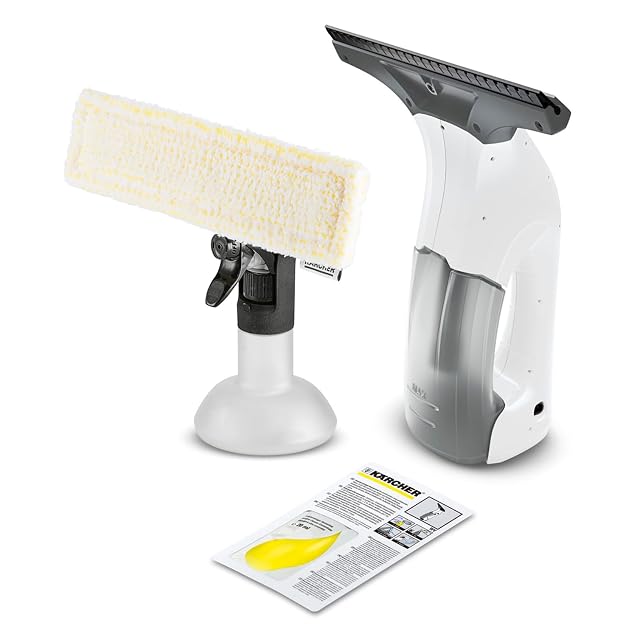
- “This all-in-one set includes the WV 1 Plus, a spray bottle, a machine-washable microfiber pad, a charger, and a 16.9 oz concentrated glass cleaner”
- Description: “requiring only a slight upward tilt as you glide forward to perfectly assist the gravity-fed vacuum seal” · “20 ml of cleaner on 250 ml of water” · “the squeegee head pops off with a single press of the recessed safety release clip”
- Reference 1.633-609.0 · Catalog: 499 g (17.6 oz)
Four hundred and ninety-nine grams, and the claim checks
“An ultra-light 1.1 lbs.” The catalog says 499 g, which is 1.1 lb.
The same figure twice, which on this shelf is worth saying out loud. The GARYOG at $66.30 claims 1.1 lb against a catalog figure of 1225 g (43.2 oz) — reconcilable, since its box holds a pole, a bracket, two cloths and a spare blade, but the page does not say which is which.
This is the lightest machine here, and the comparison matters because of how the tool is used:
this — 499 g · Kärcher WV 2 — 1.4 lb, about 635 g · HAUSHOF — “about 1.7 lb”, around 771 g · ArtnPlan — 907 g at the catalog, nothing on the page · SOMZOKY and Oqioprd — nothing published
You hold this at arm’s length with water in it, often above shoulder height. Four hundred grams between the lightest and the heaviest here is noticeable over a room of windows, which is why Kärcher lead with the figure and five rivals do not publish one at all.
The description extends the point sensibly: “fits perfectly in the palm of your hand… the ideal everyday companion”. This is a machine for the daily jobs — condensation on a bedroom window, a shower screen after use, a mirror — rather than a twice-yearly assault on the whole house.
At least five of the thirteen machines on this shelf publish 2000 Pa: the SOMZOKY, ArtnPlan, GARYOG, the HAUSHOF as “2 kPa”, and the Oqioprd in its bullets — its title says 2200.
One figure, five machines. Both Kärcher machines publish none.
What 2000 Pa amounts to: about two per cent of atmospheric pressure, enough to hold a column of water roughly 20 centimeters high. Ample, because this is not lifting dust against gravity. It is drawing a thin film of water off flat glass through a slot pressed against the surface.
The seal does most of the work. And the seal is what this listing talks about instead — three times, specifically:
“apply light pressure and glide slowly for an optimal vacuum seal” on textured tile
“a slight upward tilt as you glide forward to assist the gravity-fed vacuum seal” on a worktop
“keep surfaces generously wet while cleaning” so the blade has a film to ride on
Those three instructions will change your result far more than two hundred pascals would.
The fair criticism stands: a buyer comparing listings cannot compare this one on suction at all. But the omission is consistent with where the performance comes from, and the alternative — five listings converging on the same number in their titles — tells you nothing either.
No blade width is published either, where five machines here publish 280 mm / 11 inches. And no tank capacity, where the Oqioprd gives 200 ml, the SOMZOKY and GARYOG 150, the HAUSHOF 100 and the Kärcher WV 2 “5 fl. oz.” — about 148 ml.
The bottom edge, and the honest admission about it
“requiring only a slight upward tilt as you glide forward to perfectly assist the gravity-fed vacuum seal.”
That one phrase explains the architecture. A gravity-fed head relies on water running down into the tank. Which works everywhere except at the bottom of a pane — where the water has collected, and where the head would need to be inverted.
The answer given is a technique, and it is good advice: “you can confidently maneuver around deep baseboards or tight windowsills by turning the unit sideways and vacuuming horizontally across the bottom edge of the glass, completely bypassing any low-clearance obstructions.”
It is also exactly the gap the Kärcher WV 2 Universal at $99.99 was built to close: “360° Comfort!Clean technology to work sideways or completely upside down, letting you clear tight corners and low windowsills without streaks or leaks.”
Within one brand’s range, one machine is gravity-fed and the other is not. That is what the extra $27 buys, along with ten more minutes of runtime.
Note what the five cheap machines on this shelf say about the bottom edge: nothing. Which does not mean they have solved it — every window has a bottom edge where the water gathers, and a gravity-fed head is the normal and cheap way to build one of these.
The same mechanism explains the horizontal-surface advice, which is genuinely useful: “The unit handles flat horizontal surfaces like tables and bar tops beautifully, requiring only a slight upward tilt as you glide forward.”
Sixteen point nine ounces of concentrate, and the dilution is published
The set includes “a 16.9 oz concentrated glass cleaner” — 500 ml — and the description publishes the ratio: “adding one cap of cleaner, which is 20 ml of cleaner on 250 ml of water or about 0.8 fl. oz. on 8 fl. oz.”
Divide it: 500 ml at 20 ml a bottle is 25 bottles, each 270 ml made up — roughly 6.75 liters of solution. Most of a year of ordinary use.
The five cheap machines on this shelf supply a bottle and a cloth, and the bottle arrives empty. The SOMZOKY, Oqioprd, ArtnPlan, HAUSHOF and GARYOG include no detergent at all. So part of the price gap buys a consumable you would otherwise be shopping for.
And publishing the dilution means it is not a lock-in: at 20 ml to 250 ml you can see exactly what the machine wants, and nothing stops you refilling with your own solution afterwards.
Why a proper glass cleaner matters on this tool specifically: it lowers the surface tension so the water sheets rather than beading — and a continuous sheet is what a squeegee removes cleanly. Beads get pushed around.
The microfibre pad is machine-washable, which is the other consumable thought. A dirty pad redistributes dirt, and the GARYOG is the only other listing here to address the problem, by including two cloths.
The technique section, which no rival has
This is the only listing on the shelf that teaches you to use the tool, and four of its instructions are worth keeping.
“Keep surfaces generously wet while cleaning.” A barely damp surface is what makes a squeegee streak. The blade needs a film to ride on, and a dry patch is a dry patch on the finished pane too.
“Wipe the squeegee blade with a damp cloth before using to prevent streaks.” Dust settles on a stored blade, and the first pass carries it across the glass. Thirty seconds that changes the result.
“When cleaning textured tile, apply light pressure and glide slowly for an optimal vacuum seal.” This is the only caution of its kind here. A squeegee needs a flat plane to seal against, and a grout line breaks the vacuum — so a smooth tiled shower wall works with care, and a heavily textured one works poorly. Five listings on this shelf name “tiles” with no qualification at all.
“To prevent leaks, ensure the drain bottle is fully closed and locked before you begin.” Which tells you where a window vacuum makes a mess: not on the glass, but down your arm when the tank lets go.
And the head release: “the squeegee head pops off with a single press of the recessed safety release clip”. Recessed, so it does not release in your hand — and a removable head is what lets the blade and the tank be cleaned properly.
Twenty-five minutes, the shortest here
Up to 25 minutes. The shelf:
SOMZOKY — 2200 mAh → 45+ minutes · GARYOG — 2200 mAh → up to 40 · Kärcher WV 2 — 35 · HAUSHOF — 2000 mAh → up to 30 · this — 25 · Oqioprd and ArtnPlan — 2200 mAh and no runtime published
So this is last on the figure, and two of the machines ahead of it publish a battery capacity instead of minutes.
Which is the more useful way round, and Kärcher have it. Note what the comparison shows: the SOMZOKY and the GARYOG have the same 2200 mAh cell and declare 45 and 40 minutes; the HAUSHOF has 9 per cent less battery than the SOMZOKY and declares 33 per cent less runtime. Those cannot all follow from capacity. Milliamp-hours are not runtime.
Twenty-five minutes is still a lot of this particular tool, because the motor runs in bursts of seconds — spray, wipe, vacuum, move on. It is enough for a bathroom and several windows, and it suits the “everyday companion” use the description describes.
What it is not enough for is a whole house in one session, and there is no pole here either — so this is not the machine for the twice-a-year job. That is what the pole-equipped SOMZOKY and GARYOG are for.
Three times faster, measured against what
“Cleans 3x faster on windows, showers, and mirrors”, and in the description, “in a third of the time of traditional cleaning methods”.
The GARYOG makes the same claim — “up to 3X faster than traditional methods”. Two brands, the same multiple.
It is defensible once you see what the comparison is. The traditional routine is spray, wipe, then chase the drips and streaks with a dry cloth — and the chasing is most of the time. A window vacuum replaces that third step with one mechanical pass.
So: spray, wipe, vacuum — which is what bullet three says, and what every listing on this shelf describes once you read past the headlines.
A window vacuum does not clean the glass. It removes the water. The microfibre pad does the cleaning. “3x faster” applies to the whole job; the “one pass” claims the cheap listings make apply to the third step only.
What is not published
No suction figure, no blade width, no tank capacity, as above — three specifications every cheap machine on this shelf gives.
No extension pole in the box. The SOMZOKY at $45.99 and the GARYOG at $66.30 both include a 31–40 inch pole; Kärcher offer a “telescopic extension pole set” for the WV 2 separately. Without one this reaches as far as your arm.
No spare blade. The SOMZOKY and GARYOG both include one. Kärcher list “replaceable silicone squeegee lips” among the WV 2’s accessories, so the part exists in the range — which is the other acceptable answer, since the blade is the wear part that ends one of these machines.
No blade material on this listing, though the WV 2’s accessory list implies silicone.
No charging time, and the charger type is unspecified where the WV 2 uses USB-C.
No inverted operation, as above — the WV 2’s “360°” is the paid-for answer.
No warranty term.
Availability
Read on the day this page was built: $73 at the American Amazon shop.
Read from Keepa on the day this page was last revised; stock and price both move without notice.
Prices quoted in this text were read on 2026-10-04. The live price is at the top of the page.