What the maker puts in writing
- “Features 360° Comfort!Clean technology to work sideways or completely upside down, letting you clear tight corners and low windowsills without streaks or leaks”
- “The powerful built-in electric vacuum instantly pulls dirty water away from the glass, completely eliminating messy drips and piles of wasted paper towels”
- “Designed with a quick-drain 5 fl. oz. wastewater tank that empties directly into the sink without making you touch the grime”
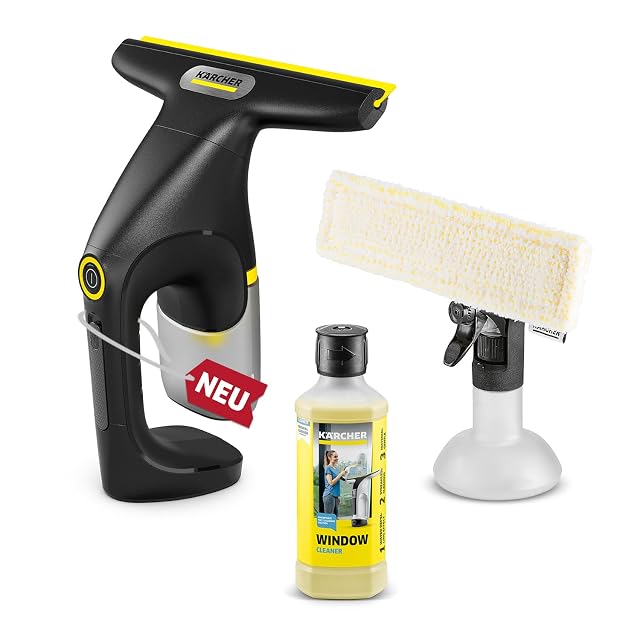
- “Includes the Kärcher WV 2 Universal Window Vac, a premium spray bottle set with a microfiber wiping cloth, a full-size bottle of concentrated window cleaner detergent, and a USB-C charging cable”
- Description: “this lightweight 1.4-pound tool” · “you can absolutely use it on horizontal kitchen counters or completely upside down to reach the very bottom of floor-length panes without losing suction” · “the standard nozzle can be easily removed… or exchanged with a separately available smaller nozzle accessory to comfortably fit narrow window panes and divided glass doors” · “a long-lasting lithium-ion battery that charges quickly via a standard USB-C cable, providing a 35-minute runtime” · “a telescopic extension pole set for high-up transom windows, extra microfiber cloths, and replaceable silicone squeegee lips”
- Reference 1.633-723.0
Upside down, which is the only real problem on this shelf
“360° Comfort!Clean technology to work sideways or completely upside down, letting you clear tight corners and low windowsills without streaks or leaks.”
Here is why that is worth a section of its own.
Most window vacuums are gravity-fed: the water runs down the blade into the tank. And at the bottom of a pane the water has collected exactly where the head would have to be inverted.
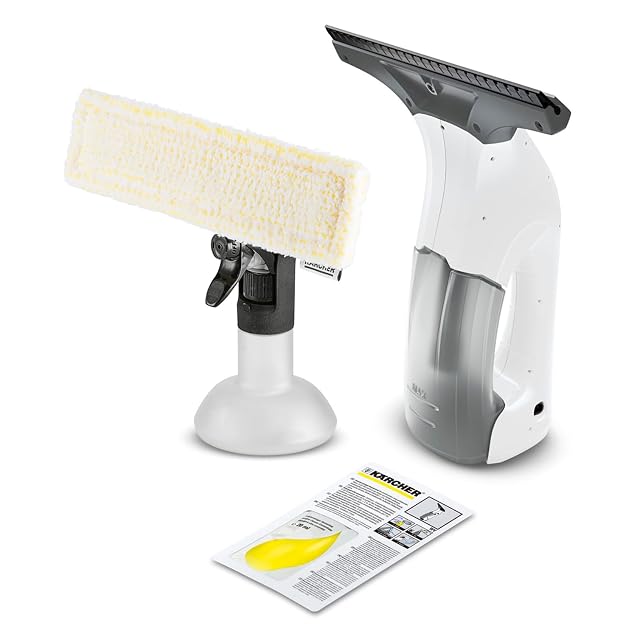
Kärcher’s own cheaper machine says so. The WV 1 Plus at $72.99 describes “a slight upward tilt as you glide forward to perfectly assist the gravity-fed vacuum seal”, and offers a workaround for the bottom edge: “turning the unit sideways and vacuuming horizontally across the bottom edge of the glass”.
That is a technique. This is a mechanism — “to reach the very bottom of floor-length panes without losing suction”.
So within one brand’s range, one machine is gravity-fed and the other is not, and that is most of what the extra $27 buys, along with ten more minutes of runtime.
What it means in practice:
Floor-length patio doors, where the bottom of the glass meets a deep sill.
Low windowsills, where there is no clearance below the pane to get a tilted head in.
Horizontal surfaces — “kitchen counters”, “glass tabletops” — where a gravity-fed head needs tilting forward and this does not.
The five cheap machines on this shelf do not raise the question at all. Which does not mean they have answered it: a gravity-fed head is the normal, cheap way to build one of these.
Five of seven machines here publish 2000 Pa: the SOMZOKY, ArtnPlan, GARYOG, the HAUSHOF as “2 kPa”, and the Oqioprd in its bullets — its title says 2200.
One figure, five machines. Both Kärcher machines publish none.
What 2000 Pa amounts to: about two per cent of atmospheric pressure, enough to hold a column of water roughly 20 centimeters high. Ample, because this is not lifting dust against gravity. It is drawing a thin film of water off flat glass through a slot pressed against the surface.
The seal does the work. And the seal is precisely what this listing sells — four different ways:
360° operation, so the seal holds at any angle
A removable nozzle, so the head can be cleaned properly
A smaller nozzle option, so the seal fits the pane
Replaceable silicone squeegee lips, so the seal can be renewed
The fair criticism stands: you cannot compare this listing on suction at all. Though neither can you usefully compare the five that publish it, since they publish the same number.
No blade width is given either, where five machines here publish 280 mm / 11 inches. The smaller-nozzle sentence implies the standard one is the wide kind.
Five fluid ounces, emptied without touching it
“a quick-drain 5 fl. oz. wastewater tank that empties directly into the sink without making you touch the grime.”
5 fl. oz. is about 148 ml, which puts it mid-shelf:
Oqioprd — 200 ml · SOMZOKY — 150 ml · GARYOG — 150 ml · this — about 148 ml · HAUSHOF — 100 ml · ArtnPlan and Kärcher WV 1 Plus — not published
The useful part is the second half of the sentence. The water that comes out of a window vacuum is genuinely dirty — it carries whatever was on the glass plus the detergent — and the ordinary way to empty one of these is to unclip a small tank and tip it, which is a splash-and-hands job. A drain that opens over a sink is a better arrangement than a tank you carry.
The WV 1 Plus makes the complementary point from the other side, warning: “To prevent leaks, ensure the drain bottle is fully closed and locked before you begin.” Which tells you where a window vacuum actually makes a mess: not on the glass, but down your arm.
And the honest caution about capacity: working wet is correct technique, not carelessness. The WV 1 Plus listing says twice to keep surfaces “generously wet”, because a barely damp surface is what makes a squeegee streak. So 148 ml on a whole room of windows means a trip or two to the sink — which is exactly why the quick drain is the right feature to have.
Thirty-five minutes, and a USB-C socket
35 minutes from a lithium-ion battery, charging “quickly via a standard USB-C cable”.
The runtime, against the shelf:
SOMZOKY — 2200 mAh → 45+ minutes · GARYOG — 2200 mAh → up to 40 · this — 35 · HAUSHOF — 2000 mAh → up to 30 · Kärcher WV 1 Plus — 25 · Oqioprd and ArtnPlan — 2200 mAh and no runtime at all
So mid-shelf, and ten minutes above its own cheaper sibling.
Note which way round the figures are given. Kärcher publish minutes and no capacity; four rivals publish milliamp-hours, and two of them never convert it. Milliamp-hours are not runtime — the SOMZOKY and GARYOG share a 2200 mAh cell and declare 45 and 40 minutes, and the HAUSHOF has 9 per cent less battery than the SOMZOKY while declaring 33 per cent less runtime. Minutes is the number you can use.
USB-C is the quiet convenience here. It is the only charging connector specified on this shelf — the GARYOG says “USB cable” without a type, and everything else says “a charger”. Which means this takes the cable already in the house, and a proprietary charger is one more thing to lose in a drawer for five years.
Thirty-five minutes is a lot of this tool anyway, because the motor runs in bursts of seconds: spray, loosen, vacuum, move on.
One point four pounds
About 635 g (22.4 oz), and the second lightest on this shelf — the WV 1 Plus is 1.1 lb / 499 g, with the catalog confirming the claim exactly.
this — 1.4 lb · HAUSHOF — “about 1.7 lb” · ArtnPlan — 907 g at the catalog · GARYOG claims 1.1 lb for the handset against a catalog figure of 1225 g that covers its kit · SOMZOKY and Oqioprd — nothing published
Weight matters on this tool because you hold it at arm’s length with water in it, often above shoulder height. Three hundred grams heavier than the WV 1 Plus is the cost of the 360° head and the bigger battery, and it is a fair trade.
Sixteen point nine ounces of concentrate, as on the cheaper Kärcher
“A full-size bottle of concentrated window cleaner detergent” — 16.9 fl. oz., which is 500 ml.
The WV 1 Plus listing publishes the dilution for the same product: “20 ml of cleaner on 250 ml of water”. At that rate 500 ml makes about 25 bottles, roughly 6.75 liters of made-up solution. Most of a year of ordinary use.
The five cheap machines on this shelf supply a spray bottle and a cloth, and the bottle arrives empty. The SOMZOKY, Oqioprd, ArtnPlan, HAUSHOF and GARYOG include no detergent at all. So part of the price gap buys a consumable you would otherwise be shopping for.
Why a proper glass cleaner matters here specifically: it lowers the surface tension so the water sheets rather than beading — and a continuous sheet is what a squeegee takes off cleanly. Beads get pushed around.
The accessory range, which is the longevity argument
Four accessories are named, and each answers a real limitation:
Replaceable silicone squeegee lips. This is the important one. The lip is the wear part — it runs along glass thousands of times, picks up grit, and hardens with age until it skips and streaks. When it goes, an unsupported machine is finished. Only the SOMZOKY and the GARYOG on this shelf include a spare; the Oqioprd, ArtnPlan and HAUSHOF include none and none of the three says whether one exists. Silicone is also the better material, because it stays supple.
A separately available smaller nozzle, “to comfortably fit narrow window panes and divided glass doors”. This is the limitation no cheap listing on this shelf admits: a wide blade cannot seal inside a small pane. Eleven inches will not fit a Georgian sash, a divided patio door or a car’s quarter-light, and you cannot get into the corners. Kärcher are the only ones here who acknowledge it.
A telescopic extension pole set, “for high-up transom windows”. And this is where the cheap machines win on value: the SOMZOKY at $45.99 and the GARYOG at $66.30 both include a 31–40 inch pole in the box. Here it is an extra purchase.
Extra microfibre cloths, because a dirty pad redistributes dirt — the GARYOG’s two cloths make the same point by including a second one.
And the method, which the headline obscures
“spray the surface with the included detergent, loosen the stubborn dirt with the microfiber pad, and vacuum the moisture away.”
Three steps, and the middle one is the one the titles on this shelf hide.
A window vacuum does not clean the glass. It removes the water. The microfibre pad does the cleaning; the machine takes the dirty solution off before it dries into a film.
Bullet two says what that is really worth: “completely eliminating messy drips and piles of wasted paper towels”. Which is the honest case for the category — not that it cleans better, but that it finishes the job mechanically instead of by buffing a pane dry.
The WV 1 Plus puts a number on the same thing: “3x faster”, or “a third of the time of traditional cleaning methods”. The GARYOG claims the same multiple. Measured against spray-wipe-and-chase-the-streaks, that is defensible.
What is not published
No suction figure and no blade width, as above.
No pole in the box, where two cheaper machines include one.
No smaller nozzle in the box, though it exists.
No spare squeegee lip in the box, though it exists.
No textured-surface caution, though bullet three names “tiled shower walls”. Its own cheaper sibling gives the only such warning on this shelf: “When cleaning textured tile, apply light pressure and glide slowly for an optimal vacuum seal.” A squeegee needs a flat plane; a grout line breaks the vacuum.
No charging time, only the connector.
No accessory prices or part numbers, which is what a buyer weighing the longevity argument would want.
No warranty term.
Availability
Read on the day this page was built: $100 at the American Amazon shop.
Read from Keepa on the day this page was last revised; stock and price both move without notice.
Prices quoted in this text were read on 2026-10-04. The live price is at the top of the page.