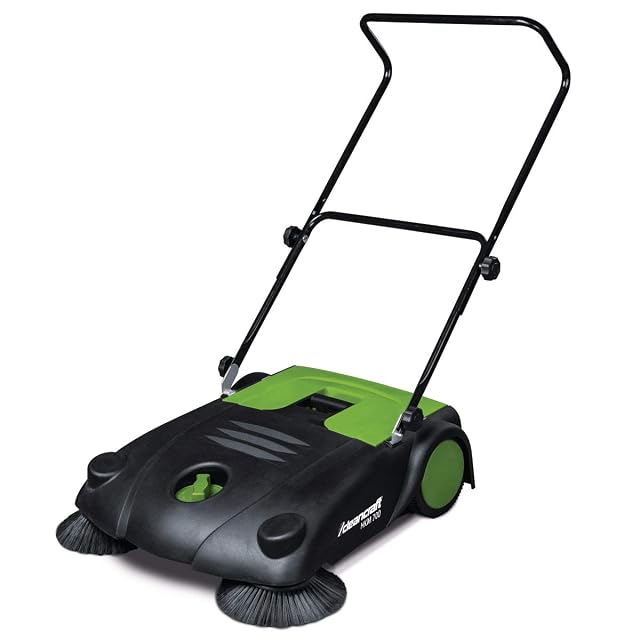
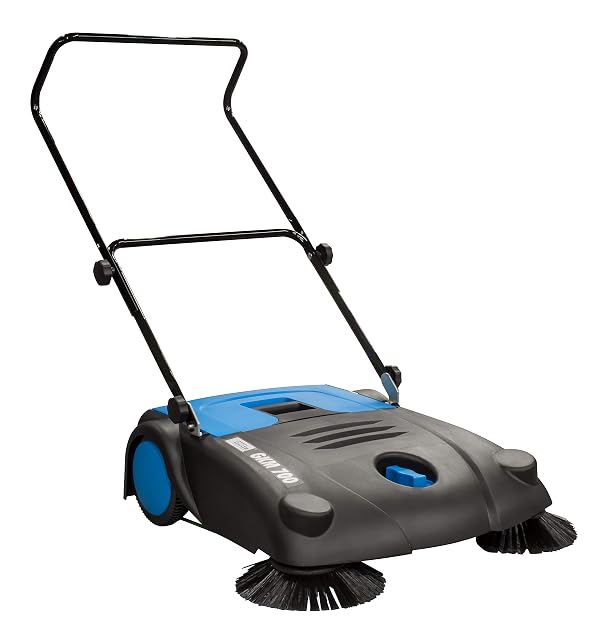
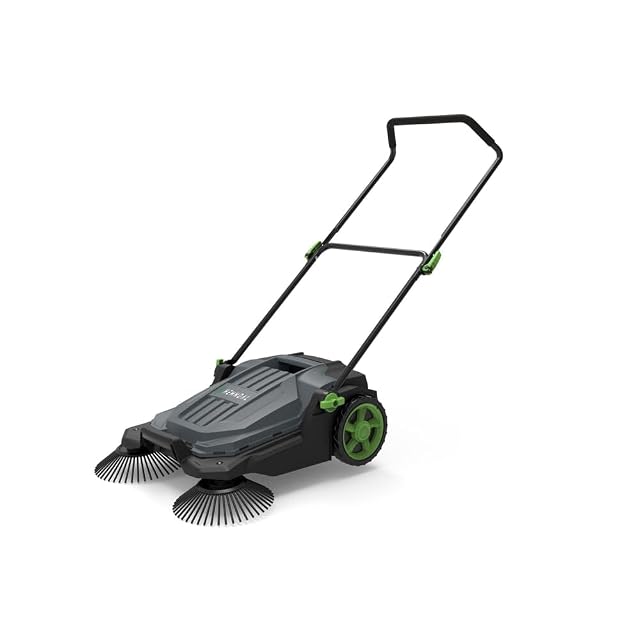
What the maker puts in writing
- “43 IN COMMERCIAL SWEEPING WIDTH… Designed for routine cleaning of commercial properties, facilities, workshops, and outdoor areas”
- “DUAL SIDE BRUSHES & 19 IN MAIN ROLLER - Equipped with dual front side brushes and a 19 in main roller brush to collect dust, dirt, leaves, paper, and other loose debris. Adjustable brush components support routine sweeping”
- “The removable 14.5-gallon debris hopper collects swept material for convenient disposal. The manual push design eliminates the need for batteries, motors, fuel, or electrical power”
- “Provides sweeping productivity of up to approximately 39,600 ft²/h… suited for warehouses, workshops, sidewalks, parking areas, commercial properties, and facility maintenance”
- “Features a folding handle and lightweight manual-push configuration”
- A specification table: “Sweeping Width: 43 in · Main Brush Length: 19 in · Side Brush Configuration: Dual Side Brushes · Side Brush Diameter: 14 in · Work Efficiency: Up to 39,600 ft²/h · Hopper Capacity: 14.5 Gallons · Hopper Type: Removable · Handle: Folding Handle · Brush System: Adjustable”
- Catalog: 889 × 787 × 406 mm (35 × 31 × 16 in)
A table where the rest of the shelf has adjectives
Set this listing against the other seven and the difference is not only the size.
It publishes a technical specification block: model, product type, operation, power source, sweeping width, main brush length, side brush configuration, side brush diameter, work efficiency, hopper capacity, hopper type, debris handling, handle, brush system.
What the other seven publish between them: a sweeping width (25.6 inches, six times over), a hopper capacity, and a great many phrases like “high-density brushes”, “large, high-performance bristles”, “dual rotating side brushes”, “5x more ground than a traditional broom”.
Four of those seven share an identical catalog weight of 11,000 g (388 oz) to the gram. One publishes dimensions of 15 × 15 × 15 mm (0.59 × 0.59 × 0.59 in). One contradicts its own sweeping width by four and a half inches.
So the comparison this shelf actually offers is between machines described and a machine specified.
Nineteen inches of roller inside forty-three inches of width
This is the only listing here publishing either brush figure, and together they explain what a width alone cannot.
Main roller: 19 inches. That is the part that throws debris up into the hopper.
Side brushes: dual, 14 inch diameter. They sweep inward from beyond the wheels, which is how a machine covers more width than its own chassis.
So of the 43 inches swept, 19 inches is genuinely lifted and the remaining 24 is funnelled into it by the side brushes. That ratio is what decides whether material reaches the hopper or simply gets pushed along in front of the machine — and it is the question no other listing on this shelf allows you to ask.
Fourteen inches of side brush diameter is a lot of reach ahead of the wheels, which is what gets a curb edge, a wall corner, or the gap beside a loading door.
Seven listings here describe a “main brush system”. Six of them publish 25.6 inches of width and say nothing whatever about the roller inside it.
And 43 inches against 25.6 is 68 per cent wider — which, on a machine whose output is width multiplied by walking pace, is most of where the productivity comes from.
The only rate on this shelf that survives division
39,600 ft²/h across 43 inches.
Divide it out: 43 inches is 3.583 feet, so 39,600 ÷ 3.583 = 11,052 feet per hour, which is 1.26 miles per hour.
That is a slow, deliberate pace — exactly how you walk when you want brushes to pick things up rather than skate over them. The figure assumes nothing unreasonable, and that is why it is worth something.
Now the alternative. The Dapper at $119.95 claims “27,900 ft/Hour” and publishes two different widths — 25.5 inches in its title, 21 inches in bullet two. At 25.5 inches that rate requires 2.5 mph; at 21 inches it requires 3.0 mph. A brisk walk and a fast walk. And “ft/Hour” is linear feet, which at 27,900 an hour is a running pace, so it must mean square feet as well.
The other six listings publish no rate at all. Five of them claim “5x more ground than a traditional broom”, which is not a measurement — though the underlying arithmetic is defensible, since a broom sweeps a sixteen-inch path back and forth where a sweeper covers its full width forward only.
So: one rate on this shelf you can plan a job around.
What 39,600 ft²/h means in practice: a 10,000 square foot warehouse floor in about fifteen minutes of walking, which is the claim that justifies a commercial machine.
Adjustable brushes, which nothing else here has
“Adjustable brush components support routine sweeping across suitable surfaces” — and in the table, “Brush System: Adjustable”.
This is the single functional feature that separates this machine from the other seven, and it decides whether a sweeper keeps working.
A sweeper only collects when the bristles just graze the floor.
Set too low, they drag. That wastes your effort — and on a hand-pushed machine you pay for drag directly — and it wears the bristles flat within a season.
Set too high, they pass over fine dust entirely and you get a machine that moves leaves and nothing else.
And bristles wear. A brush that was right in January is too high by June.
On a fixed-height machine you have one setting for the life of the bristles and for every surface you own. With adjustment you compensate for wear, and you change between a smooth warehouse floor and rough asphalt.
On the other seven listings — including all six at 25.6 inches — the brush contact you get out of the box is the contact you keep. Which is why assembly matters enormously on those machines and rather less on this one.
Fourteen and a half gallons, removable
Nearly three times the capacity of anything else on this shelf, and the hopper type is published: removable.
The shelf: 5 gallons on the IDEALHOUSE, both VEVOR listings and one Garvee · 5.25 gallons on two Garvee listings and the Dapper · 14.5 gallons here.
Fourteen and a half gallons is about 55 liters of dry debris, which matches the productivity claim: a machine that sweeps 39,600 square feet an hour would fill a five-gallon bin in minutes.
Removable is the right word and the one most of this shelf omits. Five listings publish a capacity and say nothing about how it comes out. The best statement here belongs to the Dapper, whose container “is easily removable and can be emptied without direct contact with the dirt” — which is what you want, since the contents of a yard sweeper are grit, leaf mold and worse.
The one caution the listing does not give: 55 liters of swept grit is heavy. Dry leaves weigh almost nothing, but a hopper full of sand and gravel off a car park is a two-handed lift, and this listing publishes no weight for the machine either.
No power, which is the whole category
“The manual push design eliminates the need for batteries, motors, fuel, or electrical power during operation.”
at least eight of the fifteen listings on this shelf make this argument, and on a commercial machine it is stronger rather than weaker.
The brushes are geared off the wheels, so pushing turns them. Which means:
No battery to degrade — the thing that ends most powered cleaning equipment after a few years, and the reason battery sweepers are expensive to keep.
Nothing to service. No motor, no charger, no filter.
No running cost and no fuel to store.
No noise, which on a commercial property decides whether you can sweep during business hours.
No certification or safety training of the kind a ride-on or battery machine brings with it.
And the productivity is proportional to your pace, which is exactly why the 39,600 figure resolves to 1.26 mph.
What the mechanism cannot do is the boundary this listing words better than any other here: it collects “dust, dirt, leaves, paper, and other loose debris.”
Loose is the honest limit. A mechanical sweeper takes what lies free and dry on a hard surface. It does not lift anything stuck, trodden in or wet — damp leaves clump and jam a roller rather than feeding into it — and it is not a substitute for a scrubber or a pressure washer.
Notably, the Garvee at $79.99 is the only listing here claiming lawns, and a fixed-height brush on soft uneven turf either scalps the grass or rides over the tufts.
What is not published
No weight, which on the largest machine here is the conspicuous omission. The bullet calls it a “lightweight manual-push configuration” and gives no figure, on a sweeper 43 inches wide with a 55 liter hopper. For comparison, both VEVOR listings publish 20.1 lb corroborated by catalog figures of 9099–9100 g, and the Dapper states 20 pounds. A 43 inch machine will be substantially more than that, and the catalog is silent.
No handle positions. The table publishes “Handle: Folding Handle” and no adjustment, where six rivals publish “2-position angle and height adjustment”. On a pushed machine, handle height is the difference between a chore and a backache — and on a commercial machine used for a shift rather than ten minutes, it matters more.
No wheel arrangement. Five of the cheaper listings publish a “hidden front caster and two large rear wheels” — three points, which cannot rock on uneven concrete the way four can, and which keeps the brushes in contact with the floor. On a 43 inch chassis the wheel layout is what keeps a 19 inch roller level, and nothing is said about it.
No finish or coating. The IDEALHOUSE and two Garvee listings publish a “surface coating” for rust and corrosion resistance; the VEVOR at $72.99 publishes “surface paint treatment”. This machine is sold for “outdoor areas”, “sidewalks” and “parking areas”, and publishes nothing about what protects it from weather.
No warranty, which is the real gap at this price. The Dapper at $119.95 — a quarter of the cost — publishes a 1-year limited warranty, and it is the only listing on this shelf with one. What fails on a hand sweeper is the brush spindle bearings, which take wet grit every time the machine crosses a damp yard; and since the brushes are geared off the wheels, a seized spindle ends the sweeping rather than merely stiffening the push.
No productivity interval or conditions behind the 39,600 figure — though unlike most claims on this shelf, the arithmetic behind it checks out.
Availability
Read on the day this page was built: $510 at the American Amazon shop.
Read from Keepa on the day this page was last revised; stock and price both move without notice.
Prices quoted in this text were read on 2026-10-04. The live price is at the top of the page.