What the maker puts in writing
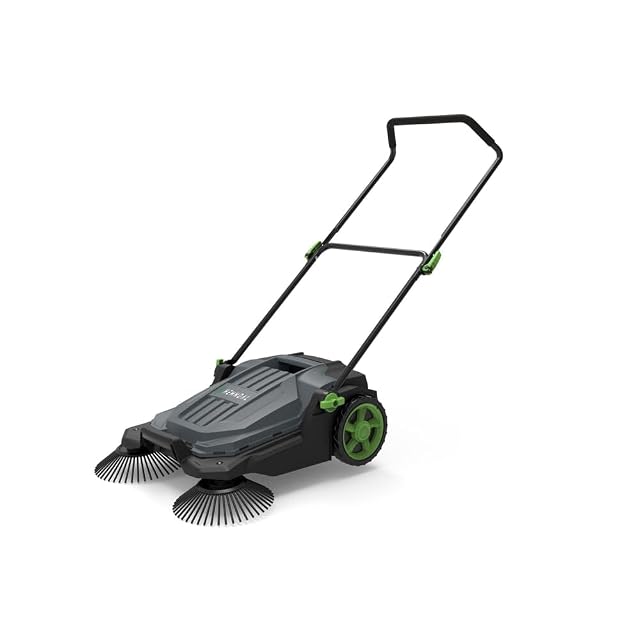
- “Featuring a 25.6” wide sweeping width, this walk-behind sweeper covers 5x more ground than a traditional broom in a single pass. Dual rotating side brushes funnel debris into the main brush system, effectively collecting fine dust, gravel, sand, and small debris from concrete, asphalt, tile, and asphalt surfaces with every push”
- “Equipped with a 5-gallon waste container, you can sweep continuously without frequent emptying… The hidden front caster and two large rear wheels glide smoothly across various surfaces with low noise, from smooth epoxy floors to uneven pavement”
- “The push handle offers 2-position angle and height adjustment… simply fold the handle for upright storage”
- “Built with reinforced metal components and high-quality engineering plastic… The surface coating treatment provides rust and corrosion resistance for long-term outdoor use. Assembly is tool-free and takes just 5 simple steps”
- “Zero power, zero fuel, zero batteries required — the rotating brushes are driven purely by the push motion”
- Catalog: 11,000 g (388 oz) · 15 × 15 × 15 mm (0.59 × 0.59 × 0.59 in)
The same machine as the one five dollars cheaper
Compare this listing with the IDEALHOUSE at $69.99 and the lists do not diverge.
Both publish: 25.6 inches of width · a 5 gallon container · dual rotating side brushes feeding a main brush system · a hidden front caster and two large rear wheels · 2-position angle and height adjustment · a folding handle · reinforced metal and engineering plastic with a corrosion-resistant coating · tool-free assembly · “5x more ground than a traditional broom” · a catalog weight of 11,000 g (388 oz) · the same surfaces, “concrete, asphalt, tile” and “smooth epoxy floors to uneven pavement”.
And this listing’s two most detailed bullets appear word for word on the Garvee at $74.99 with the 5.25 gallon bin, from the same seller:
“Dual rotating side brushes funnel debris into the main brush system, effectively collecting fine dust, gravel, sand, and small debris from concrete, asphalt, tile, and asphalt surfaces with every push.”
“The hidden front caster and two large rear wheels glide smoothly across various surfaces with low noise, from smooth epoxy floors to uneven pavement.”
So across six listings at this width — $69.99 to $85.59 — what genuinely differs is three things:
Hopper: 5 gallons here, on the IDEALHOUSE and both VEVOR listings · 5.25 gallons on the Garvee at $79.99 and the Garvee with the bag
Weight: 11,000 g here and on three other listings, identically · 9099–9100 g on the two VEVORs, which publish a figure in their bullets and match it
Price
On that evidence, five dollars buys nothing identifiable, and the IDEALHOUSE is the same machine for less.
Dimensions that cannot be the machine
15 × 15 × 15 mm is a cube an inch and a half on a side, published for a sweeper that is 25.6 inches wide by its own first bullet.
It is a placeholder, and the rest of the shelf is not much better.
Both VEVOR listings publish the same three numbers reordered: 1110 × 650 × 1059 mm (43.7 × 25.6 × 41.7 in) and 1110 × 1060 × 650 mm (43.7 × 41.7 × 25.6 in).
And 650 mm (25.6 in) is exactly 25.6 inches — the VEVOR bullet confirms the conversion, “a 25.6-inch (650mm) sweeping width” — so the 650 appearing in several of these strings is the sweeping width entered as a dimension. The same 650 turns up on the IDEALHOUSE (650 × 580 × 300) and the Garvee with the bag (650 × 670 × 980).
The only credible overall figure published anywhere on this shelf is the VEVOR pair’s 1110 mm (43.7 in) length, which is about right for a sweeper this wide.
If you need to know whether it fits a particular corner: work from the 25.6 inch width and a folded handle, not from the catalog.
The clearest description of the brush geometry here
“Dual rotating side brushes funnel debris into the main brush system.”
That sentence does more than most of this shelf, because it says how the parts relate.
Two angled brushes sit ahead of and outside the wheels, sweeping inward. A central roller then throws what they deliver up into the hopper. So the stated width is the span of the two side brushes, not the roller — which is why a sweeper can cover 25.6 inches on a chassis narrower than that.
What this listing does not give, and only one listing on the shelf does, is the size of either part. The TEXLIFT at $510 publishes a “19 in main roller brush” and a side brush “Diameter: 14 in”.
Those are the figures that matter. Main roller length decides how much of the swept width is actually lifted rather than merely pushed along. Side brush diameter decides how far ahead of the wheels the brushes reach, which is what gets a curb edge or a wall corner.
Six listings here describe a “main brush system” and measure none of it.
What it collects is honestly scoped: “fine dust, gravel, sand, and small debris”. The TEXLIFT uses the word that bounds all of these machines — “loose debris” — and that is the limit: a sweeper takes what lies free on a hard surface and nothing stuck, trodden in or wet.
A coating rather than paint
“The surface coating treatment provides rust and corrosion resistance for long-term outdoor use.”
Worth noting on this product in particular, because of where it lives and what it handles.
A sweeper is wet whenever it crosses a damp drive, it carries grit that abrades a finish, and it is typically kept in a shed rather than a house.
The parts at risk are the frame, the brush spindles and the axles — and a seized spindle is the end of the machine, since the brushes are geared off the wheels. A bearing that will not turn does not merely stiffen the push; it stops the sweeping.
Four listings here mention a finish. This and the IDEALHOUSE publish a “surface coating” for rust and corrosion resistance; the Garvee at $79.99 publishes a “sturdy metal frame”; the VEVOR publishes “surface paint treatment”, which is a weaker description, since paint and a coating are not the same commitment.
The TEXLIFT at $510 publishes nothing about finish at all, despite being the one machine here aimed squarely at commercial outdoor use.
Zero power, which is the honest argument
“Zero power, zero fuel, zero batteries required — the rotating brushes are driven purely by the push motion. No cords to tangle, no noise to disturb, no operating costs.”
at least eight of the fifteen listings on this shelf make this case and it is a good one.
No battery to degrade, which is what ends most powered garden machines after a few years. Nothing to service. No running cost. No noise.
And the sweeping rate is proportional to your walking pace — which is exactly why the only two productivity figures on this shelf resolve to walking speeds. The TEXLIFT’s 39,600 ft²/h across 43 inches divides out to 1.26 mph, a slow deliberate walk.
This listing publishes no rate, as none of the six machines at this width does. “5x more ground than a traditional broom” appears on five of them and is not a measurement — though the arithmetic is defensible, since a broom sweeps a sixteen-inch path back and forth where this covers 25.6 inches forward only.
What is not published
No productivity rate. The TEXLIFT publishes 39,600 ft²/h; the Dapper at $119.95 publishes 27,900 “ft/Hour”, which must mean square feet since 27,900 linear feet an hour is a running pace — and which also contradicts its own width, printing 25.5 inches in the title and 21 inches in bullet two.
No brush height adjustment, which only the TEXLIFT publishes. On the other seven machines the brush contact you get out of the box is the contact you keep, and that is what decides whether the bristles graze the floor or scrub themselves flat.
No roller or side brush dimensions.
No hopper removal method, where the TEXLIFT publishes a “removable” hopper and the Garvee at $79.99 an “easy-release & empty” design.
No weight in the bullets — and the catalog’s 11,000 g is the same figure as three other listings, to the gram, where both VEVOR machines state 20.1 lb and are corroborated at 9099–9100 g.
No warranty. Only the Dapper publishes one, at a year.
Availability
Read on the day this page was built: $75 at the American Amazon shop.
Read from Keepa on the day this page was last revised; stock and price both move without notice.
Prices quoted in this text were read on 2026-10-04. The live price is at the top of the page.