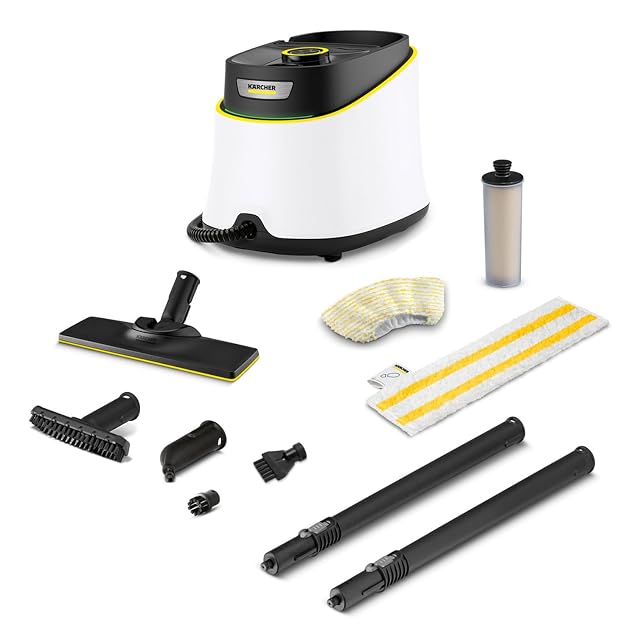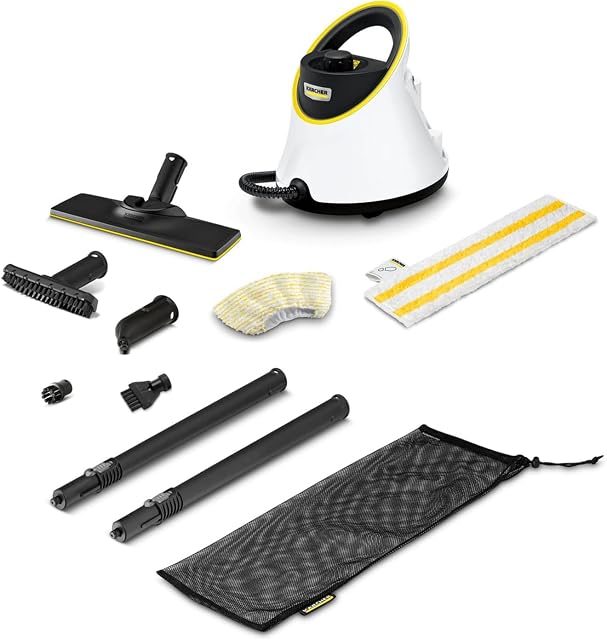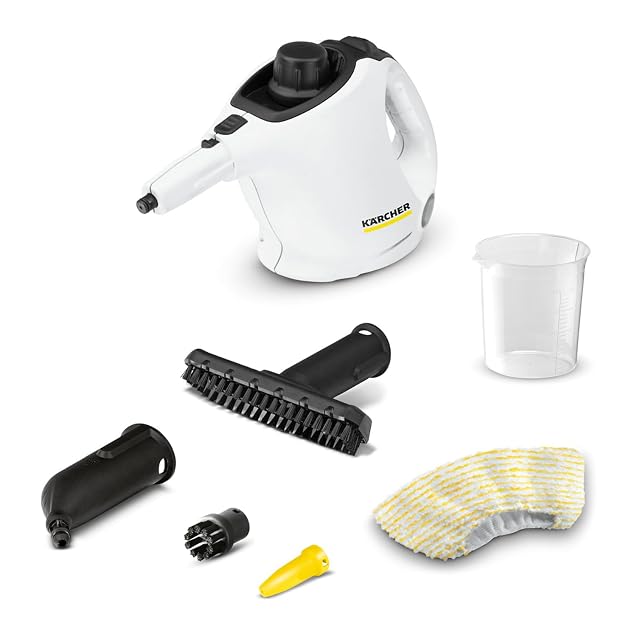
Kärcher SC 1
3 bar · 3 min heat-up · 200 ml · 1.58 kg (3.5 lb)
A handheld for taps, tiles and hobs — and honest about the twenty square meters it covers.
Best for: Taps, sinks, wall tiles, mirrors, extractor hoods and hobs — detail work, not floors
Heat instead of chemicals · review
A pressure washer and a steam cleaner in one chassis, with six safeguards including GFCI.
Where this ends up Two machines in one chassis, and the only listing on this shelf with GFCI protection. But its steam half publishes none of the five figures every rival gives — no temperature, no pressure, no tank, no heat-up, no runtime.
“Skip buying two separate machines.”
Everything else on this shelf steams. This steams and it washes, and those are genuinely different jobs: steam melts grease on contact and leaves nothing behind, where a pressure jet removes material by force and needs somewhere for the water to go.
So the division of labor is clean. The 3000 PSI side is for the driveway, the siding, the wheels and the patio. The 1500 W steam side is for the grout, the oven, the car interior and the upholstery. Neither does the other’s work: nobody steams a driveway, and nobody takes 2 GPM to a kitchen counter.
Buying both separately means two chassis, two cords, two cupboards and two sets of brushes. This is one of each, at $269.99 — the top of this shelf, $51 above the McCulloch at $218.99, which is a steam cleaner only.
That is the case for it, and it holds. The rest of this page is about what the page does not say.
Hydraulic power is pressure times flow, and the two published figures give a number larger than the published wattage.
3000 PSI is about 207 bar. 2 GPM is 7.6 liters a minute, or 1.26 × 10⁻⁴ m³/s.
207 × 10⁵ Pa × 1.26 × 10⁻⁴ m³/s ≈ 2,600 watts — of water power alone, before pump or motor losses.
The title publishes 1500 W.
There are two honest readings and the page does not choose between them:
Either 1500 W is the steam side only, which is how the third bullet reads — “the high-temperature 1500W steam cleaner” — in which case the pressure washer’s wattage is not published anywhere on the page.
Or 1500 W is the whole machine, in which case 3000 PSI and 2 GPM are alternatives rather than a pair. Work it through at a realistic 70% efficiency: about 1,050 W of water power, which at 2 GPM is roughly 1,200 PSI.
Twelve hundred PSI at two gallons a minute is a perfectly respectable domestic pressure washer. It is simply not three thousand.
Nothing here is invented. 3000 PSI is the no-flow stall figure at the nozzle, which is how the entire pressure-washer category quotes itself, and 2 GPM is the throughput. The figures just do not describe the same instant.
The flow is the number to keep, because flow is what carries dirt away. 2 GPM is squarely domestic — enough for a car, a patio and siding, not enough for a long driveway in one pass.
This is the omission that matters, and it is systematic.
Temperature. The Aspiron publishes 293 °F. The Mecmic 250 °F. The ODSD 221 °F. The Gautye 212 °F. The McCulloch “over 200 °F”. This publishes nothing — only “high-temperature”.
Pressure. Four rivals give bar or PSI: 4 bar on the McCulloch, Aspiron and HawKam, 3 bar on the ODSD and Gautye, 45 PSI on the Mecmic. This gives nothing.
Tank capacity. 64 oz on the McCulloch, 1600 ml on the Mecmic, 50.7 oz on the Aspiron, 1.69 QT on the ODSD. This gives nothing — so you cannot tell how often you will be filling it.
Heat-up time. Three rivals claim 15 seconds, two publish 4–6 minutes, the McCulloch under 12. This gives nothing — so you cannot tell which of the two architectures on this shelf it uses.
Runtime. 120 minutes on the McCulloch, 60 on the Mecmic, 50 on the Aspiron pair, 45 on the Gautye. This gives nothing.
That matters because the fifteen-second machines on this shelf are not the same kind of tool as the twelve-minute ones. A flash boiler vaporizes a trickle of water on demand; a tank boiler pressurizes a reservoir and holds temperature. The difference shows in every figure above, and this page publishes none of them.
What the wattage does tell you is useful in one respect: 1500 W at 120 V is 12.5 amps, which fits inside a standard 15 A American circuit. The Mecmic’s 2500 W works out at 20.8 A, which does not.
“Built-in pressure protection, overheating protection, motor protection, dry-burn protection, GFCI protection, and a trigger lock.”
GFCI is the one that counts. A Ground Fault Circuit Interrupter compares the current flowing out with the current coming back, and when a few milliamps go missing — which is what happens when electricity finds earth through water, or through a person — it cuts the supply in tens of milliseconds, below the threshold at which a shock stops a heart.
That is the actual hazard shared by every machine on this shelf: a mains appliance deliberately filled with water and often used on a wet floor. No other listing here mentions earth leakage at all.
One honest qualification. American outdoor and bathroom outlets have been required to be GFCI-protected for decades, so plugged in there you have the protection regardless. Older garage, basement and general interior circuits often are not — and a garage floor and a driveway are exactly where the bullets say this machine will live.
Dry-burn protection earns its place too, precisely because no tank capacity is published: a heating element run dry is how a steam cleaner dies, and with no stated volume you cannot gauge refills by eye.
A trigger lock on a 2 GPM jet is sensible — it is the safeguard that keeps the gun inert when you put it down, and it is the opposite of the McCulloch’s “steam lock”, which holds the trigger open.
How the rest of the shelf compares: the Aspiron and HawKam publish a child lock and an over-pressure release; the Mecmic a low-water alert and “no leaks, no shocks, and no scald”; the EurHomePlus a “surge thermostat that provides water shortage protection”; the ODSD and Gautye a transparent tank, which is the manual version of a low-water alert.
“into one compact unit. Save storage space.”
11099 g. The rest of this shelf: the McCulloch 5897 g, the Aspiron 4990 g. This is more than twice either.
And the footprint is the largest here: 540 × 504 × 342 mm (21.3 × 19.8 × 13.5 in) is 0.093 m (0.3 ft)³, against 0.055 m (0.2 ft)³ for the McCulloch and 0.043 m (0.1 ft)³ for the Aspiron.
So “compact” is true only in the sense the bullet intends — smaller than two separate machines — and false against anything else on this shelf. It is a floor-standing appliance, not something you carry upstairs.
Which is why the wheels and the ergonomic handle are not a feature but a necessity, and the one piece of mobility hardware nobody else here has. Eleven kilos on a handle alone would be unpleasant.
The practical consequence: this lives in a garage and comes out to where the work is. The Mecmic at $59.99 weighs a published 454 g (16 oz) and goes in a drawer. They are different propositions.
Itemized but not counted: a foam bottle, a glass scraper, round brushes, a wire brush, a curved nozzle, crevice tools, scraper tools, a spray gun.
The split is clear once you read it against the two halves. The spray gun and the foam bottle belong to the pressure washer. The round brushes, curved nozzle, crevice tools and glass scraper belong to the steam side.
The foam bottle is worth noticing, because it contradicts the best argument the category has. The McCulloch leads on exactly that: “CHEMICAL-FREE CLEANING… uses ordinary water”. A foam bottle is a detergent reservoir, so the pressure half of this machine expects a consumable the steam half does not need. Not a fault — foaming a car before rinsing is the right technique — but it is a recurring purchase.
The wire brush is the one to be careful with. Steel scratches anything polished, and steel particles left on aluminum corrode it later. The McCulloch supplies brass instead, which is softer than most of what you clean; the Aspiron pair supply three stainless steel brushes and three nylon.
No floor head on the steam side. The McCulloch has a floor mop and pads; the Aspiron pair have a floor brush and a carpet glider. This has neither, which makes its steam half a detailing tool whatever the bullets say about carpets — and steaming a carpet with a hand nozzle and no glider is slow work.
No count, which four rivals give: McCulloch 23, Aspiron and HawKam 21, Mecmic 18, Gautye 15, ODSD 12. “Multiple cleaning attachments such as” is not a list, and “such as” means the list is not even complete.
No cord length, which every rival here gives — and on an eleven-kilogram machine meant to move between a driveway and a kitchen, reach is the figure you most want. The McCulloch publishes 18 ft of cord plus a 7 ft hose; the Mecmic 16 ft; the ODSD 11.5 ft.
No hose length on the pressure side either, which is the other half of the same question.
No tank capacity for the steam, and none for detergent.
No sealed-surface warning, and this is the gap with real consequences. The bullets sell the steam side for “tile, grout, countertops, upholstery, carpets, furniture, and vehicle interiors” — and on unsealed timber, waxed wood, unglazed stone or laminate with open joints, steam drives water into the material and raises or lifts it. Only the McCulloch and the Gautye say the word “sealed” anywhere on this shelf. Worth testing a joint with a drop of water before steaming a whole floor.
No descaling or rinse function. The Mecmic is the only machine here with one — “a one-touch rinse function that clears potential clogs instantly”. Use distilled or filtered water in the steam side from the first fill.
No warranty term, where the Mecmic publishes three years with lifetime support.
And no reason given for the price gap, which is the fair way to read it: you are paying $269.99 for a published pressure washer and an unpublished steam cleaner. If you want both machines, that is a good trade. If you want only steam, the McCulloch at $218.99 publishes every figure this one withholds.
Read on the day this page was built: $270 at the American Amazon shop.
Read from Keepa on the day this page was last revised; stock and price both move without notice.
Prices quoted in this text were read on 2026-10-04. The live price is at the top of the page.
| What it is | Two machines — a 3000 PSI pressure washer and a 1500 W steam cleaner |
|---|---|
| Pressure side | 3000 PSI with 2 gallons per minute — see the FAQ on whether those are simultaneous |
| Steam side | 1500 W, and no temperature, pressure, tank, heat-up or runtime published |
| GFCI | The only listing on this shelf to publish it |
| Safeguards | Six — pressure, overheating, motor, dry-burn, GFCI and a trigger lock |
| Weight | 11099 g (391.5 oz) — more than twice the McCulloch at $218.99 |
| Mobility | Wheels and an ergonomic handle, which at eleven kilos it needs |
| Dimensions | 540 × 504 × 342 mm (21.3 × 19.8 × 13.5 in) — 0.093 m³, the largest footprint here |
| Accessories | Itemized but not counted: a foam bottle, a glass scraper, round brushes, a wire brush, a curved nozzle, crevice and scraper tools, a spray gun |
| Consumable | A foam bottle, so the pressure side expects detergent |
| Reference | BUV0001002 |
| Cord length | Not published — every rival here gives one |
| Warranty | Not published |
| Amazon reference | B0HJ5YYGT1 |
| EAN | 6978135910560 |
No, not at the same time, and the arithmetic is straightforward. Hydraulic power is pressure times flow. 3000 PSI is about 207 bar, and 2 GPM is 7.6 liters a minute, or 1.26 × 10⁻⁴ cubic meters a second. Multiply: 207 × 10⁵ Pa × 1.26 × 10⁻⁴ m³/s ≈ 2,600 watts of water power alone, before any pump or motor losses. The title publishes 1500 W. So either the figure applies to the steam side only — which is how the third bullet reads, "the high-temperature 1500W steam cleaner" — and the pressure washer’s wattage is simply not published anywhere on the page; or 1500 W is the whole machine, in which case 3000 PSI and 2 GPM are alternatives, not a pair. Working the second reading through at a realistic 70% efficiency gives about 1,050 W of water power, which at 2 GPM is roughly 1,200 PSI. That is a perfectly respectable domestic pressure washer — it is just not three thousand. Read 3000 PSI as the no-flow stall figure at the nozzle, which is how the whole category quotes itself, and 2 GPM as the real throughput. Neither number is invented; they just do not multiply.
One figure: 1500 W. Every other listing on this shelf gives five. Temperature — the Aspiron at $149.98 says 293 °F, the Mecmic at $59.99 says 250 °F, the ODSD at $49.99 says 221 °F, the McCulloch at $218.99 says "over 200 °F". This says nothing. Pressure — four rivals publish bar or PSI. This says nothing. Tank capacity — the McCulloch gives 64 oz, the Mecmic 1600 ml, the Aspiron 50.7 oz, the ODSD 1.69 QT. This says nothing. Heat-up time — three rivals claim 15 seconds, two publish 4 to 6 minutes, the McCulloch under 12. This says nothing, so you cannot tell whether it has a real boiler or a flash heater. Runtime — 120 minutes, 60, 50, 45 on four rivals. This says nothing either. What that means in practice is that you are buying the pressure washer on published figures and the steam cleaner on trust. The wattage does tell you one useful thing: 1500 W at 120 V is 12.5 amps, which fits a standard 15 A American circuit — unlike the Mecmic’s 2500 W, which works out at 20.8 A.
It is the only one that publishes it, and it is the single most useful safeguard in this category. GFCI — a Ground Fault Circuit Interrupter — watches the current going out against the current coming back. If a few milliamps go missing, which is what happens when electricity finds a path to earth through water or through you, it cuts the supply in tens of milliseconds, well below the threshold where a shock stops a heart. That is the actual hazard of every machine on this shelf: a mains appliance deliberately filled with water, often used on a wet floor. Worth knowing where you stand even so. American outdoor and bathroom outlets have been required to be GFCI-protected for decades, so plugged in there you have the protection whether the machine supplies it or not; older garage, basement and general interior circuits frequently are not. So the built-in unit matters most exactly where this machine is likely to be used — a garage floor, a driveway, a utility area. How the rest of the shelf handles risk: the Aspiron and HawKam publish a child lock and an over-pressure release; the Mecmic a low-water alert; the EurHomePlus at $109.99 a "surge thermostat" for water shortage; the McCulloch a steam lock, which is a convenience rather than a safeguard. None of them mentions earth leakage.
cleaning machines from the same category, at nearby prices. Only what all of them publish is shown: a column with holes compares nothing.
| Model | Price | Weight | Accessories | Warranty |
|---|---|---|---|---|
| This Hill BUV0001002 | $270 | 11099 g (391.5 oz) — more than twice the McCulloch at $218.99 | Itemized but not counted: a foam bottle, a glass scraper, round brushes, a wire brush, a curved nozzle, crevice and scraper tools, a spray gun | Not published |
| McCulloch MC1385 | $220 | 5897 g (208 oz) | Twenty-three, including a floor mop and pads, stored on board or in a bag | Stated as warrantied for US use, with no term given |
| HawKam CA019 | $200 | Not published | Twenty-one, itemized, including an ironing brush and a carpet glider | Not published |
| Aspiron CA019 | $150 | 4990 g (176 oz) | Twenty-one, fully itemized — including an ironing brush and towel | Not published |
Details checked on October 4, 2026.
Someone who needs a pressure washer and a steam cleaner and has one cupboard
Specifications: the manufacturer sheet for cleaning machines and the matching Amazon product page. Prices and availability: Keepa. Every figure on this page names its source.
3 bar · 3 min heat-up · 200 ml · 1.58 kg (3.5 lb)
A handheld for taps, tiles and hobs — and honest about the twenty square meters it covers.
Best for: Taps, sinks, wall tiles, mirrors, extractor hoods and hobs — detail work, not floors
3.5 bar · 30 s heat-up · 1 l refillable tank · 1,900 W
The one that refills like a kettle: thirty seconds to steam and no waiting for a boiler to cool.
Best for: Kitchens and bathrooms cleaned regularly, where the machine is picked up for twenty minutes at a time
3.2 bar · 6.5 min heat-up · 1 l tank · 1,500 W
The same coverage as the SC 3 for less money, and six and a half minutes of waiting to get there.
Best for: Planned cleaning sessions rather than quick jobs — where a six-minute wait is acceptable because you were going to be there an hour anyway