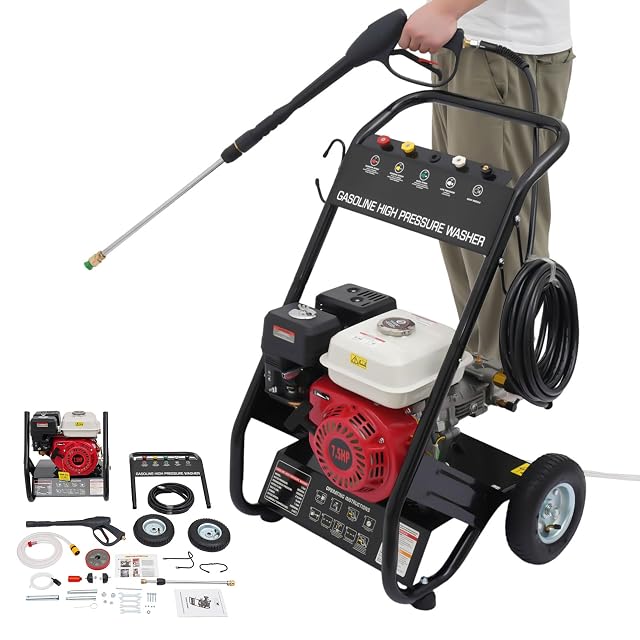
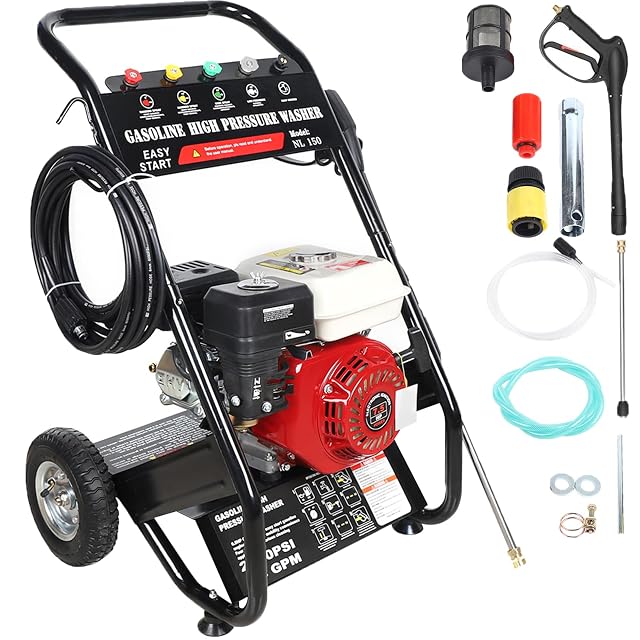
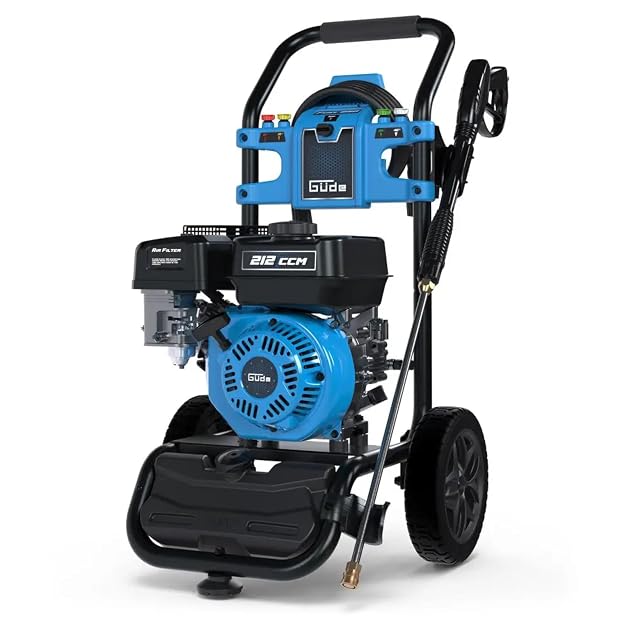
What the maker puts in writing
- “3200 PSI and 2. 5 GPM of Powerful, Deep-Cleaning Water Pressure… Easy to Fill 0.9 Gallon Gas Tank”
- “Half Gallon Onboard Soap Tank With 25 Foot Abrasion Resistant Super-Flex Hose With Lightweight Spray Gun and 5 Quick Connect Nozzles (0degree, 15degree, 25degree, 40degree & Soap). Choke Type: Manual”
- “Heavy Duty Gas Powered 212cc 4-Stroke Westinghouse OHV Horizontal Shaft Engine with Recoil Start - Long Lasting, Maintenance-Free Axial Cam Pump”
- “Tough Steel Frame Construction With 12 inch High Profile, Never-Flat Wheels… Includes Engine Oil, Tools, and Quick Start Guide”
- “Functionally Tested in the Factory and May Contain Minimum Residual Oil and/or Fuel Odor; EPA Compliant; Backed by 3-Year Limited Service, Labor, and Parts Coverage with Nationwide Customer Service and Support Network”
- Catalog: 28,576 g (1008 oz) · 533 × 495 × 991 mm (21 × 19.5 × 39 in)
The one to take of the two cheap Westinghouses
Thirty dollars separates this from the WPX3000 at $299, and it buys three things.
Output: 3200 PSI / 2.5 GPM against 3000 / 2.3. In cleaning units — PSI × GPM, which is the industry measure and which no listing on this shelf publishes — that is 8000 against 6900, a sixteen per cent gain.
Five nozzles against four. The WPX3000 drops the 15 degree tip, which is the one between a 0° pencil jet that carves grooves in decking and the 25° you use for most things. Fifteen degrees is for set-in concrete stains and paint preparation.
A half gallon onboard soap tank against a “detergent siphon hose” — a tube you drop into a bottle standing on the ground, which falls over, needs flushing after use, and means carrying an open chemical bottle round a wet driveway.
Everything else is the same machine: 212cc engine, axial cam pump, 25 foot hose, 12 inch never-flat wheels, steel frame, 3-year coverage.
The WPX3000’s only win is weight — 22,997 g (811.2 oz) against 28,576 g (1008 oz).
Three years, which is the only warranty on this shelf
All three Westinghouse listings publish “3-Year Limited Service, Labor, and Parts Coverage with Nationwide Customer Service and Support Network”.
The other eight — five Simpsons, the DeWalt, the PowerSmart — publish nothing.
There is an irony in that, and it is worth stating plainly: the three machines with the weakest pump type carry the only cover on the shelf.
An axial cam pump is driven directly off the crankshaft, costs little, and is described here as “maintenance-free” — which means sealed and unserviceable. When it fails it is replaced, not repaired. Three years of parts and labor on precisely that component is cover in the right place.
The five Simpsons take the other route: a triplex plunger pump with replaceable seals, an integrated unloader and thermal relief, rated in thousands of hours rather than hundreds — and no published warranty at all.
So the choice is between a pump that lasts and a promise if it does not.
The nationwide service network matters as much as the term. A warranty you cannot claim is a sentence.
Eight thousand cleaning units, and the machine that beats it for less
3200 × 2.5 = 8000.
The shelf, since nobody publishes the product:
Simpson CRX 4400 — 17,600 · Simpson ALH4240 — 16,800 · Simpson PS60869 — 14,000 · PowerSmart — 9500 · Simpson Aluminum 3600 — 9000 · Westinghouse WPX3400 — 8840 · Simpson PS3228 and PS61002 — 8250 · this — 8000 · DeWalt DXPW3300 — 7920 · Westinghouse WPX3000 — 6900
So the PowerSmart at $259.99 — seventy dollars less — delivers 9500 units, and it is the only listing on this shelf whose figures are PWMA performance certified, meaning verified by somebody other than the maker.
What this has that the PowerSmart does not: three years of cover, a published pump type, and never-flat wheels.
What the PowerSmart has: certified numbers, a 35 foot hose against this 25, and more output.
Pressure cuts, flow rinses. At 2.5 GPM this matches four Simpsons costing $639.99 to $829.94 on flow, and gives away pressure to all of them.
A sealed pump, and the valve that is missing
“Maintenance-free axial cam pump” is a phrase that reads as a benefit and describes a limitation.
Direct-drive off the crankshaft, few parts, low cost, and nothing you can service. Service life is typically in the low hundreds of hours against thousands for a triplex plunger pump.
What is absent is more consequential than the type. No thermal relief valve is published.
The mechanism: release the trigger and the engine keeps running, so the pump keeps turning and water circulates inside it with nowhere to go. It heats within a minute or two, and above a certain temperature the seals and valves are damaged.
A thermal relief valve dumps that hot water on the ground before it happens.
The DeWalt at $429 uses the same type of axial cam pump and publishes one: “Thermal relief valve prevents overheating for long-lasting performance.” All five Simpsons publish one, plus an “integrated unloader” that diverts flow at the pump when the trigger is off.
The three Westinghouse machines and the PowerSmart publish neither.
The practical conclusion for any of these machines: do not leave it running with the trigger off. On a sealed pump, that habit is what the three-year warranty is really insuring.
Manual choke, which only this listing states
“Choke Type: Manual.”
The only choke specification on the shelf, and it is a fair thing to tell you.
A cold petrol engine needs a richer mixture. A manual choke is a lever you close to start and open once it runs — two or three pulls, open the choke, and it settles. An automatic one does it for you and is one more part to fail.
It matters because this is a machine used a few times a year, often after months in a garage, and starting is where petrol equipment lets people down.
What actually governs that is fuel rather than choke type: stale petrol in the carburettor is the commonest reason a pressure washer will not start in spring. No listing on this shelf mentions stabiliser or draining the tank.
All three Westinghouse listings do say the machine was “functionally tested in the factory” and “may contain minimum residual oil and/or fuel odor” — which is honest, and means there is already fuel in it when it arrives.
Engine oil, tools and a quick start guide are included, which is more than most listings here state.
Never-flat wheels, and the argument against them
12 inch high profile, never-flat — solid wheels, on all three Westinghouse machines.
They cannot puncture and never need air, so a machine left from November to March rolls when you want it.
Every Simpson listing argues the opposite in identical words: “10” premium pneumatic tires roll smoothly over gravel, grass, and curbs.” That is true. An air tire deforms and climbs where a solid one skids and transmits every bump into the frame.
At 28,576 g (1008 oz) this is in the lighter half of the shelf, which softens the case for air. The three heaviest Simpsons — 120 to 135 lb — move up to 13 inch pneumatics precisely because weight makes rolling harder.
What is not published
No thermal relief valve, as above.
No low-oil shutdown, which cuts the engine before it seizes. The DeWalt at $429 has it, and so do the four Honda-engined Simpsons. Not this, its two siblings, the PowerSmart, or the $899.99 Simpson CRX.
No unloader.
No hose bore, where the WPX3000 publishes “Interior Hose Diameter - 0.25 inches” and three Simpson listings publish 5/16 or 3/8 inch depending on length — because a longer hose needs a wider bore to avoid losing pressure to friction.
No PWMA certification, which only the PowerSmart claims, and which is the only independent verification of a PSI figure anywhere on this shelf.
No state restriction, which counts in its favor: all five Simpsons are “49-State Compliant (Not for sale in California)” and the DeWalt is “49-state compliant”, where this says only “EPA Compliant”.
Availability
Read on the day this page was built: $330 at the American Amazon shop.
Read from Keepa on the day this page was last revised; stock and price both move without notice.
Prices quoted in this text were read on 2026-10-04. The live price is at the top of the page.