What the maker puts in writing
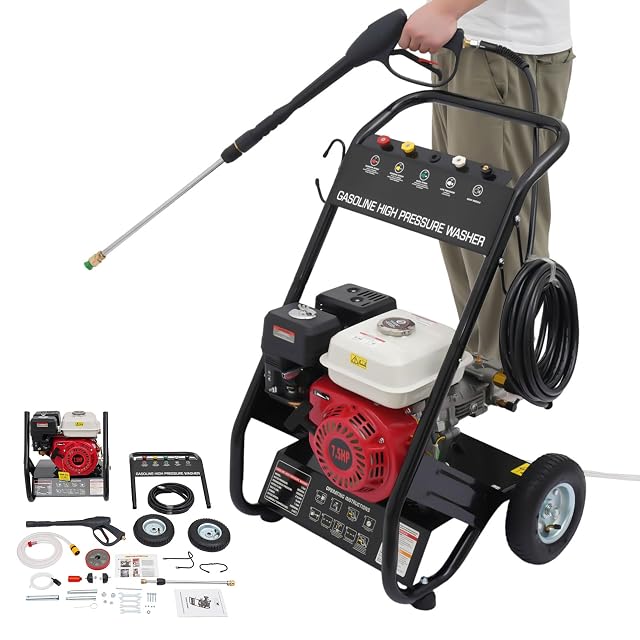
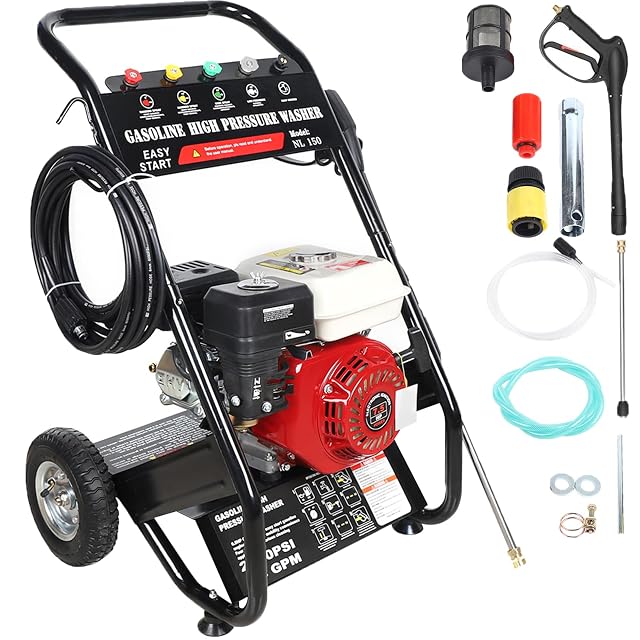
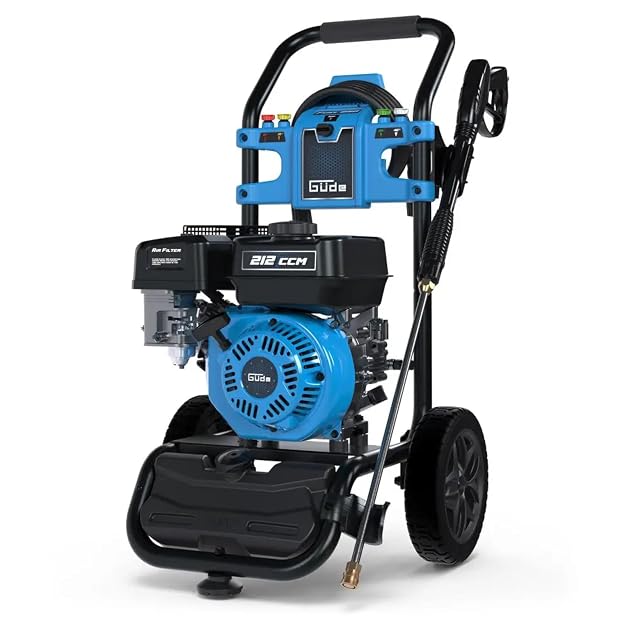
- “212cc 4-stroke OHV engine delivers 3800 PSI @ 2.5 GPM, easily reaching second-story surfaces”
- “Rugged steel frame and 35′ abrasion-resistant super-flex hose for extended service life”
- “CERTIFIED – PWMA performance certified; compliant with UL 1776 safety standards; EPA engine certified”
- “10″ pneumatic tires for effortless moving on any terrain”
- “Onboard soap tank + hook & sling, 5 quick-connect nozzles, soft-grip handle, easy-pull recoil start”
- Catalog: 27,669 g (976 oz) · 1011 × 559 × 490 mm (39.8 × 22 × 19.3 in)
“PWMA performance certified; compliant with UL 1776 safety standards; EPA engine certified.”
This is the reason to take the price seriously, and it is unique here.
The Pressure Washer Manufacturers’ Association runs a verification program for exactly one reason: ratings in this category are routinely overstated. A maker can quote the pump’s theoretical maximum, or the pressure at the pump rather than at the nozzle, or a figure reached only with the 0° tip. Certification means somebody independent measured it.
No other listing on this shelf mentions PWMA. The five Simpsons cite “49-State Compliant” and two Westinghouse machines cite “EPA Compliant”, both of which are emissions statements about the engine, not performance claims about the pump.
UL 1776 is the American safety standard for pressure washers, and that is also unique to this listing.
For a sense of why verification is not a theoretical concern on this shelf: the Simpson PS61002 at $639.99 is titled 3500 PSI while its own bullet says “3300 PSI 2.5 GPM AAA triplex pump” and its description says “Delivering 3300 PSI”. And the Simpson CRX at $899.99, titled 4400 PSI and 4.0 GPM, carries a description that reads “The SIMPSON PowerShot 4000 PSI at 3.5 GPM… The PS60869 features a commercial SIMPSON 420 engine” — which is a different model on this same shelf.
Nine thousand five hundred cleaning units
The industry measure is PSI × GPM, and not one of these eleven listings publishes it.
Simpson CRX 4400 — 17,600 · Simpson ALH4240 — 16,800 · Simpson PS60869 — 14,000 · PowerSmart — 9500 · Simpson Aluminum 3600 — 9000 · Westinghouse WPX3400 — 8840 · Simpson PS3228 and PS61002 — 8250 · Westinghouse WPX3200 — 8000 · DeWalt DXPW3300 — 7920 · Westinghouse WPX3000 — 6900
So at $259.99 this does more work per minute than the Simpson Aluminum Series at $729.99 and the Westinghouse WPX3400 at $349.
Why the product matters rather than either number alone: pressure cuts, flow rinses. A high-pressure, low-flow machine blasts a spot clean and then takes all afternoon to move the dirt down the driveway. At 2.5 GPM this matches the flow of four Simpsons priced from $639.99 to $829.94, with more pressure than three of them.
The “easily reaching second-story surfaces” claim follows from the pressure, and is fair — 3800 PSI at a 25° tip throws a usable stream two stories up.
Thirty-five feet of hose, which six rivals do not give you
35 feet puts this above the six machines supplying 25 feet: all three Westinghouse models, the DeWalt, the Simpson PS61002 and the Simpson PS3228.
It matches the Simpson Aluminum 3600 at $729.99, and is beaten only by the 50-foot hoses on the three big Simpsons.
Hose length decides whether you move the machine or the wand. Thirty-five feet reaches around most of a house from one position; twenty-five does not.
There is a cost to length that this listing does not address, and three rivals do. A long hose loses pressure to friction, and a wider bore loses less — which is why the 50-foot Simpson hoses are 3/8 inch (“3/8-inch x 50-foot Monster”), where the 25 and 35 foot Morflex hoses are 5/16 inch, and the Westinghouse WPX3000 publishes the narrowest on the shelf: “Interior Hose Diameter - 0.25 inches”.
At 2.5 GPM over 35 feet, bore is worth knowing. This listing does not state it.
Five nozzles and an onboard tank
Five quick-connect nozzles matches at least nine of the sixteen listings here. The exception is the Westinghouse WPX3000 at $299, which has four — it drops the 15° — and which has no soap tank, offering a “detergent siphon hose” instead.
An onboard soap tank is the better arrangement: you fill it once and switch to the soap nozzle, rather than feeding a tube into a bottle on the ground that falls over.
The hook & sling is a small thing that matters on a machine you store in a garage: thirty-five feet of hose has to live somewhere, and coiling it onto the frame is the difference between a tidy machine and a tangle.
One caution about the nozzle set that no listing on this shelf raises: the 0° tip is included on all eleven machines, and at 3800 PSI a pencil jet with no fan will cut flesh, carve grooves in decking and drive mortar out of brickwork. Simpson’s own listings describe the five-tip set as covering “tasks from stripping paint to car cleaning” — stripping paint is the 0° and 15° job. Use the 25° for almost everything and the 40° on anything painted.
Pneumatic tires, which is the right choice
10 inch pneumatic, matching the DeWalt, Simpson PS61002, PS3228 and Aluminum 3600.
The three Westinghouse machines use 12 inch “never-flat” solid wheels instead, and the trade is real: a solid wheel never punctures and never needs air, and a pneumatic one rolls far better over gravel, grass and curbs. Every Simpson listing on this shelf makes exactly that point — “10” premium pneumatic tires roll smoothly over gravel, grass, and curbs”.
On a 27,669 g (976 oz) machine you will be pulling across a drive and up a curb, pneumatic is worth the occasional pump.
The three heaviest machines here — all Simpsons at 120 to 135 lb — move up to 13 inch tires for the same reason.
What is not published, and all of it concerns longevity
No pump type, and this is the most consequential omission on the shelf.
The three Westinghouse machines and the DeWalt publish an axial cam pump: direct-drive, inexpensive, and described as “maintenance-free” — which on an axial cam means sealed and not rebuildable. The five Simpsons publish a triplex plunger pump, with replaceable seals, an integrated unloader, and a working life measured in thousands of hours rather than hundreds.
At this price an axial cam is the likely answer, and the frame and engine are consistent with that.
No thermal relief valve. Release the trigger and water recirculates inside the pump, heating with every second. Without a valve to dump it, the pump cooks — and that is the commonest way these machines die. The DeWalt and all five Simpsons publish one. The three Westinghouse machines and this do not.
No low-oil shutdown, which cuts the engine before it seizes. Published on the DeWalt at $429 and on the four Honda-engined Simpsons. Not here, and not on the $899.99 Simpson CRX either.
No warranty. The three Westinghouse machines publish “3-Year Limited Service, Labor, and Parts Coverage with Nationwide Customer Service and Support Network” — the only warranty on this shelf. The other eight, including this, publish none.
No state restriction, which is the one omission in your favor: all five Simpsons are “49-State Compliant (Not for sale in California)”, the CRX adding “Does not ship to California”, and the DeWalt is “49-state compliant”. This listing says only “EPA engine certified”, with no state excluded.
Availability
Read on the day this page was built: $270 at the American Amazon shop.
Read from Keepa on the day this page was last revised; stock and price both move without notice.
Prices quoted in this text were read on 2026-10-04. The live price is at the top of the page.