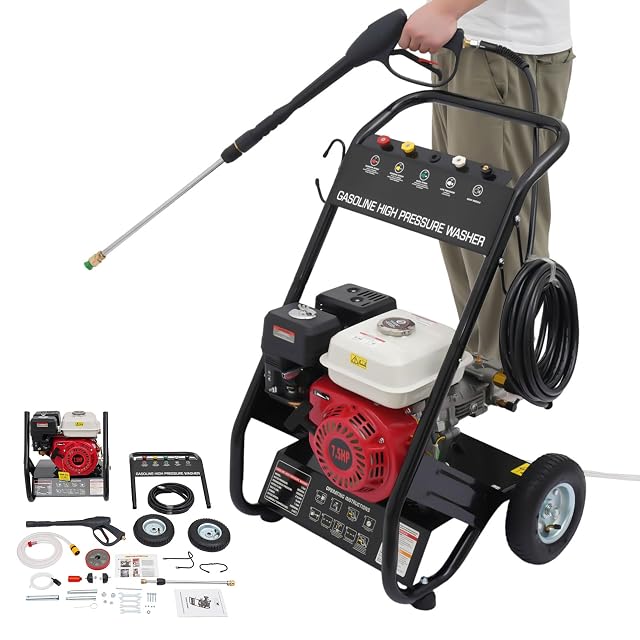
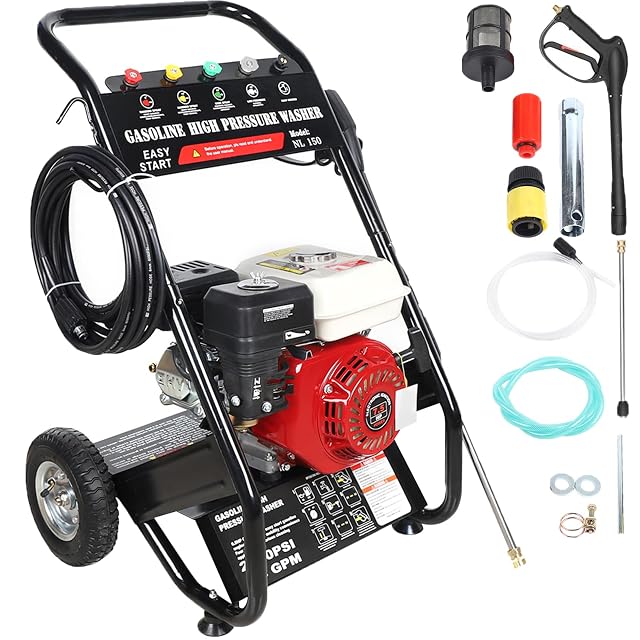
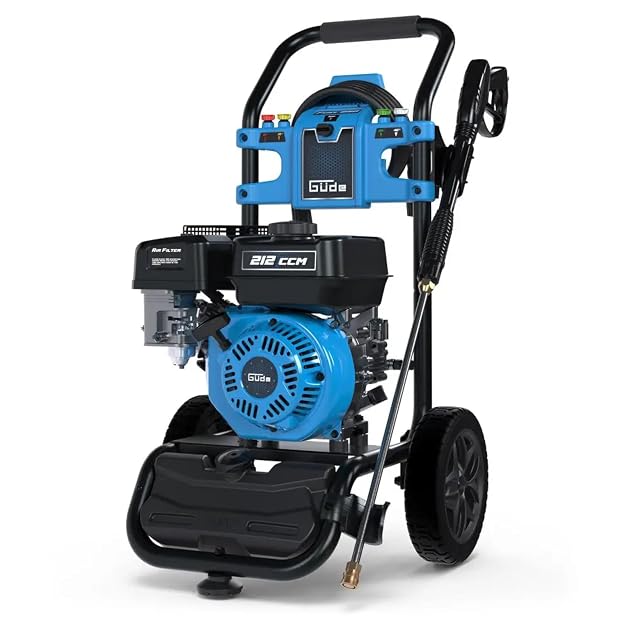
What the maker puts in writing
- “HONDA GX200 engine starts easily & includes low-oil shutdown; 3600 PSI 2.5 GPM AAA triplex plunger pump features integrated unloader; Thermal relief prevents overheating; PowerBoost Technology delivers higher pressure at the nozzle”
- “The Simpson Morflex series 35’ high-pressure hose is non-marring, flexible and abrasion-resistant; Pump/Hose Connection: Threaded M22”
- “10” premium pneumatic tires roll smoothly over gravel, grass, and curbs… Aircraft grade aluminum frame with powder-coated finish is easy to assemble and resists corrosion; 21” L x 24” W x 34” H; 78 lb”
- “Five quick-connect pressure washer tips (0°, 15°, 25°, 40°, and soap nozzle)… Professional QC spray gun with safety lock-out and 16” spray wand included”
- Description: “The aircraft-grade aluminum frame with brushed, extruded tubing resists corrosion and cuts weight” and “a 35-ft MorFlex 5/16” high-pressure hose”
- “49-State Compliant (Not for sale in California)”
- Catalog: 35,834 g (1264 oz) · 762 × 610 × 533 mm (30 × 24 × 21 in)
Sold on cutting weight, and heavier than the steel one
The description says the aluminum frame “resists corrosion and cuts weight”. The bullet publishes 78 lb.
The steel-framed Simpson PS3228 at $659 publishes 77 lb. The steel-framed PS61002 at $639.99 publishes 74 lb.
All three have the same Honda GX200, the same AAA triplex plunger pump and the same 2.5 GPM.
So the aluminum machine is one to four pounds heavier than the steel ones.
Two differences could account for it, and both are real. This delivers 3600 PSI rather than 3300, which generally means a larger pump. And it carries 35 feet of hose rather than 25 — ten extra feet of braided high-pressure line is a few pounds on its own.
The catalog figures track the bullets closely, at 35,834 g (1264 oz) here against 33,929 g (1196.8 oz) for the PS3228, so the numbers agree with each other. It is the marketing they disagree with.
What aluminum genuinely buys is corrosion resistance, which the bullet also claims and which is the sounder argument. A powder-coated steel frame rusts from any chip, and a pressure washer lives in a damp garage and gets soaked every time it is used. Aluminum does not care.
The description’s “brushed, extruded tubing” is the honest version: extruded aluminum tube is stiff, light per unit of section, and does not rust.
Seventy-one dollars over the PS3228
Four things change, and they are all worth something.
Pressure: 3300 → 3600 PSI. In cleaning units — PSI × GPM, which no listing here publishes — 8250 → 9000, about nine per cent.
Hose: 25 → 35 feet. The difference between moving the machine twice round a house and once.
Frame: welded powder-coated steel → aircraft grade aluminum. Corrosion, as above.
Gun: gains a safety lock-out, which the PS3228 does not have.
What stays identical: the Honda GX200 with low-oil shutdown, the AAA triplex plunger pump with integrated unloader and thermal relief, the 5/16 inch Morflex hose, the 10 inch pneumatic tires, the threaded M22, the five tips, the 16 inch wand, the 21 × 24 × 34 inch footprint.
So a meaningful step rather than a transformative one.
And the figure that puts it in context: the PowerSmart at $259.99 delivers 9500 cleaning units — more than this — with PWMA performance certified figures, meaning verified by somebody other than the maker. What it does not have is a rebuildable pump, a Honda engine, thermal relief, or a hose that will not mark your siding.
Output is cheap on this shelf. Durability is not.
Nine thousand cleaning units
3600 × 2.5 = 9000.
Simpson CRX 4400 — 17,600 · Simpson ALH4240 — 16,800 · Simpson PS60869 — 14,000 · PowerSmart — 9500 · this — 9000 · Westinghouse WPX3400 — 8840 · Simpson PS3228 and PS61002 — 8250 · Westinghouse WPX3200 — 8000 · DeWalt — 7920 · Westinghouse WPX3000 — 6900
Pressure cuts, flow rinses. At 2.5 GPM this has the same flow as five other machines here and more pressure than any of them — which suits the work the listing names: “deck cleaning, wood restoration, paint preparation”.
Those are all pressure jobs rather than volume jobs. Stripping a weathered deck or preparing siding for paint is about lifting a bonded layer, and 3600 PSI with the 15° tip does that where 3000 struggles.
Where 2.5 GPM shows its limit is a long driveway, where you are pushing dirt rather than cutting it. The three big Simpsons move to 3.5 and 4.0 GPM for exactly that.
For a surface cleaner, 2.5 GPM will drive a twelve to sixteen inch head properly — the head has no motor, and its nozzles are spun by the water leaving them, so flow turns the arm.
A gun that locks, which only one other machine here has
“Professional QC spray gun with safety lock-out.”
The trigger is the only thing between a 3600 PSI jet and whatever is in front of it.
Two listings on this shelf publish a lock: this and the ALH4240 at $1448.99. The other nine publish none — the PS61002 and PS3228 have a “rear-load M22 pressure washer gun”, the DeWalt an “ergonomic spray gun”, the three Westinghouse machines a “lightweight spray gun”.
What a lock prevents: a gun set down on the frame or a step with the engine running, where a foot, a hose or a dog can pull the trigger.
And the reason that is not a theoretical concern — every machine on this shelf ships a 0° tip, and not one of the eleven listings warns about it. A 0° nozzle has no fan at all: it is a pencil jet that cuts flesh, carves visible grooves in decking in one pass, and drives mortar out of brickwork.
Simpson’s own description of the tip set is accurate and is also the warning: “cover tasks from stripping paint to car cleaning”. Stripping paint is the 0° and 15° job.
Use the 25° for most work, the 40° on anything painted or wooden, and keep the 0° for concrete you do not mind marking.
The pump, which is what separates these two halves of the shelf
AAA triplex plunger, with an integrated unloader and thermal relief.
The division across these eleven listings is exact:
Axial cam — three Westinghouse machines and the DeWalt. Driven straight off the crankshaft, cheap, and described by Westinghouse as “maintenance-free”, which means sealed and unserviceable. Rated in the low hundreds of hours.
Triplex plunger — all five Simpsons. Three pistons on their own crankshaft, running slower and cooler, with replaceable seals. Rated in the thousands of hours.
And the two valves are what keep it alive. An unloader diverts flow at the pump when the trigger is released, rather than letting pressure build against a closed gun. Thermal relief dumps water before recirculation heats it enough to wreck the seals.
The commonest way any of these pumps dies is being left running with the trigger off. The three Westinghouse machines publish neither valve; the DeWalt publishes thermal relief alone.
PowerBoost Technology — “delivers higher pressure at the nozzle” — appears on this, the CRX 4400 and the PS60869, and is explained on none of the three. Treat it as an unexplained term rather than a specification.
A Honda GX200 and a non-marring hose
Honda GX200 with low-oil shutdown, shared with the PS61002 and PS3228.
The most widely serviced small engine in the world: a carburettor, a recoil spring or a gasket set is available anywhere, and anyone who services mowers knows it. Low-oil shutdown cuts the ignition before the engine seizes, which on a machine used a few times a year after months in a garage is the realistic failure.
It is absent from the three Westinghouse listings, the PowerSmart, and the $899.99 Simpson CRX — which runs Simpson’s own CRX 420cc engine rather than a Honda.
The hose is non-marring, which three Simpson listings publish and no other brand here does. Thirty-five feet of high-pressure line gets dragged across whatever you are cleaning, and a rubber hose leaves black streaks on painted siding, decking and paving. A polyurethane jacket does not.
And the bore is published in the description as 5/16 inch, which matters: a hose loses pressure to friction, and bore has to scale with length. The 50 foot Monster hoses on the three big Simpsons are 3/8 inch for that reason, and the Westinghouse WPX3000 publishes the narrowest here at 0.25 inches over 25 feet.
What is not published
No warranty. The three Westinghouse machines publish “3-Year Limited Service, Labor, and Parts Coverage with Nationwide Customer Service and Support Network”. All five Simpsons, the DeWalt and the PowerSmart publish nothing.
Which remains the counter-argument to the whole Simpson case: the machines with the rebuildable pump carry no promise, and the machines with the sealed pump carry three years.
No soap tank or detergent route. Two Westinghouse machines publish a “Half Gallon Onboard Soap Tank”, the third a “detergent siphon hose”, the PowerSmart an onboard tank. This publishes a soap nozzle and nothing about where the soap comes from.
No PWMA certification, which only the PowerSmart claims.
No fuel tank capacity.
No explanation of PowerBoost.
And not for sale in California, as with all five Simpsons here.
Availability
Read on the day this page was built: $730 at the American Amazon shop.
Read from Keepa on the day this page was last revised; stock and price both move without notice.
Prices quoted in this text were read on 2026-10-04. The live price is at the top of the page.