What the maker puts in writing
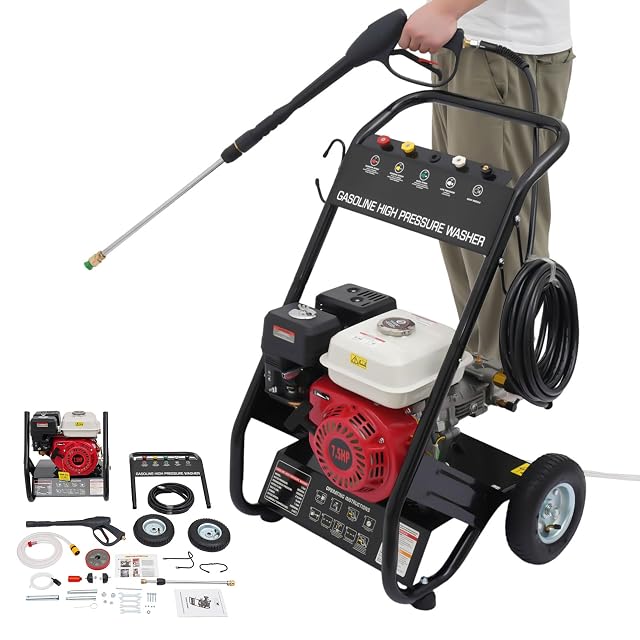
- “Easy-to-assemble and easy-to-start with its Honda GX270 premium engine, the PowerShot power washer is great for contractors who specialize in deck cleaning, wood restoration, paint preparation”
- “A powerful, reliable, maintenance-free AAA industrial triplex plunger pump delivers 4000 PSI at 3.5 GPM and includes thermal relief to prevent overheating; PowerBoost Technology delivers higher pressure at the nozzle”
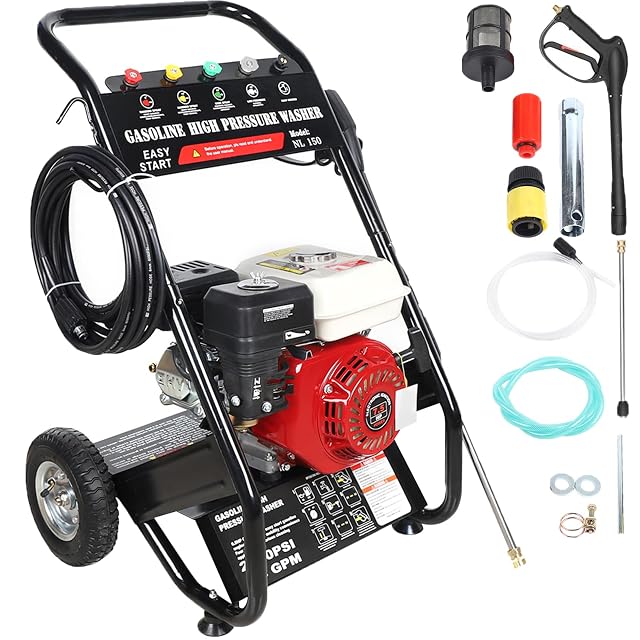
- “Monster 3/8-inch x 50-foot high-pressure hose is kink- and abrasion-resistant; 5 Quick connect nozzle tips: 0°, 15°, 25°, 40° and Soap; Ergonomic spray gun 31-inch steel wand/lance”
- “13-inch premium pneumatic tires deliver ease of maneuverability across uneven ground… welded steel frame construction with powder-coated finish”
- “49-State Compliant; Direct Drive; Pump/Hose Connection - Threaded M22 connection; Dimensions - 38” L x 23.5” W x 29” H; 120 pounds”
- Catalog: 54,431 g (1920 oz) · 965 × 597 × 737 mm (38 × 23.5 × 29 in)
Three and a half gallons a minute, which changes what the machine is for
Pressure cuts. Flow rinses. That is the whole distinction, and this is the first machine on the shelf with real flow.
At 2.5 GPM — which five machines here manage — you break the grime off a driveway and then push it slowly towards a drain. At 3.5 GPM it goes.
In cleaning units, PSI × GPM, the measure no listing here publishes:
Simpson CRX 4400 — 17,600 · Simpson ALH4240 — 16,800 · this — 14,000 · PowerSmart — 9500 · Simpson Aluminum 3600 — 9000 · Westinghouse WPX3400 — 8840 · Simpson PS3228 and PS61002 — 8250 · Westinghouse WPX3200 — 8000 · DeWalt — 7920 · Westinghouse WPX3000 — 6900
So this does fifty-five per cent more work per minute than the next Simpson down, and nearly twice what any machine under four hundred dollars here manages.
It also unlocks the accessory that transforms a driveway. A surface cleaner has no motor: its two nozzles sit on a swivel and are spun by the water leaving them, in reaction. Flow turns the head. Most need 2 GPM as a floor, and a twenty inch head — the widest sold — needs real volume to spin properly. At 3.5 GPM this will drive one.
The cost is water. Three and a half gallons a minute is 210 gallons an hour, which on a metered supply is a figure worth knowing before you start.
Fifty feet of three-eighths hose, which is the right bore
“Monster 3/8-inch x 50-foot high-pressure hose is kink- and abrasion-resistant.”
Both numbers matter together, and three listings on this shelf publish the pair.
A hose loses pressure to friction along its length, and a narrower bore loses more. So bore has to scale with length and flow:
Westinghouse WPX3000 — 0.25 inch over 25 feet at 2.3 GPM, the narrowest here
Simpson PS3228 and Aluminum 3600 — 5/16 inch over 25 and 35 feet at 2.5 GPM
this, the CRX and the ALH4240 — 3/8 inch over 50 feet at 3.5 to 4.0 GPM
Fifty feet of 5/16 inch at 3.5 GPM would drop real pressure at the nozzle. The Monster hose is wide because it has to be.
What fifty feet buys in practice: you clean a whole side of a house without moving a 120 lb machine. The 25 foot hoses on six listings here mean repositioning constantly.
Threaded M22 is the domestic standard, and what lets you fit a surface cleaner or foam cannon. Only the Westinghouse WPX3400 on this shelf says what M22 actually lets you buy.
And a 31 inch steel wand, nearly twice the 16 inch wands on the three smaller Simpsons and the DeWalt — which is the difference between reaching a gutter from the ground and fetching a ladder.
A real Honda, where the dearer Simpson has a house engine
Honda GX270, against the Simpson CRX 4400 at $899.99 which runs Simpson’s own “CRX 420cc premium engine”.
The CRX delivers more — 4400 PSI at 4.0 GPM, 17,600 cleaning units — and gives up two things for it.
Parts and service. A Honda GX is the most widely serviced small engine family in the world. A carburettor, a recoil spring or a gasket set is available anywhere, and anyone who services garden machinery knows it. A CRX is Simpson’s own.
Low-oil shutdown. The CRX listing does not publish one. The three Honda GX200 Simpsons here all do, and so does the DeWalt at $429. A low-oil cutout kills the ignition before the engine seizes, which on a machine used a few times a year after months standing is the realistic failure.
This listing does not publish a low-oil shutdown either, though the GX270 carries one as standard — which is a gap in the page rather than the machine.
There is one more thing worth knowing about the CRX listing: its description reads “The SIMPSON PowerShot 4000 PSI at 3.5 GPM… The PS60869 features a commercial SIMPSON 420 engine.” Those are this machine’s figures and this machine’s model number, on that listing’s page, attached to the wrong engine.
The pump, and what “maintenance-free” means here
AAA industrial triplex plunger, with thermal relief and direct drive.
The division across the shelf is exact:
Axial cam — three Westinghouse machines and the DeWalt: driven straight off the crankshaft, cheap, sealed, rated in the low hundreds of hours.
Triplex plunger — all five Simpsons: three pistons on their own crankshaft, slower and cooler, with replaceable seals, rated in the thousands of hours.
“Maintenance-free” appears on both types and means different things. On an axial cam it means unserviceable. On a triplex it means the crankcase oil is filled for life while the seals and valves remain replaceable.
Thermal relief dumps water before recirculation cooks the seals — because when you release the trigger the pump keeps turning with water trapped inside, and that is the commonest way any of these pumps dies. The three Westinghouse machines publish none; the DeWalt does.
What this listing does not publish, unlike the three smaller Simpsons, is an integrated unloader — the valve that diverts flow at the pump when the trigger is off. Its “Direct Drive” note is the related fact: the pump turns at engine speed rather than through a gearbox, which is simpler and runs hotter than a belt-driven arrangement.
PowerBoost Technology — “delivers higher pressure at the nozzle” — appears here, on the CRX and on the Aluminum 3600, and is explained on none of them.
A hundred and twenty pounds, and thirteen-inch tires
120 pounds in the bullet, 54,431 g in the catalog — which is 120.0 lb exactly, the only perfect agreement between bullet and catalog on this shelf. The ALH4240 publishes 133 lb against a catalog 56,245 g, which is 124 lb.
Where it sits: Westinghouse WPX3000 22,997 g (811.2 oz) · PowerSmart 27,669 g (976 oz) · WPX3200 28,576 g (1008 oz) · WPX3400 28,600 g (1008.8 oz) · DeWalt 29,030 g (1024 oz) · PS61002 33,021 g (1164.8 oz) · PS3228 33,929 g (1196.8 oz) · Aluminum 3600 35,834 g (1264 oz) · this 54,431 g (1920 oz) · ALH4240 56,245 g (1984 oz) · CRX 4400 61,235 g (2160 oz)
What makes 120 lb workable is the 13 inch premium pneumatic tires, which the three heaviest Simpsons all use where the lighter ones use 10 inch. A bigger wheel rolls over gravel and climbs a curb with far less effort.
The three Westinghouse machines use 12 inch never-flat solid wheels, which cannot puncture and never need air — but skid on gravel and send every bump into the frame. At 23 to 29 kg (50.7 to 63.9 lb) that is a reasonable trade; at 54 kg (119 lb) it would not be.
What 120 lb rules out is lifting it alone into a van or up steps. And the published 38 × 23.5 × 29 inch footprint is worth measuring against your garage before ordering — four listings on this shelf publish no dimensions at all.
Five tips, a long wand, and the one with no warning
0°, 15°, 25°, 40° and soap, with an ergonomic spray gun and the 31 inch wand.
Nine of eleven listings here supply five tips; the Westinghouse WPX3000 supplies four, dropping the 15°.
At 4000 PSI the 0° tip deserves the caution no listing on this shelf gives. A zero-degree nozzle has no fan: it is a pencil jet that cuts flesh, carves grooves in decking in one pass, and drives mortar out of brickwork. Simpson’s own phrase for the set — covering “tasks from stripping paint to car cleaning” — is accurate, and stripping paint is precisely the 0° and 15° job.
Use the 25° for most work and the 40° on anything painted or wooden.
And note what this gun does not have: a safety lock-out. Only the Aluminum Series 3600 at $729.99 and the ALH4240 at $1448.99 publish one on this shelf. At 4000 PSI with a 0° tip fitted, a gun set down on a frame with the engine running is a real hazard.
What is not published
No warranty. The three Westinghouse machines publish “3-Year Limited Service, Labor, and Parts Coverage with Nationwide Customer Service and Support Network”. All five Simpsons, the DeWalt and the PowerSmart publish nothing — on a machine at $829.94.
No low-oil shutdown, as above.
No integrated unloader, which the three smaller Simpsons publish.
No safety lock-out on the gun.
No soap tank or detergent route. Two Westinghouse machines publish a “Half Gallon Onboard Soap Tank”; this publishes a soap nozzle and nothing about where the soap comes from — which on a machine for “deck cleaning, wood restoration, paint preparation” is a practical omission, since those jobs start with a chemical.
No PWMA certification, which only the PowerSmart at $259.99 claims — the single independently verified PSI figure on this shelf.
No fuel tank capacity, which all three Westinghouse listings publish.
And not for sale in California, as with all five Simpsons here.
Availability
Read on the day this page was built: $830 at the American Amazon shop.
Read from Keepa on the day this page was last revised; stock and price both move without notice.
Prices quoted in this text were read on 2026-10-04. The live price is at the top of the page.