What the maker puts in writing
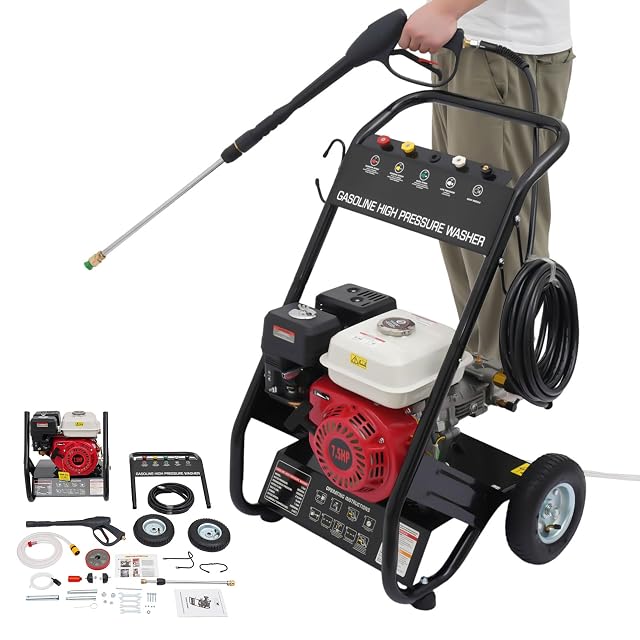
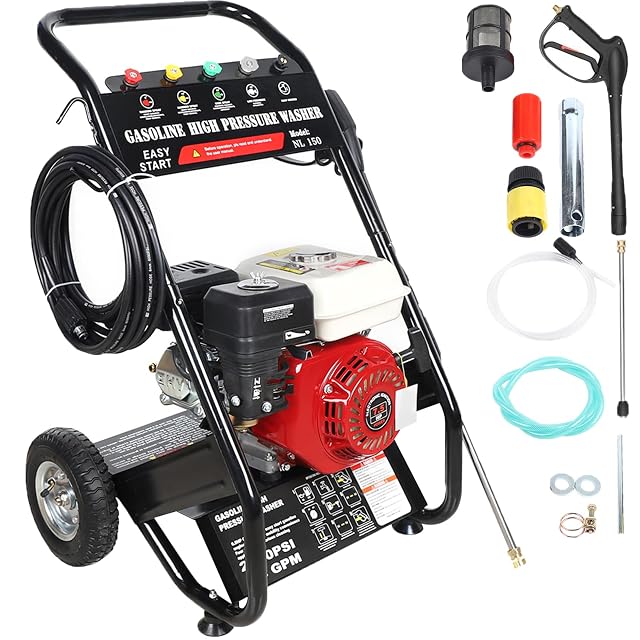
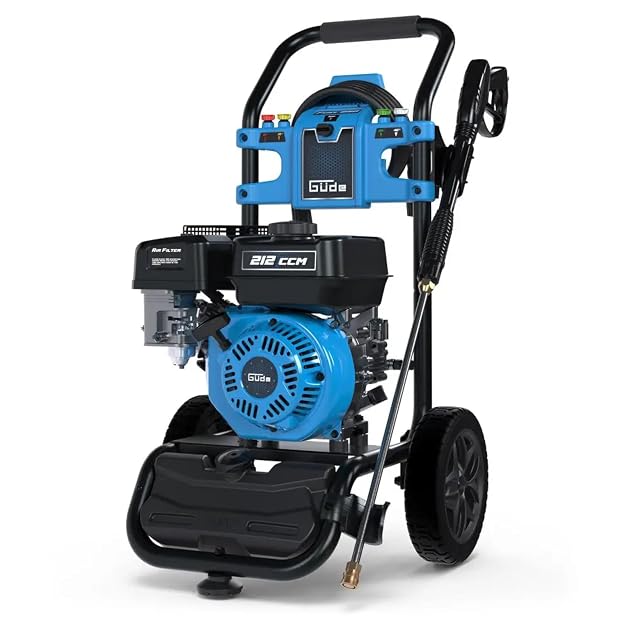
- “Easy-to-start with a DeWalt 208cc engine, perfect for cleaning decks, patios, siding, and prepping exteriors for painting”
- “OEM Technologies axial cam pump delivers 3300 PSI at 2.4 GPM. Welded steel frame with powder-coated finish adds durability. Thermal relief valve prevents overheating for long-lasting performance”
- “Premium 10-inch pneumatic tires allow for smooth maneuvering across uneven terrain. Dimensions: L:41” x W:21” x H:24””
- “Comes with a 25-ft abrasion-resistant hose, 5 quick-connect nozzles (0°, 15°, 25°, 40°, soap), ergonomic spray gun, and 16-inch steel wand”
- “49-state compliant. Maintain max fuel level 1/2 inch below filler neck to prevent spillage. Factory-tested pressure washers may contain minimal residual fuel or odors”
- Description adds: “DEWALT 208cc engine with low-oil shutdown” and “the included 25-ft MorFlex” hose
- Catalog: 29,030 g (1024 oz) · 1041 × 533 × 610 mm (41 × 21 × 24 in)
Two protections, and no other cheap machine here has both
This is the reason to pay the premium, and it is worth understanding what each one saves.
Thermal relief protects the pump. Release the trigger and the engine keeps running, so the pump keeps turning with water circulating inside it and nowhere to escape. Within a minute or two it is hot enough to wreck the seals and valves. The valve dumps that water on the ground before it happens.
That is the commonest way a pressure washer pump dies, and it happens to people who stop to move a hose and leave the engine running.
Published here, and on all five Simpsons. Not published on the three Westinghouse machines or the PowerSmart.
Low-oil shutdown protects the engine. It cuts the ignition when oil falls below a threshold, instead of letting the engine run itself dry and seize. On a machine used three or four times a year, after months standing in a garage, that is the realistic failure mode.
Published here and on the four Honda-engined Simpsons. Absent from the three Westinghouse listings, the PowerSmart, and the $899.99 Simpson CRX.
So a $429 machine carries protection that a machine at more than twice the price does not publish.
Eighty dollars over the Westinghouse, and what the trade actually is
The Westinghouse WPX3400 at $349 gives:
3400 PSI / 2.6 GPM — 8840 cleaning units · a half gallon onboard soap tank · 12 inch never-flat wheels · a stated M22 accessory compatibility list · three years of service, labor and parts with a nationwide network
This gives:
3300 PSI / 2.4 GPM — 7920 units, about ten per cent less · thermal relief · low-oil shutdown · 10 inch pneumatic tires · a welded powder-coated steel frame · published dimensions · no warranty
So the eighty dollars buys protection instead of performance, and gives up a written promise in exchange.
Both use an axial cam pump. The Westinghouse calls its version “maintenance-free”, which means sealed and unserviceable; this one calls it “OEM Technologies” and says the same thing by omission. Either way the pump is replaced rather than rebuilt, and rated in the low hundreds of hours against the thousands a triplex plunger pump manages.
The honest summary: if you will remember not to idle it with the trigger off, the Westinghouse is better value and carries the only warranty on this shelf. If you will not, this is the machine that survives the mistake.
Seven thousand nine hundred and twenty cleaning units
3300 × 2.4 = 7920. The industry measure is PSI × GPM, and no listing here publishes it.
Simpson CRX 4400 — 17,600 · Simpson ALH4240 — 16,800 · Simpson PS60869 — 14,000 · PowerSmart — 9500 · Simpson Aluminum 3600 — 9000 · Westinghouse WPX3400 — 8840 · Simpson PS3228 and PS61002 — 8250 · Westinghouse WPX3200 — 8000 · this — 7920 · Westinghouse WPX3000 — 6900
Second lowest on the shelf, and the lowest of anything above three hundred dollars.
Pressure cuts, flow rinses. At 2.4 GPM this is a tier below the 2.5 and 2.6 GPM machines on rinsing speed, which on a driveway is what you feel — the dirt is loosened and then pushed, and pushing takes water.
What matters for one specific accessory: a surface cleaner has no motor, and its nozzles are spun by the water leaving them, so flow turns the head. Most want 2 GPM or more, and 2.4 will drive a twelve to fourteen inch head properly. A sixteen or twenty inch head wants more.
The listing’s own use cases are well chosen for the figure: “decks, patios, siding, and prepping exteriors for painting”. Paint preparation is a pressure job rather than a volume job, and 3300 PSI with the 15° tip is the right tool for it.
Pneumatic tires, and published dimensions
10 inch pneumatic, matching the PowerSmart and three Simpsons.
The three Westinghouse machines use 12 inch never-flat solid wheels instead. The trade is real in both directions: a solid wheel cannot puncture and never needs air, so a machine left all winter rolls in spring. An air tire deforms and climbs where a solid one skids and sends every bump into the frame.
All five Simpson listings make the case in identical words — “roll smoothly over gravel, grass, and curbs” — and this listing says “smooth maneuvering across uneven terrain”.
At 29,030 g (1024 oz) across a gravel drive, air is the better choice.
Dimensions: 41 × 21 × 24 inches, published. Four listings on this shelf publish none at all, and on a machine that has to live somewhere in a garage that is a figure you want before ordering. The three big Simpsons publish theirs too — 38 × 23.5 × 29 inches for the two largest.
The welded, powder-coated steel frame is the standard here: the five Simpsons all publish the same construction, except the two Aluminum Series models which use “aircraft grade aluminum” — and which, at 78 and 133 lb, are not lighter than the steel ones.
Half an inch below the filler neck
“Maintain max fuel level 1/2 inch below filler neck to prevent spillage.”
A small instruction, and the sort of thing a listing earns trust by including.
Petrol expands as it warms. A tank filled to the brim in a cool garage pushes fuel out of the cap vent once the engine has run — onto a hot engine, down the frame, and onto the drive. Half an inch of air absorbs it.
Two Simpson listings carry the same note word for word, and all three also share the other piece of candour: “Factory-tested pressure washers may contain minimal residual fuel or odors.”
So it arrives having been run, with fuel already in it. Which is reassuring about quality control and is also why it smells.
What no listing on this shelf mentions is the other half of fuel care: stale petrol in a carburettor is the commonest reason one of these will not start the following spring. A stabiliser in the tank, or draining it before storage, is worth more than any specification here.
What is not published
No warranty, and this is the significant omission. The three Westinghouse machines publish “3-Year Limited Service, Labor, and Parts Coverage with Nationwide Customer Service and Support Network”. The other eight listings on this shelf — this included, and all five Simpsons — publish nothing.
No soap tank. The WPX3200 and WPX3400 both publish a “Half Gallon Onboard Soap Tank”, the PowerSmart an onboard tank, the WPX3000 a “detergent siphon hose”. This listing publishes a soap nozzle and no tank or siphon, so how detergent reaches the gun is unstated.
No unloader, which all five Simpson triplex pumps publish — the valve that diverts flow at the pump when the trigger is released, and the companion to thermal relief.
No hose bore, where the WPX3000 publishes 0.25 inches and three Simpson listings publish 5/16 or 3/8 inch by length.
No PWMA certification, which only the PowerSmart at $259.99 claims — the single independently verified PSI figure on this shelf.
No fuel tank capacity, which all three Westinghouse listings publish (0.9, 0.95 and 1 gallon).
Availability
Read on the day this page was built: $430 at the American Amazon shop.
Read from Keepa on the day this page was last revised; stock and price both move without notice.
Prices quoted in this text were read on 2026-10-04. The live price is at the top of the page.