What the maker puts in writing
- “With 1200w power and 10-Amp motor with heating protection, this fireplace vacuum cleaner hot ash provides powerful suction and is compatible with both warm (ash below 104F (40°C (104 °F))) and cool ash”
- “With the 5ft long suction hose and 15ft long power cord, there is plenty of maneuverability to reach for those hard to get at places. Three universal wheels can easily move the ash vacuum for fireplaces from the living room to the kitchen”
- “Equipped with fire-retardant cloth filter & HEPA to prevent fine dust particles from escaping into your breathing space and protect the motor from being damaged… the cloth filter can be washable, reusable and replaceable”
- “Filling level indicator… If the coverage reaches 100%, the indicator will turn full red. You can still continue to vacuum, but the suction power will decrease”
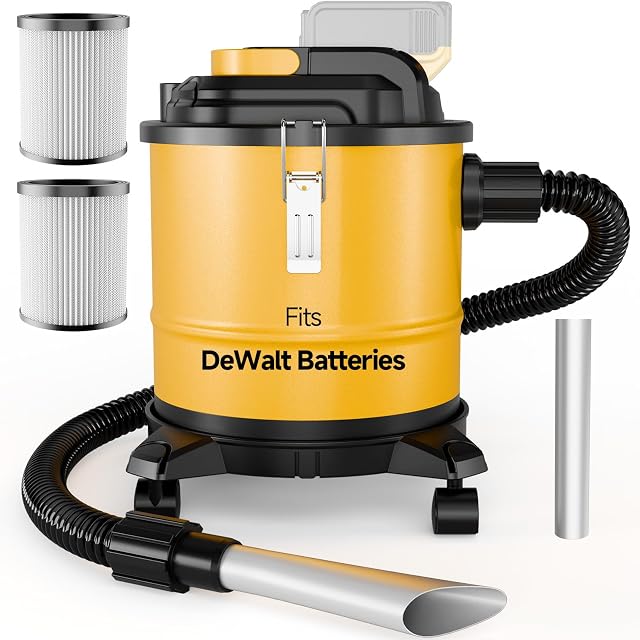
- In the box: “Container lid, Metal container, Flexible metal suction hose, Aluminum suction tube, HEPA filter, Filter bag, Wheel holder with wheel, Extension wands, Crevice nozzle, Upholstery nozzle, and Combi-attachment for carpets and smooth floors”
- Catalog: 5640 g (198.9 oz) · 5.3 gallon
Twenty feet, and the machine stays where you put it
15 ft cord + 5 ft hose.
The longest total reach on this shelf, and at 5640 g (198.9 oz) that is not a luxury. The comparison:
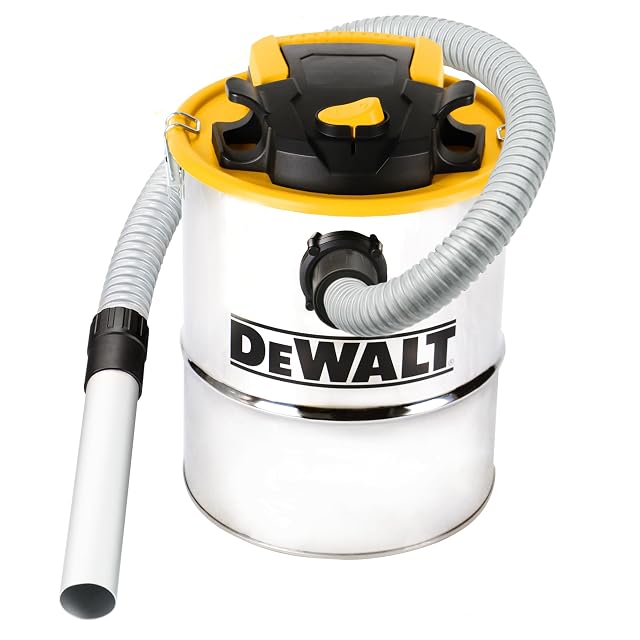
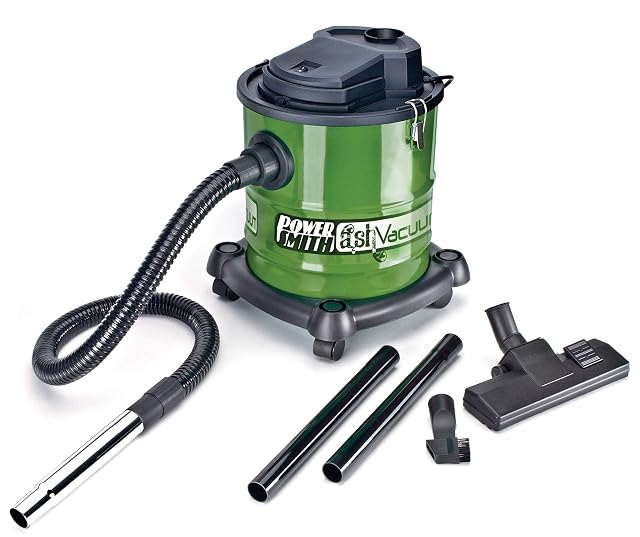
this — 20 ft · VEVOR 5.3 gallon 13 + 5 = 18 ft · PowerSmith PAVC101 a 16 ft cord · DEWALT a published 12-ft range · VEVOR 4 gallon 12 ft · VANPORE green a 3.5 m radius (11.5 ft) · PowerSmith PAVC102 a 10 ft hose · Snow Joe a 3.9 ft hose · SIPPON ×2 a cord of “31.5 inches”, eighty centimeters, which cannot be meant
What twenty feet buys is not moving the canister. It waits in the hallway or by the door while the nozzle reaches the back of a grate, and on a machine this heavy that is the whole difference between using it and not.
The three universal wheels are the other half of it — and they are removable, which is the detail someone thought about: the machine stores flat for eight months of the year.
The only fill indicator on the shelf
“If the coverage reaches 100%, the indicator will turn full red. You can still continue to vacuum, but the suction power will decrease.”
Two sentences, and the second is the good one.
The failure people actually meet with an ash vacuum is not a full drum. It is a loaded filter — the motor roaring, the nozzle picking up nothing — and the usual conclusion is that the machine has broken. An indicator turns a mystery into a reading.
And telling you that you can keep going is unusual honesty: it says the limit is performance, not safety, so you can finish the hearth and empty afterwards.
Nothing else here has one. The nearest equivalents are the Snow Joe, whose cartridge “resists clogging”, and the VANPORE, which explains the underlying mechanism: “the bag filter prevents the pleated filter from clogging.”
A fire-retardant cloth filter, named
“Equipped with fire-retardant cloth filter & HEPA to prevent fine dust particles from escaping into your breathing space and protect the motor from being damaged.”
Only two listings on this shelf publish a rating for the element: this one, and the SIPPON pair with their “flame-retardant filter”.
It is the right place to put the specification. Everything else in the ash path is metal — the container, the hose, the aluminum tube. The element is cloth and paper, in moving air, with ash packed hard against its face. If anything live is drawn in, that is where it lands.
The arrangement is the standard two stages, and the box list confirms both: a filter bag and a HEPA filter. The cloth stage is washable, reusable and replaceable.
What is not addressed is drying. A washed element needs hours before refitting, and only the PowerSmith PAVC102 (two filters supplied) and the ApexPower (two, with the reason stated — “one operates while the other is cleaned or air-dried”) deal with it.
Twelve hundred watts, with a thermal cutout
1200 W, 10-Amp, with heating protection.
The first two are the same number twice: on 120 V American mains, 10 A is 1200 W. Both PowerSmith listings publish only the amps; the VEVOR and VANPORE pairs publish only the watts. This is the one listing giving both.
Heating protection is the part nobody else mentions — a thermal cutout that stops the motor before it cooks. On a vacuum whose filter progressively chokes its own airflow, and whose airflow is what cools the motor, that is a genuinely relevant safeguard. A blocked ash vacuum run hard is exactly the condition that burns a motor out.
The shelf’s five units, for reference: 1200 W (VEVOR ×2, VANPORE ×2, here) · 10 Amp (PowerSmith ×2) · 800 W (SIPPON ×2) · 5 Amp with “up to 500 W of suction” (Snow Joe, the only input-versus-output distinction) · 4 HP (DEWALT, which is 2983 W and impossible from a domestic socket) · 10,000 Pa (ApexPower, the only suction pressure here).
Warm ash, canceled by its own parenthesis
“compatible with both warm (ash below 104F (40°C)) and cool ash.”
Forty degrees is barely above body temperature. Ash at 40 °C (104 °F) is cold ash. The parenthesis takes back the adjective.
The ApexPower makes the identical mistake — “both cold and warm ash. Pay Attention: The ash temperature must be below 104℉/40℃!”
The honest versions on this shelf are the ones that give the number and claim nothing extra: both SIPPON listings and the DEWALT, all at 40 °C (104 °F). Or the ones that give a rule instead: both VEVOR listings, “dry ash after the fire is fully extinguished”, and the Snow Joe, “cold ash”.
The least useful are both PowerSmith listings, which promise “warm and cool ash” and publish no limit anywhere.
So treat the warm-ash line here as marketing, and note what sits behind it instead: a metal container, a metal hose, a fire-retardant element and a thermal cutout. Taken together that is a better answer to the risk than the sentence that raised it.
A full box, and nozzles for the other eleven months
Lid, metal container, flexible metal hose, aluminum tube, HEPA, filter bag, wheel holder, extension wands, crevice nozzle, upholstery nozzle, and a combi-attachment for carpets and smooth floors.
Eleven items, which is the most complete box list on the shelf — and the upholstery and carpet/floor attachments say what it is really for: a canister vacuum that handles ash, rather than an ash-only tool used three weeks a year.
The PowerSmith PAVC101 makes that case explicitly, with a 16 ft cord and casters “allows use as a regular shop vacuum”. This listing does it through the nozzles.
What is not published
No blower. Eight of twelve listings here convert by moving the hose to the outlet: both VEVOR, both SIPPON, both PowerSmith, both VANPORE. Not this one, and not the DEWALT, ApexPower or Snow Joe.
No suction figure in pascals, where the ApexPower publishes 10,000.
No noise figure. Only PowerSmith (79 dB, called quiet) and ApexPower (60 dB) give one, and nineteen decibels is roughly eight times the sound pressure.
No distinction between drum and ash capacity. The PowerSmith PAVC101 publishes “Canister Size: 5.2 Gallons, Canister Ash Capacity: 3 Gallons”, and its sibling says “4 gallon Ash capacity”. A bare 5.3 gallons here could mean either, and on the PAVC101’s evidence the ash figure would be meaningfully lower.
No certification named, where the ApexPower publishes CE, CB and GS and the Snow Joe publishes ETL.
Availability
Read on the day this page was built: $80 at the American Amazon shop.
Read from Keepa on the day this page was last revised; stock and price both move without notice.
Prices quoted in this text were read on 2026-10-04. The live price is at the top of the page.