Softwood decking has hard and soft bands in every board, and water at pressure removes the soft ones first.
Settings
Widest fan, lowest pressure the machine offers, and start further away than feels useful. If your machine has a dial on the lance, this is the job it was made for.
Along the grain, always
Work along the length of each board, in a continuous pass, never across it. Crossing the grain leaves visible bands at every stop.
Do not pause
A stationary jet on timber marks in under two seconds. Start the pass with the trigger already open and beyond the board end, and finish beyond the other end.
The alternative that works better
A dedicated deck cleaner, a stiff brush and a rinse at low pressure cleans just as well and does not touch the fibers. It takes longer and the boards last years longer, which on a deck is the better trade.
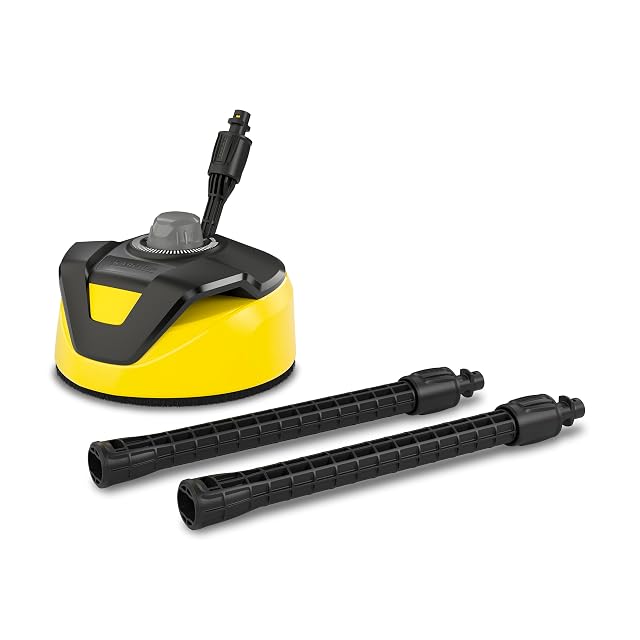
An adjustable surface cleaner
If you use one, raise the jets. Fixed-height heads are set up for paving and are too close for timber.
The questions we hear
What does furring actually look like?
The soft summer growth between the harder grain lines is washed out, leaving raised fibers. Wet, it looks clean; dry, it looks hairy and grey, it splinters, and it holds dirt worse than before. Sanding is the only fix.
Can I use a rotary nozzle on decking?
No. A rotary nozzle concentrates the whole jet on a point, and on timber it cuts. There is no safe distance for it on a softwood deck.
Last reviewed 2026-08-16