What the maker puts in writing
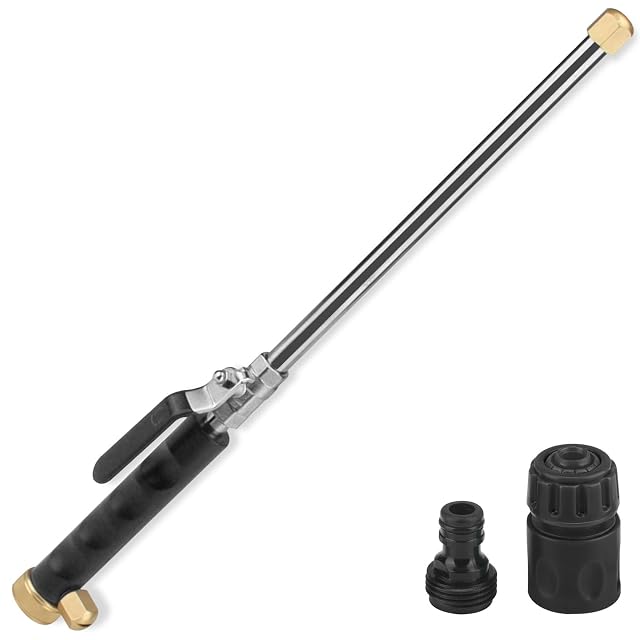
- “Dual Spray Options: Includes jet stream nozzle for concentrated cleaning; fan spray nozzle for wide coverage; quick switch between spray types to match different cleaning needs”
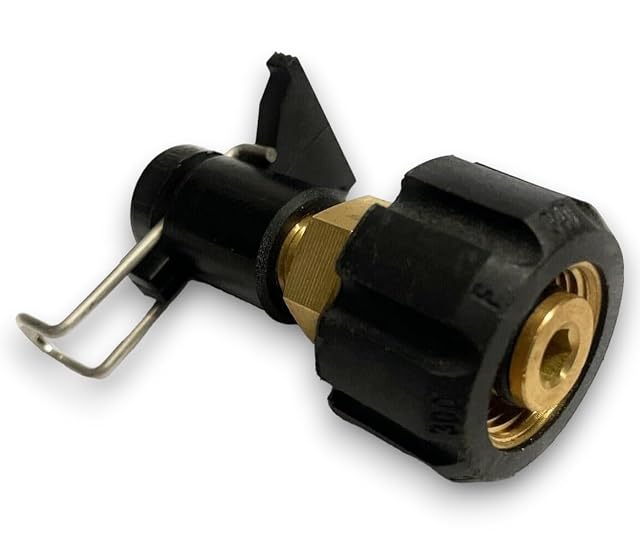
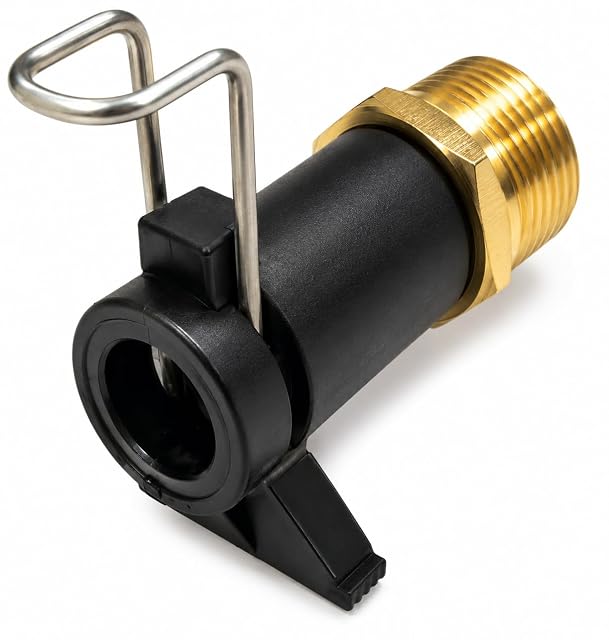
- “Universal Hose Compatibility: Comes with 3/4 inch and 1/2 inch garden hose connectors; quick couplers allow tool-free setup; secure connection minimizes leaks during use”
- “Sturdy and Rust-Resistant: Solid brass connector resists corrosion; aluminum alloy spray wand is lightweight yet strong”
- “Flexible Water Pressure Use: Works effectively with regular garden hose pressure; compatible with pressure washer systems for higher performance when tackling stubborn dirt”
- “Suitable for car washing, patio and driveway cleaning, garden watering, furniture rinsing, pet bathing, and tool maintenance”
- Reference SQ-18 · Catalog: shipping box 432 × 25 × 25 mm (17 × 0.98 × 0.98 in)
The claim its shelf-mate contradicts
“Works effectively with regular garden hose pressure.”
The YunGuoGuo at $18.99 is the same class of product, fits the same tap, and opens its page with the opposite: “needs to be connected to a high-pressure cleaner to generate strong power; otherwise, it can only provide ordinary water pressure.”
Two garden-hose wands on one shelf, and one of them tells you first thing that the tap is not enough.
The physics sides with the other one. A domestic mains supply runs at roughly 4 bar, about 60 PSI, against the 4000 PSI the pressure-washer lances here are rated for. Narrowing the outlet raises the water’s velocity — which is why a jet tip genuinely strips loose dirt better than an open hose — but it cannot raise the pressure, because there is no pump in the circuit.
So read “effectively” as relative, because it is measured against nothing.
Against a bare hose end, the claim holds. This will rinse a car, clear loose debris off a patio, reach a gutter line and manage the “pet bathing” the bullets name. The jet tip does concentrate what the tap gives you, and the fan does cover ground.
Against a pressure washer, it does not. And the second half of the same bullet — “compatible with pressure washer systems for higher performance” — is the part that needs a number it does not have. See the last section.
Two connector sizes, which is the best thing on this page
“Comes with 3/4 inch and 1/2 inch garden hose connectors; quick couplers allow tool-free setup.”
No other item on this shelf ships two fittings, and this is the small practical detail that prevents a real problem.
3/4 inch GHT is the American garden tap standard, so that is what most buyers need. 1/2 inch is what you meet on older indoor fittings, utility sinks, imported hose sets, and a good many caravan and boat supplies.
Compare the alternatives on this shelf.
Its shelf-mate, the YunGuoGuo, says: “all 3/4” standard garden hoses, and other sizes with standard 1” hose connectors” — mixing a thread size with what reads like a fitting diameter, and leaving you to work out whether an adaptor is in the box.
And on the pressure-washer side of the shelf the trap is worse. The TOR specifies M22-14mm. The Simpson says only M22. M22-14mm and M22-15mm carry the same name and do not seal against each other — which is the single commonest incompatibility in this whole category, and the one the threaded items here mostly decline to pin down.
“Secure connection minimizes leaks” is a weaker claim than it looks, since a garden fitting leaks at the washer, not the thread, and no spare washers are mentioned. Keep a few.
Aluminum in the tube, and why that is the right way round here
“Solid brass connector resists corrosion; aluminum alloy spray wand is lightweight yet strong.”
Both metals are where they should be, and the reasoning inverts what it would be on the pressure-washer side of this shelf.
Brass at the threaded end. That part stays wet, gets cross-threaded onto taps, and sits in a puddle between jobs. Brass does not corrode and is soft enough to seat on a hose washer without cutting it.
Aluminum in the tube. Roughly a third the density of steel, so a wand you hold out at arm’s length toward a roofline is markedly easier to aim — and at the 60 PSI a tap supplies, aluminum is far stronger than it needs to be. The YunGuoGuo uses stainless in the same place, which is stronger and heavier for pressure it will never see.
Where aluminum loses is at the threads: a softer alloy strips if you cross-thread it or lean on it, and that is what fails on this kind of tool. Hand-tight is enough on a garden fitting.
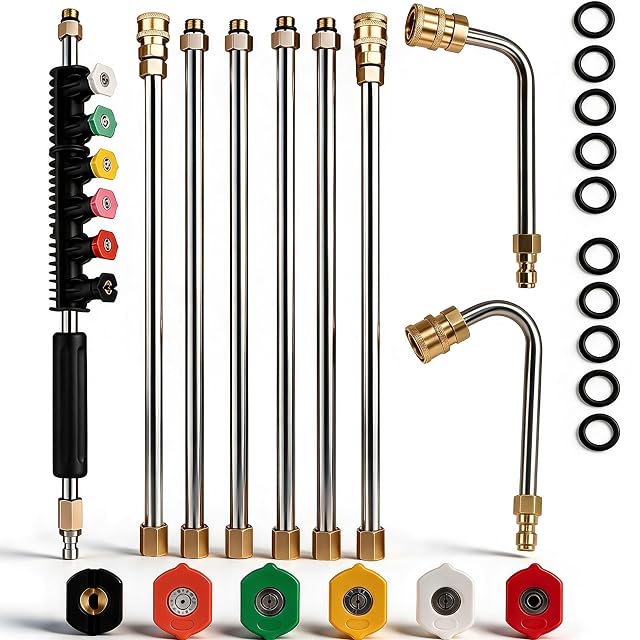
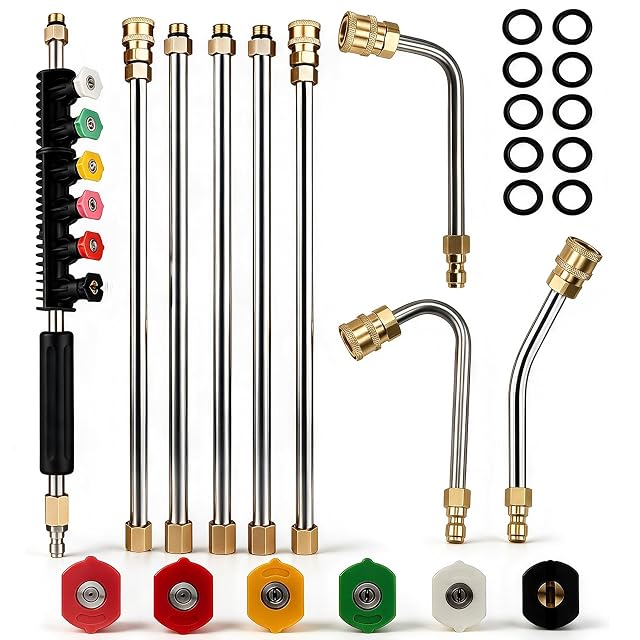
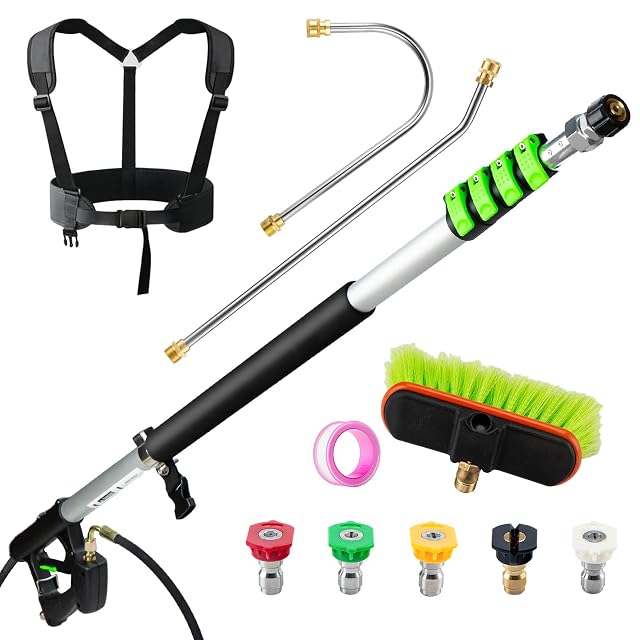
The rest of the shelf: stainless with brass fittings on the Xiny Tool and both Selkie lances, which are rated to 4000 PSI and need it; aluminum on the TOR, which at 24 feet has no choice; ceramic, brass and aluminum alloy on the AURORA CAR rotary nozzle.
Two patterns, a quick switch, and the one thing a tap can give you
Jet stream and fan spray, with “quick switch between spray types”.
On mains pressure those are the only two patterns that mean anything. The fine gradations between a 15° and a 25° tip only show when there is enough pressure behind them for the difference to register — which is why the big nozzle sets on this shelf belong to the machines, not to the taps.
The sets, for the record:
Xiny Tool — six: 0, 15, 25, 40, 60 and soap
Selkie pair — five each: 0, 15, 25, 40, 65, under a heading that says six
TOR — five, angles unnamed
this and YunGuoGuo — two
AURORA CAR — one, a rotary
Simpson — none; it is a wand only
What a quick switch is worth is more than it sounds: swapping a quick-connect tip means shutting the water off, pulling the collar, dropping the tip in wet grass and finding it again. A switch on the wand is a one-handed operation while the water is running, and for a job that alternates between rinsing a panel and blasting a wheel arch that is the difference between using both patterns and using one.
What is not published
No pressure rating, and here it matters more than on the other garden-hose wand, because this one actively claims “compatible with pressure washer systems for higher performance”. An aluminum tube with a brass garden-hose coupler is not pressure-washer hardware, and inviting a machine onto it without stating a ceiling is the one genuinely unsafe gap on this page. For comparison, the items on this shelf that are built for a machine publish 4000 PSI (Xiny, both Selkie, TOR), 4500 (Simpson), or a range from 1000 to 4000 (AURORA CAR). Treat the pressure-washer sentence as applying to a low-pressure or 2-in-1 machine with a garden-hose outlet, not to a 1/4 inch quick-connect gun.
No length. The catalog shipping box is 432 × 25 × 25 mm, about 17 inches, which caps the wand near that — the shortest clue on the shelf. The Simpson publishes 31 inches, the TOR 24 feet extended, the Selkie pair 97 to 120 inches assembled.
No temperature limit, where the Xiny Tool and Simpson both publish 140 °F and the Simpson adds “only for cold water use”.
No weight, where only the Simpson gives one: 181 g for a 31-inch wand.
No spare washers, as above, on a product whose selling point is two threaded fittings.
No warranty, where the Simpson’s 90 Day limited accessory is the only term on this shelf.
And no model number in the title, though the catalog carries SQ-18 — a small thing, but it is the only identifier if you ever need a part.
Availability
Read on the day this page was built: $29 at the American Amazon shop.
Read from Keepa on the day this page was last revised; stock and price both move without notice.
Prices quoted in this text were read on 2026-10-04. The live price is at the top of the page.