What the maker puts in writing
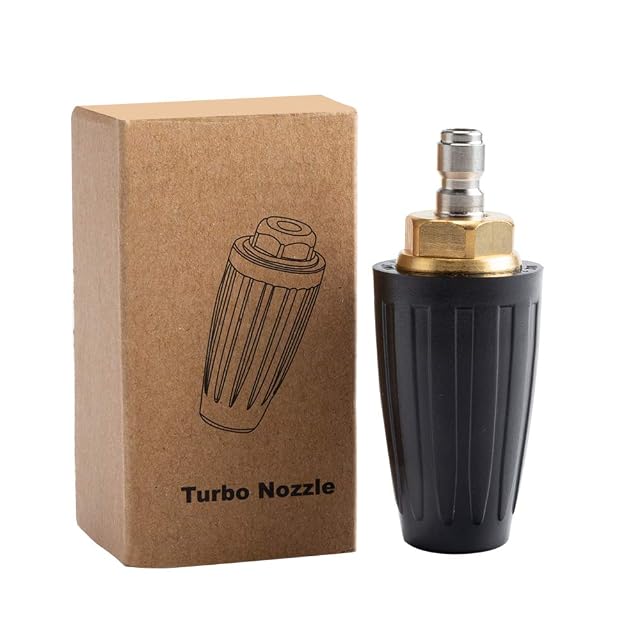
- “This turbo rotary spray nozzle is 4.0 Orifice, 4.0 GPM with a 1/4” quick connect plug for pressure washers up to 4000 PSI (1000PSI to 4000 PSI for Power Washer)”
- “Rotating turbo nozzle use centrifugal force to produce a strong impact and a spray pattern. The spray adds additional scrubbing ability to the cleaning process”
- “The pressure washer turbo nozzle is made of durable ceramic core and rubber exterio and brassr. The vortex nozzle is aluminum alloy”
- “Great for rust removal, metal or plastic tank cleaning, boat cleaning, cleaning dirty garage floors, stripping paint from wood exterior, and removing mud and clay from highway and construction equipment”
- “Our 24-hour customer service team is here to help you with any issues you may have”
It is not a wand, and that is the first thing to get right
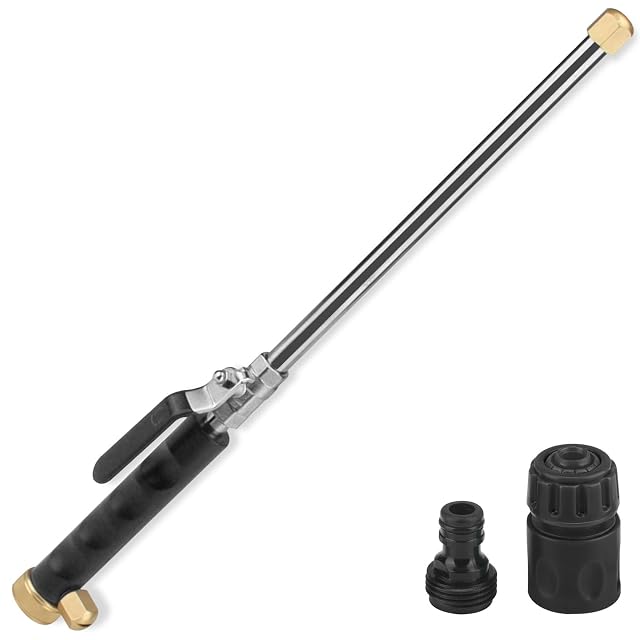
At least six of the ten items on this shelf make your lance longer. This one changes what comes out of the end.
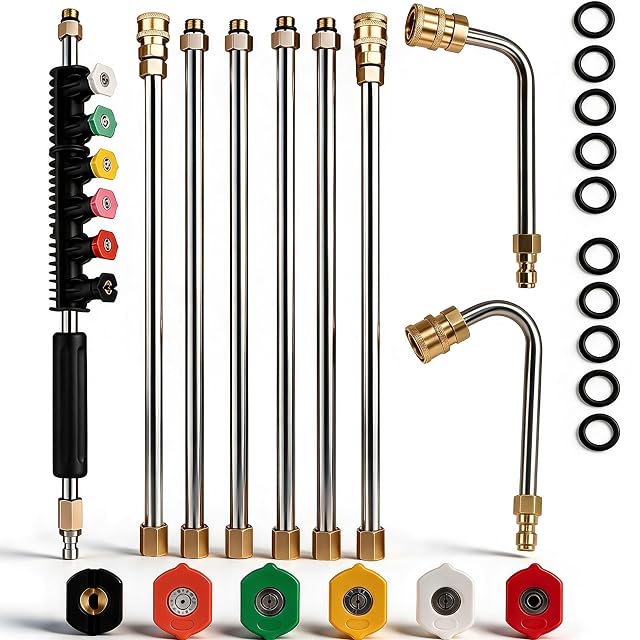
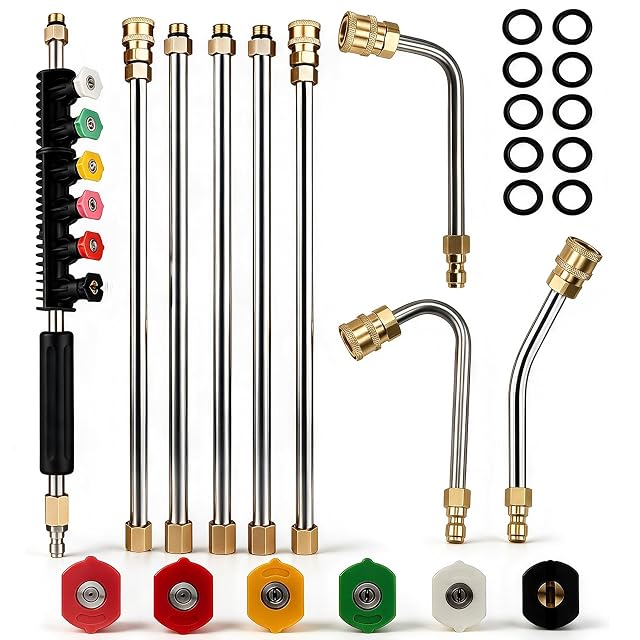
So it does not compete with anything here. It competes with the 0° tip in the nozzle sets — the Xiny Tool at $29.99 includes six tips, the Selkie pair five each, the TOR at $91.99 five — and it replaces that tip with something that does the same work differently.
Which means the honest comparison is not a price comparison. If you have no lance, this does nothing for you. If you have a lance and a set of tips, this is the one tip the sets do not contain.
“4.0 Orifice, 4.0 GPM.”
A pressure-washer nozzle has no moving parts. It is a hole, and the hole sets the relationship between your pump’s flow and the pressure you actually get.
Orifice numbers are conventionally the flow in gallons per minute the hole passes at 4000 PSI — which is exactly why this listing publishes 4.0 and 4.0 GPM in the same breath. And because flow through an orifice rises with the square root of pressure, the sum runs backwards.
Put this on a machine delivering 1.8 GPM, which is typical of a domestic electric washer:
4000 × (1.8 / 4.0)² ≈ 810 PSI.
The nozzle is not faulty. The hole is too big for the pump, and the water leaves before pressure can build.
So the machines this suits are the ones near four gallons a minute — which on this site’s shelves means a petrol washer, not an electric one. The This Hill unit on the steam-cleaner shelf publishes 2 GPM; on that machine this nozzle would give roughly 1,000 PSI.
Check your own machine’s GPM before ordering. The 4000 PSI in the title is the nozzle’s ceiling, not a promise about your pump.
And credit where it is due: this is the only item on this shelf to publish a minimum — “1000PSI to 4000 PSI” — which is the figure that tells you a rotary nozzle needs real pressure to spin at all. It is also the only item here whose compatibility depends on a number most buyers have never looked up.
What spinning a zero-degree jet actually buys
A 0° nozzle puts the whole output of the pump onto a point a few millimeters across. It cuts, and it cuts a line — which is why it gouges timber, etches concrete in stripes, and is genuinely dangerous to skin.
A rotary nozzle takes that same pencil jet and whirls it, so the point traces a circle perhaps two inches across, many times a second.
The bullet describes it correctly: “centrifugal force to produce a strong impact and a spray pattern… adds additional scrubbing ability.”
So you keep the impact of a 0° jet across the coverage of a 25° fan, and the surface is struck repeatedly rather than scored once. That is a real difference in kind, not a marketing distinction.
Which is why the jobs named here are the right ones — “dirty garage floors”, “removing mud and clay from highway and construction equipment”, “rust removal” — and why one of them is not.
“Stripping paint from wood exterior” is in the list, and it is exactly where this does damage. The jet that lifts the paint raises the grain underneath, and on softwood siding it will leave a furred surface that then needs sanding. No caution accompanies it.
The other job worth pausing on is “boat cleaning”. A rotary at these pressures will take gelcoat off as readily as growth.
Ceramic, brass and aluminum, which is the right division of labor
Three materials, and each is where it should be.
A ceramic core. Everything about a rotary nozzle wears at one place: the small hole the water leaves through, and the seat the spinning element rides on. Water at 4000 PSI carrying whatever sand came off the driveway is abrasive, and once the hole opens up the nozzle loses pressure permanently — the arithmetic above, running the wrong way. Ceramic is far harder than brass or steel, so it is the correct choice for the orifice, and it is the specification that decides how long this lasts.
Brass for the body, which does not corrode sitting in a bucket of water between jobs.
Aluminum alloy for the vortex nozzle, which is the lightest option for the part that has to spin — and spin speed is what the pattern depends on.
Compare the rest of the shelf: stainless steel on the Xiny Tool and the Selkie pair, aluminum on the TOR (which at 24 feet has no choice), brass fittings with an aluminum wand on the POOPLE at $28.79.
What is not published
No temperature limit, where the Xiny Tool and the Simpson both publish 140 °F and the Simpson adds “only for cold water use”. A ceramic-and-rubber assembly has a limit whatever it is. Worth stating plainly: the steam cleaners on this site’s neighboring shelf run between 212 and 293 °F, and nothing on this shelf is rated to pass that.
No weight. Only the Simpson publishes one — 181 g for a 31-inch wand.
No thread specification beyond “1/4 inch quick connect”, which is in fact the one fitting on this shelf that is genuinely standard. The threaded fittings are where the trouble is: the TOR specifies M22-14mm, the Simpson says only M22, and M22-14mm and M22-15mm carry the same name without sealing against each other.
No warranty. “Our 24-hour customer service team” is not a term. The Simpson wand’s 90 Day limited accessory is the only actual warranty on this shelf.
No fan-pattern equivalent given, which would be the useful comparison — a rotary is usually reckoned to do the work of a 0° tip over the area of a 25°, and the listing leaves the buyer to guess.
Availability
Read on the day this page was built: $14 at the American Amazon shop.
Read from Keepa on the day this page was last revised; stock and price both move without notice.
Prices quoted in this text were read on 2026-10-04. The live price is at the top of the page.