What the maker puts in writing
- “TRUE 4-IN-1 CLEANING SYSTEM – STEAM SPRAY SCRUB EXTRACT – Cold water extraction system with integrated 1,200W steam heater reaching up to 208.4°F in approximately 1 minute. Delivers 120 PSI through a diaphragm pump while a 1,500 RPM nylon brush agitates and the vacuum extracts in one pass. Built-in thermostat protection with steam on/off control”
- “COMMERCIAL 20 AMP POWER – 2,500 WATTS TOTAL OUTPUT – Operates on 110–125V and 50 ft power cord. Designed for standard 20A outlets”
- “WALK-BEHIND PERFORMANCE – 18.5” CLEANING PATH – Single-piece nylon brush spinning at 1,500 RPM lifts embedded soil while delivering 100 CFM airflow and 6.5” water lift through a 1.5” vacuum hose”
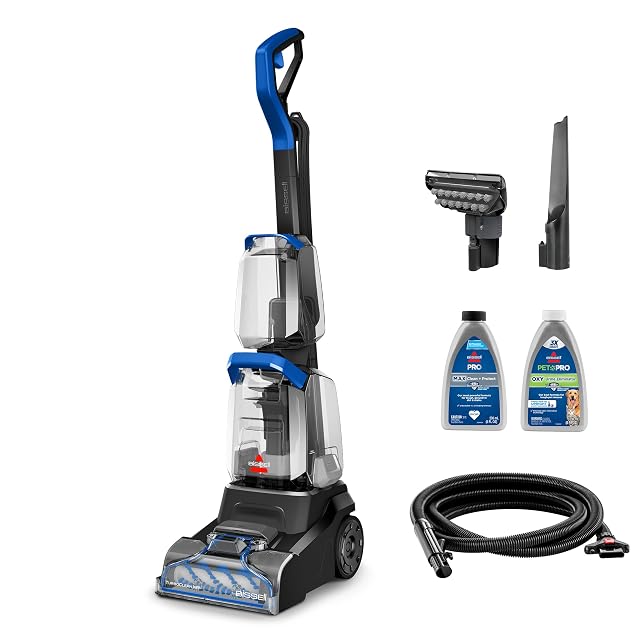
- “Includes a 10 foot hose, 3.5” upholstery tool for stairs and furniture, and a 9” extension wand”
- “10.5 gallon solution tank and 8 gallon recovery tank… Designed for up to 15,000 sq ft of cleaning productivity”
- “CONTROLLED COMMERCIAL OPERATION – 75 dBA SOUND LEVEL”
- “DAPPER WARRANTY – 2 YEAR PARTS & LABOR – U.S.-based support, parts in stock, phone troubleshooting first, and nationwide technician service if needed”
- Catalog: 1130 × 475 × 864 mm (44.5 × 18.7 × 34 in)
Fifteen measurements, where the rest of this shelf has adjectives
Set this listing beside the other seven and the difference is not the price.
1200 W heater · 208.4 °F in about a minute · 120 PSI from a diaphragm pump · 1500 rpm nylon brush · 18.5 inch path · 2500 W total on 20 A at 110–125 V · 50 ft cord · 100 CFM airflow · 6.5 inch water lift · 1.5 inch vacuum hose · 10 ft hose · 10.5 and 8 gallon tanks · 15,000 sq ft productivity · 75 dBA · 2 year warranty
What the seven domestic machines publish, collectively: three tank capacities, four hose lengths, two brush-row counts, one brush count, and a great many adjectives — “ultra-powerful suction”, “professional-level”, “powerful suction”, “high-speed brushroll”, “scientifically proven”.
Only one of them cites a test: the Shark CarpetXpert at $299.95, with ASTM F2828.
So the choice this shelf offers is between machines described and a machine measured.
Twenty amps, which is the first thing to check
“2,500 WATTS TOTAL OUTPUT - Operates on 110-125V… Designed for standard 20A outlets.”
2500 W at 120 V is 20.8 amps.
A typical American domestic circuit is 15 amps and supplies about 1800 W. This will trip it.
And on a 20 A circuit, 20.8 A is above the continuous rating — the convention is to load a breaker to no more than 80 per cent, which is 16 A. So in practice this wants a dedicated 20 A outlet, of the kind found in some kitchens, garages and workshops and in very few ordinary rooms.
Which is almost certainly why the cord is 50 feet: long enough to reach the one 20 A socket in the building from several rooms away.
No other listing on this shelf raises the question, because the domestic machines all sit well under 1800 W.
Settle the breaker before the price.
Water lift and airflow, which nothing else here publishes
“delivering 100 CFM airflow and 6.5” water lift through a 1.5” vacuum hose.”
These two together are the professional equivalent of air watts on a vacuum, and they are the figures that decide extraction.
Water lift is the depression the vacuum can pull, expressed as the height of a water column it will raise. It describes how deep into the pile the machine reaches to take water back.
CFM is airflow. It describes how fast it moves that water away.
You need both. High lift with low flow pulls hard on a small area and moves nothing. High flow with low lift skims the surface and leaves the carpet wet underneath.
And the 1.5 inch vacuum hose is the companion figure: the bore has to be wide enough not to throttle 100 CFM, which is why a professional machine uses a hose twice the diameter of a domestic one.
What the rest of the shelf says instead: “ultra-powerful suction” on both Sharks, “powerful suction” on three Bissells, “professional-level” on the Hoover PowerScrub.
Five adjectives, no measurements. This is the single clearest difference between this listing and the other seven.
Cold water, and a heater that reaches boiling
The title says “Cold Water” and the first bullet says “integrated 1,200W steam heater reaching up to 208.4°F”, which reads as a contradiction and is not.
“Cold water” is trade terminology for an extractor that is not plumbed to a hot supply — you fill it from a cold tap and it heats its own water. The opposite is a “hot water” machine that takes a feed from a boiler, which is a van-mounted or truck-mount arrangement.
208.4 °F is 98 °C, which is essentially boiling. And “in approximately 1 minute” is the useful half: a heater that takes twenty minutes to come up is a heater you work around.
Why heat matters on carpet: it dissolves greasy soil that cold water leaves, and it shortens drying because hot water evaporates faster from the fiber. Hoover’s HeatForce on two machines here addresses the second half only, warming the airflow rather than the water.
Thermostat protection with steam on/off control is the right pair of safeguards: a cut-out so a dry heater cannot run away, and a switch so you can work cold on heat-sensitive fibers — wool and some synthetics mark permanently above about 60 °C.
A hundred and twenty PSI, and fifteen hundred revolutions
“Delivers 120 PSI through a diaphragm pump while a 1,500 RPM nylon brush agitates and the vacuum extracts in one pass.”
Three mechanisms working together, all quantified, and the last three words are the point: spray, scrub and extract happen simultaneously rather than in separate passes.
120 PSI is the spray pressure. Pressure is what drives solution into the pile rather than leaving it on top — and it is what the Shark CarpetXpert is describing without a figure when it says “high-pressure PowerSpray penetrates deep into fibers without oversoaking them”.
A diaphragm pump is the right choice for this duty: it tolerates running dry briefly and handles the mild abrasives in cleaning solution better than a gear pump.
1500 rpm is the only brush speed published anywhere on this shelf. The alternatives: “five counter-rotating” brushes on the Hoover PowerScrub, a “4-ROW DeepReach PowerBrush” on both Bissell TurboClean uprights, “a high-speed brushroll” on the Shark CarpetXpert, and nothing at all on the Hoover SmartWash or the two portables.
Single-piece is worth noting too: one molded brush rather than rows of tufts, which is simpler to clean and has nothing to shed.
And 18.5 inches of path is roughly 50 per cent wider than a domestic upright, which is most of where the productivity comes from.
Tanks that tell you the recovery rate
10.5 gallon solution, 8 gallon recovery.
You would expect the reverse, since the recovery tank receives the water plus the dirt. A smaller recovery tank is therefore a statement about the expected return: roughly 76 per cent comes back, with the rest evaporating in the heated airflow or staying in the fiber.
That makes this the only listing on the shelf you can reason about this way, and it explains why carpet takes hours to dry even behind a good machine.
Only two other listings publish a capacity at all, and both are clean-water only: the Bissell Little Green at 48 oz and the Hoover SmartWash at 96 oz. Five publish nothing.
The practical consequence: you will empty the recovery tank before the solution runs out, so plan around eight gallons rather than ten and a half. Eight gallons of dirty water is about 30 liters — thirty kilos — and no listing on this shelf publishes a drain.
“Up to 15,000 sq ft of cleaning productivity” is the one unusable figure here, because no interval is stated. Per tank fill, 10.5 gallons over 15,000 sq ft is an implausibly light application; per day it is a plausible commercial output. The listing does not say which.
This is the only listing on the shelf that names no cleaning product at all. It is a “cold water extraction system” and you put in whatever you choose.
The other seven all tie you to a bottle:
Shark CarpetXpert — 12 oz Deep Clean Pro + 16 oz OXY Multiplier — two products, and its headline 20× claim needs both
Shark StainStriker — 16 oz + 32 oz — two again
Hoover PowerScrub and SmartWash — “Pair with Hoover Carpet Cleaner Solution”
Bissell TurboClean OXY — “our most powerful formula”, two 8 oz bottles
Bissell TurboClean PET and Little Green — Bissell formula
Over years of use the bottle is the real cost of a domestic machine, and professional extraction chemicals are bought in gallons at a fraction of the per-use price.
The one rule that applies regardless: use low-foam extraction solution. Ordinary carpet shampoo foams enough to fill a recovery tank with bubbles and carry them into the vacuum motor — and on an eight-gallon tank that is a lot of foam to generate before you notice.
Seventy-five decibels, and a warranty
75 dBA is the only noise figure on this shelf, and for a 2500 W commercial machine it is moderate — domestic vacuums typically run 70 to 80.
That matters commercially rather than domestically: it is the difference between cleaning an office during business hours and having to wait until everyone goes home.
Two years parts and labor, and the wording is unusually specific: “U.S.-based support, parts in stock, phone troubleshooting first, and nationwide technician service if needed.”
Three useful commitments there. Parts in stock is the one that decides whether a repair takes a week or a season. Phone first is the right order. And a technician is what you need on a machine too heavy to post.
No other listing on this shelf publishes a warranty at all.
What is not published
No weight, which on a walk-behind machine 1130 mm long is the omission you notice. Two tanks hold 18.5 gallons between them — about 70 kg of water when both are part full — so the machine plus its load is a serious thing to get up a step. The domestic uprights here run 5897 g to 9049 g empty.
No productivity interval, as above.
No test or standard for cleaning performance. The fifteen measurements are a stronger substitute than most adjectives, but the only standard citation on this shelf belongs to the Shark CarpetXpert: “based on ASTM F2828”, the published test for soil removal from carpet.
No drain, despite an 8 gallon recovery tank.
No filter or lint-trap detail, which on a machine pulling 100 CFM of dirty air matters: the fluff that comes off a carpet has to be caught before the motor.
No dry time, although the combination of 208.4 °F water and 6.5 inches of lift is the arrangement most likely to shorten it.
And no brush height adjustment, which on a machine with a 1500 rpm brush and an 18.5 inch path would be the obvious control for moving between a commercial loop pile and a domestic cut pile.
Availability
Read on the day this page was built: $2400 at the American Amazon shop.
Read from Keepa on the day this page was last revised; stock and price both move without notice.
Prices quoted in this text were read on 2026-10-04. The live price is at the top of the page.